


Purpose v. Goal: Story Always Comes First

Monday, September 30, 2024


Despite what the dictionary says, purpose and goal are not always the same. This is especially true when writing fiction. Educating my audience is my purpose, but telling a good story is my goal.

I recently purchased a novel from a local author. The story takes place in the region, and the premise sounded good. But when I started reading it, I didn’t get far.

The book begam with a lecture on the social history of the area. I made it through the first chapter and debated whether I should read on. Maybe the author had finished her sermon and was ready to move on to the story. But when I started the second chapter, it was more of the same, so I gave up. The book may have had the perfect plot and told a wonderful story, but I’ll never know.

It’s an easy trap to fall into, though.

I write because I’m addicted to it. I can’t not write. The genre is more of a choice, however. I write middle grade historical novels because I believe it is important for today’s children to know their history. So my purpose is to educate them about their country’s past. But my readers want a story, not a lecture, and if they get bored they will put the book down without learning anything I am trying to teach them. Without a good story, my purpose is lost.

When I wrote Desert Jewels, I wanted to show everything that the Japanese Americans on the West Coast went through during World War II when they were forced to leave their homes and live in internment camps. Unfortunately, that was unrealistic. There were some events and circumstances that I couldn’t weave into the story without bogging it down, so I had to leave them out. I probably still left in a few things I shouldn’t have, but hopefully the story is strong enough that my readers forgive me those slips. And I was able to provide enough of the flavor of those camps to give readers an understanding of what happened there.

By the time I sent Creating Esther to my middle-grade beta readers, I was doing better. However, I still wanted to show everything about how my Ojibwe protagonist lived before she went to a white-run boarding school, and that was unrealistic, too. Fortunately, this time I had the sense to ask my beta readers to point out those passages that sounded like lessons, and they did. The final version either reworked those parts or left them out.

Each beta reader questionnaire since then has asked that same question. I seem to have learned my own lesson, because the answer is usually “none.” When they do point something out, however, I find a way to make it flow with the story. If I can’t, it goes into the trash bin.

Fiction isn’t a textbook or a sermon. If it is written that way, readers will put it down. And they should.

As I said at the beginning of this post, education is my purpose, but telling a good story is my goal.

So if you want your readers to learn something new, put story first.


Traditional and Beautiful

Monday, September 23, 2024


John and Christina’s wedding couldn’t have been nicer. Everything was traditional: the rehearsal and rehearsal dinner, the church ceremony, and the reception. Traditional and beautiful.

At Christina’s bridal shower, we played a game where we guessed how Christina had answered some questions about the two of them. One asked who would cry first. Caroline and I both wrote down Christina because, as Caroline put it, “John doesn’t cry.” Christina said John would cry first and, as it turned out, she was right. He chocked up when reading his written vows, but I found out later that wasn’t the first time he had cried. Apparently he had cried while getting dressed and again while meeting Christina when she arrived. It was clear from the goofy look on his face when he watched her come down the aisle that there was no sadness or second thoughts in those tears.


Christina’s niece and nephew were the flower girl and ring bearer, although their role was mostly limited to walking down the aisle and then joining their parents in the front row. Six-year-old Ethan made a respectable ring bearer, but three-year-old Emma is a firecracker. There were a few times when she appeared shy, hiding behind one of her parents or her grandfather, but most of the time she bounced around full of energy. According to her mother, she claimed it was her wedding and wanted to go up on stage. Her father took her out, and the wedding proceeded without that disruption.

They weren’t the only children there. The matron of honor’s husband brought four of their five, and the best man and his wife brought their youngest, who is still being weaned. Calvin spent as much time with other people as with his parents. The next photo shows him with my daughter, Caroline, and her husband, Pete.


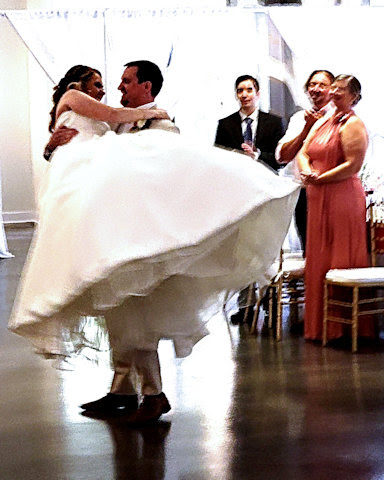
The reception was a lot of fun, and the younger members of the crowd really got involved in the dancing. That includes John and Christina. The next photo shows him lifting her in the air during their first dance.


It's the small mishaps that make a wedding memorable, however, and John and Christina had a few. As you can see in the dance photo, her traditional dress had a very wide skirt. As they were coming down the aisle together as husband and wife, they stopped a couple of times to kiss. The second time John bent Christina over, and her skirt brushed against one of the vases of flowers that was lining the aisle. (You can see them in the following photo of the chapel at the Chapel Hill Bible Church.) The vase fell over and the water spilled out, so if John’s very klutzy mother hadn’t noticed it before she got there, there might have been another spectacle besides the wedding.


Christina’s dress may have also played a role in the way they drove away from the church. John got her settled in the back seat before going around to the front and driving away as if he were her chauffer. Those of us who watched them leave speculated that her skirt was too wide to fit in the front seat.

Another mishap occurred when Christina tossed the bouquet. She had a special one for throwing, and the individual flowers separated while the bouquet was in the air. If the flying flowers were caught by two or more girls, will they get married on the same day?


I missed the cake cutting because I was outside taking photos of the car being “decorated” by the best man.


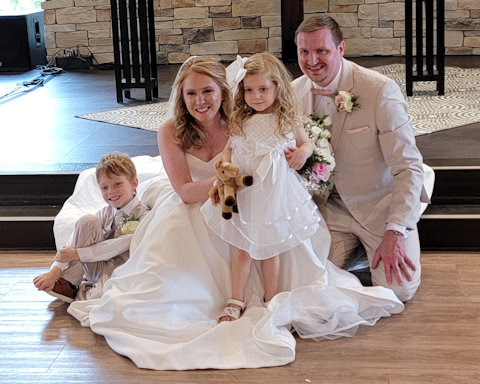
The final photo shows the groom’s parents. Aren’t we a handsome couple? We’ve been married for 45 good years, and we wish the same (actually 50 or more) for John and Christina.


But, of course, the best thing about the wedding is that John and Christina were joined together in the type of holy matrimony created by God, where male and female become one. May Christ be the true head of their family and love the glue that holds them together, as Christ’s love does for His own bride, the Church.

Congratulations, Christina and John.


Drinking Starbucks Coffee

Monday, September 16, 2024


My son got married this past weekend. I’ve been to busy to blog about it yet, so I decided to be lazy and reprint a blog post from October 27, 2014 discussing the legal aspects of using trademarks in novels. I chose this post in particular since the issue came up at the author’s fair I attended last month.

I will blog about John and Christina’s wedding next week.

Drinking Starbucks Coffee

I drink a lot of coffee, although not usually from Starbucks. But my characters go there. That’s because it is a nationally-recognized name, and I like to use some recognizable brands to give my stories a sense of authenticity.

But I know writers who are scared of using brand names. They think it will violate copyright or trademark laws, or they don’t want to use the ® symbol because it can interrupt the flow of the story.

I don’t worry about any of that.

You can’t copyright names, so copyright law doesn’t apply. You can trademark names, and Starbucks is a registered trademark. However, trademarks have a specific, limited purpose, so the protection the owner gets is much narrower than with copyrights.

Trademarks protect against consumer confusion over the source of a product or service. Consumers use recognizable names and symbols to tell them that they are getting a certain quality or a product with particular characteristics. When you see the Nike swoosh on a pair of shoes, you expect them to last for a while. When a counterfeiter prints the swoosh on shoddy-quality shoes, people are mislead. That harms both the consumer (who is not getting what he or she expected) and Nike (who could lose sales to the counterfeiter and suffer harm to its reputation when the shoes fall apart).

Your characters can drink 7-Up without worrying about trademark infringement. No one is going to go out and buy counterfeit 7-Up based on your novel, nor will readers assume that the makers of 7-Up are connected with your book. You don’t have to call it lemon-lime soda.

A brand name can lose its trademark protection if consumers use it generically for any brand of the same type of product. After people started referring to all tissues as kleenex and to photocopies made on any brand photocopier as xeroxes, the owners of those trademarks spent a lot of money educating consumers on the proper use of the terms. That’s why brand owners would like you to use the © symbol. But you aren’t required to. If you want to help trademark owners protect their property and you think “the real thing” will add authenticity, just capitalize Coke.

So let your characters drink Starbucks’ coffee if they want to. Or 7-Up. Or Coke. (There seems to be a lot of drinking in this post. Maybe I should send my characters to the bathroom more often.)


Setting is Important

Monday, September 9, 2024

I just finished reading Bummer Camp by Ann Garvin. Unfortunately, I cannot recommend it to anyone because the plot was ridiculous. It may have been intended for humor, but I winced much more often than I laughed.

Normally, I would have put it down after a few chapters. So why didn’t I? The story took place in a summer camp in the woods, and I was caught up in the well-executed setting.

The photo shows the outdoor amphitheater at Presbytery Point in Michigan, a Presbyterian camp located on the Upper Peninsula. I spent a number of summers there as a child. Or rather, I spent seven days there each summer, since the individual camps were only a week long. I always looked forward to going but got homesick after being there a couple of days. And yet, the next year I couldn’t wait to return. So the setting of Bummer Camp brought back many pleasant memories.

Setting can be an integral part of a book’s plot, as it was here, but it is the plot that is crucial to the story. Even though I finished the book, I will not read another one by Ann Garvin.

Still, although a good setting is never an excuse for a bad plot, it can cover some sins.

That’s why a good writer doesn’t ignore the setting.

One Wedding Down, the Big One Yet to Go

Monday, September 2, 2024


My niece, Rachel, got married on Friday, so that’s one down and one to go. I didn’t have to do anything for Rachel and Göran’s wedding other than show up, so it was the easy one. As the mother of the groom, however, I will be much more involved in John’s wedding.

My brother and his family don’t farm, but when he retired from his last church, he and my sister-in-law bought a farmhouse and the outbuildings that came with it. When Rachel and Göran decided to have an outdoor wedding on the farm, they knew that there was plenty of room in the barn and other buildings if the weather didn’t cooperate. Fortunately, though, it did. The sun beat down and made it rather warm when the service started, but it soon cooled off and the weather turned out to be ideal.

The full Camp contingent, including my soon-to-be daughter-in-law, was in attendance. We had a good visit without the rush that is likely to overwhelm us the next time we meet.

My brother performed the mostly traditional ceremony. Rachel and Göran wrote their own vows, as well, and it was clear that they understand what it takes to make a marriage work.

Although the ceremony and the bride’s dress were on the traditional side, not everything was. My sister-in-law grew up on a farm and is a farm girl through and through. She knows how to drive a tractor and there was one in the yard, so when someone dared her to chauffer the bride and groom around, she did, driving them along the road that leads to the farm. It was one of many wonderful photo ops.

Rachel and Göran are among the few people who actually make a living as performers. In fact, they met playing Mr. and Mrs. Banks in the musical version of Mary Poppins. So instead of the traditional couples’ dance, they performed “Everything” by Michael Buble.

The buffet was set up in the barn and the dancing was there, too, but we ate outside and enjoyed a beautiful sunset.

The wedding and reception were delightful, but they are only the beginning.

My wish for the happy bride and groom lasts forever.

May God bless your marriage.


A Disorganized Author Fair

Monday, August 26, 2024


I've always had mixed feelings about the value of attending author fairs, and Saturday was a good advertisement for staying at home.

Here is how they usually go. After paying a table/registration fee, which varies with the venue, I sit at a table for 3 to 5 hours talking to visitors and selling books. For part of the time, anyway. Although I enjoy the interaction with readers, there is a lot of down time. I take something to do, but it isn’t always enough. Still, if I make more than my table fee, I usually consider it a success.

By that measure, Saturday’s Hammond Author and Art Fair was a success. And I did get a lot of work done. But by other measures, it was a failure.

The Hammond Public Library event is the most expensive author fair that I participate in, so I was pleasantly surprised when they gave participants a ticket for lunch at a food truck. Unfortunately, the line was too long. I didn’t want to take that much time away from my table, so I munched on the snacks I had brought from home.

The bigger problem, though, was the distraction. The material soliciting author participants said we would have a fifteen-minute slot somewhere else in the library to give a reading from one of our books. I went through Learning to Surrender and selected two related passages to make up my quarter hour.

When I arrived at the library, the reading opportunity had morphed into fifteen-minutes each to discuss why we had written our books. Furthermore, the schedule for the two rooms to be used did not include me. (More about that later.) The employee who was passing out the schedules promised to slot me in at the end, however.

I might have been okay with that format, but just before these sessions were supposed to start, they morphed again. Now the 15-minute presentations were to (and did) take place in the same room as the book sales.

That was totally counter-productive. Before then, visitors felt free to walk from table to table, talking to the authors and buying books. Now, sales suddenly stopped. Too many people thought it was rude to wander around looking at books and talking to other authors while someone was giving a public speech. (Fortunately, I had already made my table fee back before the sessions started.)

That wasn’t the worst problem, either. I felt as if I was forced to sit through solicitations I had no interest in, and I imagine I wasn’t alone. The original format would have allowed people to choose which, if any, of the sessions they wanted to attend. The revised location made that impossible.

The Hammond Library staff who work on the author fair are extremely nice, but the fair itself has always been badly managed. My checks don’t get cashed for months, and this time they lost the check and messed up my registration. They must have found it because they allowed me to participate without asking for a replacement check, which I was prepared to give them. However, that is probably why I wasn’t on the original presentation schedule, and when they moved it to the other room, they simply forgot about me. I don’t know if I would have had additional sales if I had been called up to present, but I definitely felt left out.

If they use the same format next year, I won’t participate. Like I said, though, the staff is extremely nice, so maybe they’ll listen to feedback.

I certainly hope so.


A Tale of Two Wedding Showers

Monday, August 19, 2024


I’ve mentioned before that my son and my niece are getting married within two weeks of each other. Rachel is getting married at the end of this month and John’s wedding is on September 14. Both brides had showers, although they were reversed, with Christina’s before Rachel’s. Both were fun, but they were also very different.

My daughter, Caroline, and I flew out to North Carolina for Christina’s shower. We left from and returned to different airports and used different airlines, but we managed to work our schedules to arrive at and leave from the Raleigh airport at approximately the same times. Unfortunately, Caroline couldn’t make it to Rachel’s shower, so I was the only one there from the Camp family, but I enjoyed the 1½ drive for listening to classical music on the way there and an old radio drama on the way home.

Christina’s shower was what I consider a traditional bridal shower with games as well as food and gifts. With probably only two exceptions, including me, the guests were all Christina’s age or younger. Everyone dressed up a little, and it was all women. Not even John was there. (He was on his bachelor party trip to Niagara Falls. Knowing who else went, I doubt that it got very wild, but they probably had a great time.)

One of the three games involved splitting into teams and dressing up a “bride” in a toilet paper wedding dress. That’s the photo at the top of the page. The team that dressed the woman in the middle won. Christina was the judge, and I agree with her choice. (If there had been a last-place pick, it would have been the team I was on.) The other two games were pen-and-paper: one to see how well you knew the bride and groom and one a bingo game based on the presents she received.

Rachel also had food and gifts at her shower, but there were no games. Instead, her guests decorated concrete and clay pipes and turned them into flower arrangements to line the aisle at the planned outdoor ceremony. The next photo shows Rachel demonstrating what was to be done, and the third shows some of the guests doing it.

Since we were painting, people wore jeans or other casual clothing. The casual dress also worked well for the setting, which was the farm buildings on my brother’s property. As you can see from the picture, there were men at the shower, and many of the guests were older than Rachel—either aunts and uncles or friends of her parents who also played a big role in Rachel’s life.

Both were a lot of fun, but they demonstrate how different wedding showers can be.

I’ll leave you with a photo of the three Camp women taken at Christina’s shower, with the bride-to-be in the middle.