


Showing posts with label Ireland. Show all posts

War and Peace

Monday, June 26, 2023


From the Republic of Ireland we crossed the invisible border to Northern Ireland, which is part of the United Kingdom. We wouldn’t have known we were crossing the border if our tour director hadn’t told us. We didn’t even need our passports, although the currency changed from the Euro to the British pound.

Northern Ireland may have been slightly greener, but the main differences weren’t in the scenery. For most of Ireland’s existence, there wasn’t much difference in the history, either.

And then there was.

England conquered Ireland over a century ago and has had an uneasy relationship with it ever since. In 1920, Great Britain partitioned Ireland into two separate jurisdictions, although both were still part of the United Kingdom. Then in 1948 most of Ireland gained its complete independence, while the six northernmost counties continued to be part of the UK. That’s still the situation today.

Many people have heard of the violence in Northern Ireland (referred to as “the Troubles) from the late 1960s until 1998. Although on the surface it appeared to be a religious struggle between the Roman Catholics and the Protestants, it was really a political struggle between those who wanted independence (who happened to be primarily Roman Catholics) and those who wanted to remain part of the United Kingdom (who were mostly Protestants). As the violence escalated, most people stayed in their own, segregated neighborhoods because they were safer there, although those boundaries weren’t always respected. Finally, a political peace was brokered in 1998 by a group headed by John Hume, who received the Nobel Peace Prize and two other peace prizes for his work. The second photo is one of many murals in Derry and, according to our tour director, it shows one of the first innocent child victims, a schoolgirl who was leaving a store at the time. The third shows the peace prizes awarded to John Hume, which are displayed in the Guild Hall in Derry.


Also while in Derry, we walked partway across the Peace Bridge, which winds back and forth to show that the road to peace is never straight.

In Belfast, we saw and signed a “peace wall.” These walls were built to separate the neighborhoods during the Troubles. Most have since been torn down, but this one remains. Although it does separate the still segregated neighborhoods, it appears to be mostly a tourist attraction now. Tour buses stop there, as ours did, so that anyone who wants to can sign their name on the wall, presumably in support of peace. The photo at the head of this post shows me signing the peace wall at one of the few available spots I could reach, although Roland had to help me up afterwards. Because of his height, he had an easier time finding a space. The next two photos show the Peace Bridge in Derry and Roland signing the peace wall in Belfast.


The other “war and peace” story we heard was just that—a legend that obviously has no truth to it but is a fun tale. While staying in Belfast, we took a day trip to the Giant’s Causeway, which is a natural formation created by volcanic activity. It resembles the foundations for a causeway, and there is apparently a similar formation thirteen miles away in Scotland. So the story goes like this.

An Irish giant and a Scottish giant heard about each other and wanted to have a fight, so the Irish giant built a a causeway between Ireland and Scotland. When the Irish giant saw the Scottish giant, however, he realized that he was a dwarf in comparison. He hurried back home and his wife dressed him up like a baby. When the Scottish giant came looking for the Irish giant, he saw the “baby.” The Scottish giant thought, “if the baby is that big, the father must be huge,” so he fled back to Scotland destroying the causeway on his way.

The next three photos are various views of the Giant’s Causeway.


Two other stops in Northern Ireland are worth noting. The
Titanic was built in Belfast, and we visited a museum at the shipyards. there. The museum is built to look like a ship’s hull if you look at it from the right direction. We also saw two waterfalls on our trip. Neither was very impressive, but since I love waterfalls I will include the one we saw on our way to Derry. The final two photos show the Titanic Museum and Glencar Waterfall.


That’s it from Ireland.

 

Hunger and Ruins

Monday, June 19, 2023


Our tour of Ireland started in the Republic of Ireland, where the Great Famine and ruins were the main themes. There were a few other sites of interest, too, which I will cover at the end of the post.

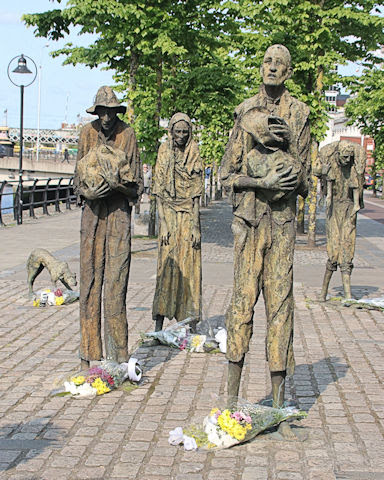
We came across our first references to the Great Famine our very first day in Ireland, when we saw a famine memorial and visited a famine ship. The memorial is composed of several sculptures showing starving people making their way to the seaports to find a better life elsewhere. The famine ship is a replica of the Jennie Johnston, which was called a famine ship because it took starving emigrants across the ocean to North America—primarily Canada. These ships were also called “coffin ships” because many of the passengers didn’t make it, although the Jennie Johnston was an exception. One of her voyages even arrived with one more passenger than it left with.

The next two photos show the famine memorial and the replica of the Jennie Johnston.


During the tour, we learned more about the famine. The potato crop was the only one affected, and wealthier people and most city-dwellers had enough to eat, but tenant farmers relied on potatoes as their principal crop and food, so when the blight arrived in Ireland in 1845 and decimated the crop over the next few years, those families starved. And since many of them couldn’t pay their landlords, evictions were common. The government did try to provide some relief, with the idea of taking it to the people, but one of the men administering the relief wasn’t willing to give up his physical comforts to travel to the back country. When he made them come to him, the famine march became a death march. We drove by part of the route, but the memorial itself was down roads the bus couldn’t travel.

The last year of the famine was 1852. When it was over, approximately one million people had died and another one million had emigrated to other countries, dropping Ireland’s population by about 20%.

We also saw a lot of ruins during our tour. The first was the Glendalough Ecclesiastical Settlement, which is the ruins of an old monetary. It was established by St. Kevin in the 6th century. Round towers were a prominent feature of monasteries a thousand years ago, functioning as a bell tower to call people to worship or inform them of important events, and the one at Glendalough is well preserved. Also well-preserved is St. Kevin’s Church, which is also known as St. Kevin’s Kitchen because the chimney looks a lot like one you find in a kitchen . Legend has it that when the Normans plundered the monastery in the 12th century, they didn’t bother with St. Kevin’s Church because they thought it was where food was prepared rather than a religious building. The next two photos show the round tower and St. Kevin’s Church (behind the graveyard).


We also visited the Rock of Cashel, which is better preserved than Glendalough. It started as a fortress but was turned over to the church body in 1101 when the King of Munster wanted to curry favor with the church (and probably with God, as well). The next photo shows the Rock of Cashel from down below.


The other well-known ruin we saw was Blarney Castle. That’s it in the photo at the head of this post. As a fiction writer I’m already filled with blarney, and Roland had heard stories about the locals using the stone as a toilet, so neither of us was interested in taking the long climb up a narrow stairway to kiss the stone. The castle grounds have a decent garden, but other than that we both considered it a waste of time. I couldn’t even get a photo of the stone from below.

Although we saw a number of other ruins from a distance, the only one worth mentioning is a ring fort that we viewed from above. The American Embassy in Dublin was designed to resemble these ancient forts. The next to photos show the old and the new.


Famine exhibits and ruins weren’t all the highlights of the Republic of Ireland, however. The following photos show St. Patrick’s Cathedral (Dublin), Kilkenny Castle (Kilkenny), Cong (where the exteriors were filmed for The Quiet Man with John Wayne and Maureen O’Hara), Kylemore Abbey (where nuns still live and work), the Cliffs of Moher, and a sheepdog demonstration (near Sligo).


One other stop is worth mentioning. At Waterford, we got a tour of the Waterford factory, which we both enjoyed. The final photos show glass blowing (cutting the stem for a wine glass), a girl cutting a design into a wine glass, and a crystal violin that sells for just under $25,000.


Next week I’ll blog about our visit to Northern Ireland.

An Accidental Literary Tour

Monday, June 12, 2023


Roland and I just got back from a tour of Ireland. It was supposed to be more of an overview rather than following a particular theme, but it turned out to have a number of literary connections.

Dublin was full of them. Our first day there, we walked almost to the Samuel Becket Bridge on our way to EPIC, the emigration museum. While there, we noticed a display with a query about C.S. Lewis. Most people think of him an Englishman because he spent most of his life in England, but he was born in Ireland and spent his early childhood there.

These two photos show the Samuel Becket Bridge and the C.S. Lewis display.


Arizona and LighhousesArizona and LighhousesOn our second day in Dublin, we visited St. Patrick’s Cathedral. Jonathan Swift, the author of Gulliver’s Travels, was the dean there for many years. In those days, it was popular (among those who could afford it) to make a death mask to remember the deceased by, and Jonathan Swift’s death mask is kept in the cathedral. That’s it at the head of this post. We also learned that people tended to fall asleep during his sermons, so he had someone build him a mobile pulpit that he could use while walking around among his congregation.

James Joyce is Dublin’s favorite son. His novel Ulysses follows his hero through an ordinary day in Dublin, and his short story collection Dubliners also shows his love for the city. While I don’t have a photo about him specifically, the next one shows a typical street in the city he loved.


The entire country claims William Butler Yeats, but he considered County Sligo to be his childhood home. The next photo is from that area and shows the scenery that he might have grown up with.


When we got to Belfast, we learned that Anthony Trollope had written his early novels while working for the Irish postal service, and part of that time he was headquartered in Belfast’s customs building. That building is the final photo.


So as you can see, our tour of Ireland turned out to be a literary journey after all.