


Showing posts with label Michigan. Show all posts

Laboring Under the Sea

Monday, September 5, 2011

Submarines usually make people think of Memorial Day more than Labor Day. Still, the soldiers and sailors of World War II were laborers, too.

The picture is the USS Silversides submarine, which Roland and I passed as we sailed through the channel at Muskegon, Michigan.* The next morning we walked to its mooring at the Great Lakes Naval Memorial and Museum.

We started in the land part of the museum, where we found equipment from World War II submarines and exhibits on submarine  history. This is the only time during our vacation that I asked Roland to take a picture of me. Here I am as the periscope lady. (And yes, I maintained that sunburn during the entire trip.)


After we were done with the museum building, we boarded the USS Silversides. She is credited with sinking 30 Japanese vessels during World War II and damaging at least 14 others. As you can see from the picture at the top of the post, the submarine was a tight fit for the 80 men who lived and worked on it. Not the place for a claustrophobic sailor.

Nor for someone who is 6'5", as Roland is. This picture shows him entering a hatch. Yes, I said entering. He climbed through it backwards.


The submariners used every inch of space. The men who manned the torpedoes even slept with them. If you look closely at the next picture, you can see the torpedoes over the bunks. The black hole in the middle is the torpedo tube for firing them.


Whatever could go wrong, would, so the crew had to cram the submarine with spare parts. And practically every other inch of wall space contained instruments. Here are just a few of them.


We visited one more piece of history before leaving the museum. The last picture shows the U.S. Coast Guard Cutter McLane, which patrolled the Alaskan coast during World War II. It is less than half the size of the Silversides, but the 30 men it carried had a lot more room to stretch their legs.


Happy Labor Day to everyone who works for a living, and that includes stay-at-home moms and dads. But I'm sending a special holiday greeting to those who currently labor in the military and to the veterans who labored there in the past.

Thank you for serving.

__________
*All pictures in this post are copyright 2011 by Kathryn Page Camp.

A Grand Old Lady

Monday, August 29, 2011

By tradition, ships are always female. And the best-dressed ships are the ones that carry passengers on multi-day trips.

Roland and I toured the S.S. Keewatin while our own boat was docked in Douglas, Michigan. (S.S. stands for steamship.) The Keewatin carried passengers across the Great Lakes from 1908 through 1965 and is now a museum.

The Canadian Pacific Railroad commissioned and operated the Keewatin. The company had railroad terminals at ports along Lake Superior and later on Lake Huron's Georgian Bay. The most direct route between them was over the water, but nobody could figure out how to lay tracks there. So the company had the Keewatin built to transport passengers from one terminal to another.

What did Roland and I learn from our tour of the passenger ship? First, we learned that people can do the seemingly impossible if they plan well enough. The Keewatin was built in Scotland for use on the Great Lakes, but there was a problem. The Canadian Pacific Railroad wanted a 350-foot boat. That made it too long to fit through the Welland Canal, which connected Lake Ontario with Lake Erie, so each half was built to float on its own. When the Keewatin reached the canal, workmen cut it in two. Once the sections were safely in Lake Erie, workmen re-joined the halves. This 1907 picture shows the midsection while the two halves were separated.


Second, the Keewatin told us that people haven't changed much in 100 years. We still like to relax in luxury while traveling, and the Keewatin's public areas look a lot like today's cruise ships. Here are two pictures.* (And no, that isn't a ghost in the dining room. It's just a headless mannequin dressed as a waiter.)


On the other hand, the cabins weren't as roomy as we expect today. Here is a Keewatin stateroom.


Like lighthouses, ships have their own personalities. One unique feature of the Keewatin is this planter . . .


that becomes a ceiling for the hallway below it.


The pots were nailed down to keep them from falling on unsuspecting passengers in rough seas. Still, I don't want to be underneath when the plants are being watered.

If you find yourself in the Saugatuck-Douglas area, be sure to see this grand old lady.

__________
* All pictures in this post are copyright 2011 by Kathryn Page Camp. The original picture of the Keewatin cut in two was taken in 1907 and is in the public domain. 
 

Big Ships in Small Places

Monday, August 22, 2011

Help! The S.S. Badger is running us down!

Okay, that's a slight exaggeration. The largest car ferry on Lake Michigan was behind us in a narrow channel, and it made us nervous. But the ferry captain had enough room to pass, and he did.

I don't know why we didn't plan more carefully. We had seen the Badger arrive the night before and knew it was large and impressive. We also knew the Badger left its berth at 8:00 a.m., heading from Ludington, Michigan to Manitowoc, Wisconsin. But we wanted to sail north to see Big Sable Point Lighthouse, and that's the time we chose to leave.

We were just entering the channel when I heard the chains rattle as the Badger raised its anchor. And then it was behind us. I barely had time to snap this picture before Roland sent me up to the bow to watch for rocks while he steered as close to the edge of the channel as he dared.*

And then it was safely past us. I'm sure we weren't the first sailboat to try to beat the Badger out, and the captain knew what he was doing. Still, if there is a next time, we will make sure we don't cut it that close.

Here is another picture of the Badger, taken from shore the evening before. You can see how narrow the channel is.


The next afternoon we arrived at Muskegon at the same time as the Lake Express car ferry was leaving for Milwaukee. Fortunately, we saw it coming along the channel before we entered, so we waited in the basin inside the seawall until the ferry passed. The recreational vehicle in this picture obviously didn't mind sharing the channel with the larger boat.


The two ferries are quite different. The S.S. Badger is a steamship that carries 600 passengers and 180 vehicles (including RVs), while Lake Express operates a modern, high-speed ferry that carries 42 cars and 12 motorcycles. The Badger takes 4 hours for a 60-mile trip and offers a stateroom option for those passengers wanting privacy, while the Lake Express ferry takes 2 1/2 hours for a 90-mile trip and provides only group seating. If my calculations are correct, the Badger costs approximately $250 ($300 with the stateroom option) one-way for a family of four with a car and two children between 5 and 15, and Lake Express costs around $350 to $400 (depending on booking date) for the same family.

Both ferries are good options for people who want to cut miles off their trips from Michigan to Wisconsin or Wisconsin to Michigan. The drive around the bottom of Lake Michigan and through Chicago is 400 miles if going between Ludington and Manitowoc and 275 miles if going between Muskegon and Milwaukee.

While we were in Ludington, I overheard two middle-age couples talking about the Badger. They were questioning why people would pay to take a boat that billowed smoke when there were other options. Personally, I can't understand why anyone would want to miss out on Chicago, which is rich with cultural heritage and wonderful places to go and see. Given the choice between the Badger and the Lake Express ferry, though, I'd rather cross Lake Michigan on the Badger. Aside from the cheaper price, a steamship ride is just more romantic. At least that's my opinion.

Ferries weren't the only big ships we came across in a small space. On our way home, we spent two nights at the Grand Haven Municipal Marina in a slip that was right on the Grand River channel. We went to bed sometime between 9:00 and 9:30 p.m. the second night because we wanted to get an early start in the morning. Before we could fall asleep, however, we heard a ship's horn very close by. Roland rushed up to the cockpit, and then I heard "Oh, wow," followed by, "Kathryn, come out here."

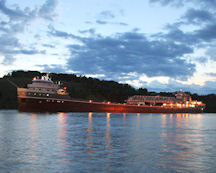
A lake freighter was moving along the river right in front of us, presumably making its way to the power plant a little farther in. The sun had already set and the light was fading fast, but I ran inside and got my camera anyway. Here is the result of my low-light photography.


Big ships in small spaces can be both awesome and scary, but they make for interesting experiences and great pictures.

I'm glad I didn't miss them.

__________
* All pictures in this post are copyright 2011 by Kathryn Page Camp.

Lighting the Way

Monday, August 15, 2011

For centuries, lighthouses have warned sailors that they are close to land or a reef, keeping boats from running aground and joining the shipwreck statistics. Lighthouses are not only vital to the safety of water traffic but are also scenic. And they were one of the highlights of our sail up the eastern shores of Lake Michigan last month.

The original lights were called lighthouses because they provided lodging for the lighthouse keeper and his family. Back in those days, the keeper needed to be on the premises to trim the wicks, replenish the fuel that kept the light burning, and do other maintenance work. Now that the lights are automated, they no longer require a resident lighthouse keeper. The newer ones don't include a house but do make attractive additions to the landscape.

Lighthouses are more than that, though. Even with today's reliance on GPS and other modern inventions, these lights still shine through the dark and the fog to guide ships away from rocks and shoals and mark the entrances to rivers and harbors. And that's a good thing. Otherwise, I shudder to think were we would be if our GPS failed in low visibility.

During our trip, I noticed that each light has its own character. The picture at the top shows the Holland Harbor Lighthouse, affectionately nicknamed "Big Red."* None of the other lights we saw on our vacation had the same look as Big Red. Or the same look as any other light or group of lights. Even the three lights that were similar in shape and color were placed in different contexts.

The difference in character is part of their charm. At least that's my opinion. See if you agree.

St. Joseph North Pier Inner and Outer Lights

South Haven Pierhead Light (at the end of the pier)

Grand Haven South Pier and Pierhead Inner Lights

Coast Guard Station with Muskegon South Pier and Breakwater Light

White River Light Station--the only one no longer in operation

Little Sable Point Lighthouse

Ludington North Breakwater Light

Big Sable Point Lighthouse

Although South Haven, Grand Haven, and Muskegon all have round red silos on the south pier, those lights still have individual characters. The South Haven light stands a solitary vigil at the end of the pier, the Grand Haven light yields pride of place to the imposing building that houses a fog signal (as well as a light), and the Muskegon light stands sentinel between the Coast Guard Station and the breakwater light.

Unfortunately, the White River Light Station was the only place we went into. Although Big Sable and Little Sable are open to the public, they are only accessible by land, and they were both too far away to hike or bike. So we had to be satisfied with seeing them from the lake.

The way they were meant to be seen.

__________
* All pictures in this post are copyright 2011 by Kathryn Page Camp.


Pure Michigan

Monday, August 8, 2011


Okay, so I stole the title from Michigan's tourism ads. To ensure that the theft is legal, I'll make the following disclaimers: I am not affiliated with the State of Michigan (except as a former resident and a frequent visitor), and it does not endorse my blog or any post. Even so, I bet it won't object to what I say.

In July, Roland and I took a three-week sailing vacation along the eastern shore of Lake Michigan. Actually, the winds didn't cooperate, so it was more of a motoring vacation. But we port-hopped up to Ludington and back again. (The picture shows our 34-foot sailboat, Freizeit, resting at White Lake Yacht Club.)

The highlights of our trip were lighthouses, ferries, and World War II history, which I will talk about in later posts. Western Michigan is also known for its beaches, but although we saw a number from the lake, we didn't have time to visit them on this trip. Still, I know from experience that Ottawa Beach at the Holland State Park is a great place to swim and sun, and the campground is just steps away. Some of the other inviting beaches we saw from the water are South Beach at South Haven, Oval Beach at Saugatuck, Grand Haven State Park at Grand Haven, and Pere Marquette Beach at Muskegon.

For those of you who are considering your own trip (by water or by land), here is a pictorial look at other aspects of Pure Michigan that we enjoyed along the way.*

At South Haven, I walked out to the end of the south pier and was awed by the sunset.

At Saugatuck, we watched the recreation occurring in the harbor. (Yes, there were plenty of motor boats there, too, but we're sailors, after all.)

At Grand Haven, we waited until the sun went down and took in a performance of the Musical Fountain while relaxing in Freizeit's cockpit.

At Ludington, we wandered around Waterfront Park and delighted in the many sculptures. This one is "Follow the Leader" by W. Stanley Proctor.

And when high waves kept us in Muskegon for an extra day, we toured the Hackley and Hume homes, where lumber barons and partners Charles H. Hackley and Thomas Hume lived. The picture is the Hume house.
As I said, the highlights are still to come. Even so, these are all good ways to spend your time when visiting Pure Michigan.

__________
* All pictures in this post are copyright 2011 by Kathryn Page Camp.