


Showing posts with label Travel. Show all posts

Colorful Morocco

Monday, November 17, 2025


Every country we visited on this trip was colorful, but Morocco came out ahead.

Before I get to that, however, I’ll give you a little-known fact about Morocco’s history as it relates to the U.S. In 1777, Morocco became the first country to recognize the United States as an independent nation, and it has maintained its diplomatic relationship with the U.S. ever since.

Our entry into Morocco was by ferry into Tangier, and that city wasn’t anything special. After leaving Tangier, however, we took a very interesting excursion to Chefchaouen, which is known as the blue city. Many of the buildings are blue because indigo and other light blues repel mosquitos. The photo at the top of this page is from Chefchaouen, and the next two photos show the city from above and a typical building entrance.


From there we went to Fes, where our Moroccan guide ran us ragged walking through the maze of the medina (walled city). Unfortunately, we were walking so quickly that I didn’t have a chance to stop and take any great photos. If I had fallen behind, I would still be trying to find my way out.

Before we went to the medina, however, we stopped at the Royal Palace at Fes. (There seems to be a royal palace in every large city.) It was just a photo stop since we weren’t allowed inside, but the next two photos show the front of the palace and one of its doors, which demonstrate more of the colorful nature of the country.


From Fes, we traveled to Casablanca, stopping at the capital city of Rabat on the way. Although Casablanca means “white house,” it is Rabat that is known as the white city. You can see why from the next photo, which was taken at the Kasbah (meaning citadel or fortress). The one following it shows that even the royal guards wear white. As you can tell from their uniforms, the royal guard and the other four men at the main entrance to the royal palace are from different services.


The main sight at Casablanca is the Hassan II Mosque, which is one of the largest in the world. It had a lot of colorful detail, but I can’t do it justice without making this blog post way too long. Instead, you’ll just have to make do with an exterior shot that gives you some idea of its size and the pretty green that adorns it.


We also made a very quick stop to take pictures of the exterior of Rick’s Café. The one in the movie was purely fictional, and the current one opened later on the strength of the movie’s popularity. Still, you can’t go to Casablanca without at least taking a photo. That’s the next one.


After Casablanca, we drove to Marrakech, which is known as the red city because of the clay used for the buildings. It was the third city nicknamed for a color on our travels through Morocco. The next two photos show streets in the red city that live up to its name.


Marrakech was our last stop in Morocco. For good measure, I’ll throw in a photo from the night we arrived. Roland had a bad cold and missed out on this optional excursion, but you can tell what I was doing that night.


It was a good trip, and I’m very glad we went. But it’s over, and next week I’ll move on to something else.


Historic Spain

Monday, November 10, 2025


When we visited Spain last month, what stood out most was its history. Spain’s history predates the Romans, but the tour only took us back as far as the Moors.

The Moors were Muslims from Africa, and they conquered Spain in the 8th century. They divided the country into states and ruled for 500 years until the Christians started making serious inroads. As part of their conquest, the Christians destroyed most of the mosques and the Islamic sites. There were two major exceptions, however, which were spared when the rulers of those areas decided to surrender rather than to fight to the end. One was the mosque in the city of Córdoba, which subsequently became a Catholic cathedral. Now called the Mosque-Cathedral of Córdoba, it retains many of the architectural features of the original mosque. These photos show the exterior and the interior of the Mosque-Cathedral.


The other exception was The Alhambra, which was built and originally occupied as a Muslim royal complex that was a fully-contained city separate from the city of Grenada. The photo at the top of this post is an exterior shot of The Alhambra, and the one below shows some interior detail.


After The Alhambra was taken over by the Christians in the late 1400s, it housed the royal court of Ferdinand and Isabella and was the place where Christopher Columbus received the royal endorsement for his expedition.

The next photos are from Seville and show the cathedral where Christopher Columbus is buried, his tomb (which is actually in the coffin in the monument rather than in the floor beneath it), and another monument to Christopher Columbus with the three ships represented halfway up.


Spain was Christopher Columbus’ first burial place, but then his son took his bones to Santo Domingo, and from there they traveled to Cuba before returning to Seville. The tomb at Seville was opened on the 500th anniversary of his voyage and it was discovered that only some of his bones were there, but those bones were validated as his through a DNA comparison with his son’s bones, which are buried in the same cathedral.

As mentioned, Ferdinand and Isabella lived in The Alhambra, but the royal palace at Madrid is actually more imposing from the outside. The royal family does not live there these days, but the next photo shows its majesty.


Moving forward in history, Seville held a world exhibition in 1929. Unfortunately, it coincided with the Wall Street crash. Even so, many countries built elaborate and structurally solid exhibit buildings that are still in use today, many as university buildings. Spain’s own exhibition building houses offices so the interior isn’t open for tourists, but the courtyard is, and it’s impressive. The last two photos show the building that surrounds the courtyard and one of the many beautiful bridges leading to the center of the courtyard.


Next week I’ll take you to the final country on our trip—colorful Morocco.


Creative Portugal

Monday, November 3, 2025


Roland and I just returned from a trip to Portugal, Spain, and Morocco. The three countries have a lot of similarities, but they are also different. In these next three blog posts, I am going to highlight one of the major characteristics of each.

We began our trip with several days in Porto, Portugal on our own, with a break for a full-day cruise up the Douro River, before joining our tour group in Lisbon.

Portugal was crammed with reminders of how creative its population was (and is). To start with their artistic achievements, notice the photo at the top of this page, which shows a doorway inside the Porto cathedral. The cathedral is filled with blue tile art, and the next photo is one of many examples from the interior walls.


It isn’t just interiors that show the country’s artistic bent, however. The cathedral also has blue tiles on an exterior porch. Unfortunately, that side is undergoing reconstruction and doesn’t appear in the next photo. The Carno Church also has an exterior wall filled with blue tile art, however, and that’s the following picture.


These are examples of art created centuries ago, but not all of Portugal’s public art comes from the distant past. For example, the sidewalks of Lisbon are decorated at intervals with different black mosaic pictures. This next photo shows a tribute to the men who imbed those pictures into the sidewalks, and it consists of a sidewalk picture as well as the figures of two men doing the work.


Art isn’t the only source of creativity, however. Science can be creative, too. Just think of inventors such as Thomas Edison and Alexander Graham Bell. Then there were the 15th-century accomplishments of Portugal’s Prince Henry, better known these days as Prince Henry the Navigator. Contrary to that designation, he wasn’t an explorer and never navigated the seas, but his sponsorship was responsible for making the explorers’ lives easier. He hired cartographers to map the oceans and men of various callings to develop the caravel, a sailing ship that could use square sails as well as triangular ones, making it easier to maneuver and less dependent on currents and trade winds. Magellan, Columbus, and subsequent explorers all benefited from the work done under his sponsorship.

The next photo is a maritime monument in Lisbon. You can see Prince Henry in front leading the way, with the other explorers following him.


I’ll end this post with some general images of the Portugal we experienced. The first are pictures of streets in Porto and Lisbon, respectively; the third was taken during our cruise on the Douro River; the fourth is a picture of Porto and the river from the top of the distinctive Don Luis I bridge; and the final one shows the bridge and the monastery at one end of it all lit up at night.


Portugal was my favorite country on the trip, but there was more to come. Stay tuned next week to read about historic Spain.


Following Lewis and Clark

Monday, May 26, 2025


Roland and I just returned from a cruise on the Columbia and Snake Rivers, following part of Lewis and Clark’s route. Actually, I’m not sure “following” is the right word, since we started closer to the end and moved backwards. Or maybe it is, because they used the same route to return to St. Louis.

The photo shows the confluence of the Snake (on the right) and the Columbia (on the left). Lewis and Clark came up the Snake to the Columbia, which they followed to the Pacific Ocean.

Most people don’t know that their mission was a failure. That is to say, they failed in their first objective, which was to find a water route from the Missouri River to the Pacific Ocean. They failed for the simple reason that no such route exists.

In a broader sense, though, the mission was a huge success. The Corps of Discovery, as it was officially called, mapped its way from St. Louis to the Pacific, making friends with the Native Americans and recording new plant and animal species along the way.

It was a success in another way, as well. The men suffered much hardship, but in a day when explorers had a high death rate, only one man died, and he had a burst appendix. That may be because of the medical information the expedition carried in its library of books on plants, animals, and medicine. The next photo lists the contents of the traveling library.


I thought about trying to write a middle-grade historical novel about the expedition, but the youngest member of the Corps of Discovery was probably about seventeen or eighteen and I’m not sure how well I would be able to portray him to a younger audience. Besides, I have lots of other plot ideas vying for my time.

Still, I may reconsider someday.


The Page Travel Bug

Monday, April 28, 2025


My father had the travel bug, and he passed it down to his children and grandchildren. Or to most of his grandchildren, anyway. My son, John, was a disappointment.

After John left home, he took very few trips, and all of them were within the U.S. So I was pleasantly surprised in 2023 when he decided to go to Greece with my brother Gordon and my niece and nephew.

But let me go back and explain where the bug came from.

It started with my father, Oliver Page. Before Daddy was married, he traveled to the Middle East and taught at a private school in Amman, Jordan. He returned on sabbatical when he was a family man, and we lived there when I was six and seven (with my birthday occurring in the middle of the eight-month trip). When we reached England, and on our way back home, we worked our way across Europe seeing the sites until we reached (and after we left) Amman. While living there, we took advantage of weekends and holidays to travel around the area by foot (hitchhiking) or bus.

We had been back in the states for three years when Daddy decided to take another sabbatical with his family, this time to Edinburgh, Scotland. We sightsaw through England on our way there and in Europe during our spring break.

Other years, we traveled around the continental United States or to Mexico or Canada. Daddy got a month of vacation each year, and he made the most of it.

Daddy and Mama continued traveling after my brothers and I left home, but I wasn’t usually with them.

Roland didn’t travel much while growing up, but I soon infected him with the travel bug, too. While Caroline and John were young, we took international vacations to Germany, Mexico, Great Britain (England and Scotland), Canada, and the Middle East (Jordan, Egypt, and Israel), as well as traveling around the continental U.S. The photo at the top of this page is from our 1998 trip to the Middle East with my mother, my brothers, and my niece and nephew. (Daddy was 88 and too infirm to go with us.) Roland isn’t in the photo because someone had to take it.

During our time as empty nesters, Roland and I have continued to travel extensively. At first we traveled mostly in the U.S. (often to states where Roland had never been, but also to Alaska and Hawaii where I hadn’t been either), but we have done 14 international trips since the children left home, with two more booked and others under consideration.

Caroline and Pete are also experienced international travelers, but, as I mentioned at the beginning of this post, I despaired of John.

Then he went to Greece. Still, that could have been a one and done.

Fortunately, it wasn’t. John and Christina just returned from a delayed honeymoon trip to Italy. (Delayed only in the sense that they were married in September.) I don’t know if she urged him into it or if he was as interested in going as she was.

In any event, I hope that my entire family now has the travel bug.


Visiting America's National Parks

Monday, October 14, 2024


I just put together a collaborative presentation on national parks for my camera club, and it reminded me how important it is to visit our country’s national wonders.

There are 63 national parks, and Roland and I counted up the number we had visited. We’re not sure we got them all, but we saw at least six with the children and at least ten additional ones by ourselves, either before they were born or after they grew up. While that sounds like a lot, it is only about a quarter of America’s national parks.

I’ve been to a few more because my family traveled all over the country when I was a child, but I don’t remember all of them. There were also some duplicates, such as the Grand Canyon and Yellowstone.

The photo at the head of this post is the well-known Old Faithful geyser at Yellowstone National Park. I took it and the following photo from the Mammoth Springs area of the park during my visit there with Roland in 2005.


In 2014, Roland accompanied me on a research trip for Desert Jewels. Roland had never been to the Grand Canyon, and, since we were going to be sort-of in that area, we added it to the itinerary. This photo was taken from the east side of the rim, and that’s the Colorado River at the bottom.


A year ago we drove out to visit Roland’s sister in Arizona. Along the way, we visited two national parks and a national monument. The national parks were both in New Mexico. The next photo is a rock formation inside Carlsbad Caverns, which I call a stone waterfall. The one after that was taken at White Sands National Park and shows a dry lake bed that apparently has a little water in it for one or two months a year but not during September when we were there.


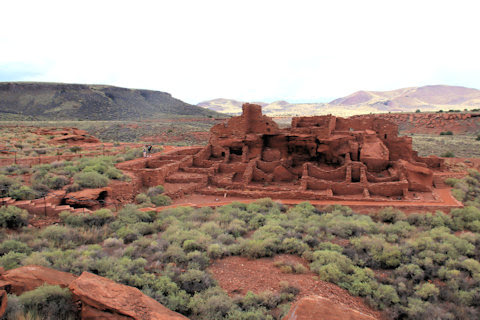
The National Park System includes more than just national parks, however, for a total of 431 locations. We have visited many of the national monuments, battlefields, and other historic sites on the list—some with and some without the children. Although I have limited space here, I am including photos of two of the 86 national monuments. The first is Wupatki National Monument in Arizona, which we visited on our way back from Sue’s house last year. The second is from our 2005 trip to Yellowstone and needs no introduction.


It would have been nice to include some photos of the many national parks, monuments, and battlefields that we visited with the children while they were growing up, but those photos were taken with film. I’m simply too lazy to dig through boxes of prints to find them.

I highly recommend visiting America’s national parks. In fact, any site within the  national park system is well worth seeing. Go to www.nps.gov to find information on particular locations.

If you are a senior (62 or more) or a veteran, you can get a lifetime pass. The senior lifetime pass is $80, but that is well worth the money if you plan on going to several places. Roland and I both purchased senior lifetime passes because we didn’t realize we only needed one. A pass is valid for everyone in the holder’s car when the entrance fee is per car and for a total of four persons when the entrance fee is per person. It does have the customer’s name on it, though, so if two spouses each plan on doing some independent travel, then maybe getting two is worth it.

There is also a free lifetime pass for veterans, which also covers all the occupants of the car or three individuals besides the veteran. If we had realized that, we would have saved even more money. Even so, what we did spend has already been worth it.

Here is a link to the page with information about passes.

Entrance Passes (U.S. National Park Service) (nps.gov)

If you are planning a vacation and don’t know where to go, check out the national park system.


Romania

Monday, August 5, 2024


We finished our Eastern European cruise in Romania. We docked in a fairly rural area and took an excursion bus to Bucharest, which is not on the Danube. When we left the boat (for good) and were waiting for the buses, there were feral dogs close by. I didn’t see it but was told that one of them had chased a woman. When I saw them, however, they were just standing or lying about, including one lying in the street and making cars drive around it. Here’s a photo.

The bus dropped us at our hotel in mid-afternoon. In the meantime, it took us on an excursion into and around Bucharest.

Our first stop was at the Palace of Parliament. The Communist dictator, Nicolae Ceausescu, built the huge building (one of the world’s largest) as a monument to himself. In the process, he tore down houses and perfectly good buildings and spent more money than even Trump has, impoverishing the population and draining the economy. He limited people to two hours of electricity a day in order to preserve the limited energy supply available to the building and to Romanian industries.

After Ceausescu was overthrown and executed in 1989, Romania had no idea what to do with the white elephant that was very expensive to maintain. They considered selling it but couldn’t figure out how much it was worth, so they turned it into government offices. It wasn’t paying for itself, though, so they also rent out office space to commercial entities (and probably anyone who is willing to pay the rent). It also contains an international conference center and several museums and can be visited by tourists for a price, but we only saw it from the outside. The inside would have been interesting, but I’m not sure we would have had time for it.

The next two photos show the Palace of Parliament and the Central Committee Building at Revolution Square, the significance of which is described in the subsequent paragraph.

We made a short stop at Revolution Square, named after the revolution that overthrew Ceausescu in December 1989. He tried to give a speech to calm the crowds that gathered in front of the Central Committee Building, but the angry mob forced him to flee to the roof, where he escaped in a helicopter. He was captured and executed three days later (on Christmas), and that was the end of Communist rule in Romania.

Our next stop was for a walking tour and lunch in Old Town. The highlights of Old Town were the palace occupied by King Vlad III and the oldest church in Bucharest, which is right next to the palace. We didn’t go inside the church for lack of time, but we had an entirely different reason for staying away from the palace—it probably would have collapsed on our heads. The photo at the head of this post shows the palace from one direction, but the next photo, taken from a different direction, shows the true state of the wreckage. The guide said that there is some discussion about restoring it, but that will be a long time in the future, if ever.

So why is King Vlad III’s palace important? He was also known as Vlad the Impaler and was the model for Dracula. He got his nickname because he executed his enemies by running a stake through them lengthwise, starting at the space between the legs and going toward the brain. It was apparently a very slow, painful death.

Here are two other photos taken in Old Town. The first is a street, and the second is the oldest church.

The last stop on our excursion was at the Village Museum, which includes the current “palace.” The remaining members of the last royal family stay there at times, but calling it a palace may be overdoing it since there is no monarchy in Romania today. The family was staying there when we visited, so we couldn’t get too close. But the real attraction at the museum is all the old houses that were moved there to show how people used to live. One of the really cool ones is the buried house used by poor people in one region. As you can see from the final photo, only the top of the house is above ground.


That was the end of our very interesting cruise. If you want an easy way to see Eastern Europe, I recommend Viking.

But now I have to come up with an entirely new topic for next week’s blog.