Showing posts with label characters. Show all posts

Finding Names by the Side of the Road

Monday, January 5, 2026


Roland and I went to Raleigh, North Carolina, over the holidays to celebrate Christmas with our children. On the way there and back, we drove by Mount Airy and Pilot Mountain. That’s Pilot Mountain in the photo.

For those of you who don’t know, Mount Airy, North Carolina, was Andy Griffith’s childhood home and the inspiration for the fictional town of Mayberry on the Andy Griffith Show. Mt. Pilot was the fictional county seat on that same show. It’s obvious where the name of the county seat came from, and apparently the name of the town came from Mayberry, Virginia, just across the state line.

Not all names are that easy to come up with when writing a story. Still, I have noticed that road trips provide me with a great resource. When Roland is driving, I read the exit signs and write the town names in a notebook for later use. Sometimes they are common names like Monroe, but at other times they are more unusual, such as Gallipolis or Litchfield.

Since I write historical fiction, I often use real locations. It would be hard to write about the Great Chicago Fire or the siege of Vicksburg without setting those stories in Chicago or Vicksburg, respectively. But when I’m writing about something that happened throughout the U.S., or at least in a relatively large area, I may create a fictional town to give me more flexibility in the layout, shops, and general characteristics of the setting. In that case, I look at the names on my list and consider using one, but I do a Google search to ensure that the state I am locating it in doesn’t have a town by that name. Since I collect names from all over the country, I can usually find something that works.

That’s a secondary use of my list, though. I primarily use it for surnames. Most of my characters have last names that I pulled from my list of towns, such as Girard or Morton or Waldon.

But whether I use the names for characters or locations, interstate exit signs can be a great resource.


Ambiguous Characters

Monday, June 9, 2025


Ambiguity can be good or bad, depending on the writer’s purpose. If a writer is looking for clarity, then ambiguity is his or her enemy. If the writer wants to keep the reader guessing, however, then ambiguity is his or her friend. This is true of characters as well as events and circumstances.

Professor Snape from J.K. Rowling’s Harry Potter series is a good example. Is he friend or foe? Most of the time he looks like a villain, and then something happens and you wonder. Even if you think you’ve figured it out by the end of a book, the next one makes you question your earlier conclusion. It isn’t until the end of the series that we discover the answer. And no, I’m not going to spoil it for you.

The photo at the top of this post shows a Jack of Clubs that I intentionally distorted to make it ambiguous. If you look closely you can tell it’s a Jack, although the clubs are harder to see. That’s what happens with an ambiguous character. The reader gets enough detail to make out the character’s more superficial traits, but the deeper ones are unclear.

I used the Jack of Clubs to represent an ambiguous character in one of my current works-in-progress, which takes place in 1850 when gambling had fewer restrictions than it does now. My protagonist, Matthew, is befriended by Addison, who is a professional gambler. At first, Addison won’t let fourteen-year-old Matthew join in his poker games, declaring that Matthew is too young and too naïve. Eventually, however, he allows Matthew to play with ever-increasing amounts of money until Matthew steals money from his father and loses it all to his supposed friend.

When Matthew confronts the gambler about his betrayal, Addison says he was concerned about Matthew getting addicted and wanted to shock him into understanding that gambling doesn’t pay. Then the conversation continues as follows. (Keep in mind that this is the first draft and will probably change.)

“If you’re trying to teach me a lesson, I’ve learned it.” Matthew swallowed. “So you can give the money back now.”

“Unfortunately, I don’t think you have learned it, and if I return the money, you never will.”

So is Addison a good guy or a bad guy? I don’t even know myself.

But sometimes a little ambiguity is a good thing.


The Dangers of Modeling Characters on Real People

Monday, August 14, 2023


Every character we include in our fiction reflects people we have known. Each characteristic—whether noble, embarrassing, or quirky—came from our experience with someone. It may be buried deep in our subconscious, but we didn’t create it. Even so, some people stand out more than others, and we may be fascinated with them and their lives. So how can we write about them without getting into trouble?

As I promised last week, this week’s post discusses some of the dangers of modeling characters on real people. It will start by discussing two of the cases covered in my book Writers in Wonderland: Keeping Your Words Legal and will end with some ideas on how to avoid the pitfalls.

Fetler v. Houghton Mifflin Co., 364 F.2d 650 (2d Cir. 1966)

Imagine yourself living in the glow that follows your first published book. Then the sheriff knocks on the door and hands you a summons. Your brother has sued you for defamation.

Oh, you say, that won’t happen to me. I only write fiction, and everybody knows fiction isn’t true. Besides, I’ll have a disclaimer at the beginning of my book saying that any resemblance to any person living or dead is purely coincidental.

That may have been what Andrew Fetler thought when he published The Travelers. If so, he soon discovered that he was wrong.

The novel revolved around a family very much like Andrew’s family and an older brother very much like Andrew’s older brother, Daniel. But the fictional parts portrayed the older brother taking actions Daniel found repugnant. So Daniel sued, and the entire family took sides.

The lower court judge dismissed the case without a trial, but the federal appeals court overturned the decision. It said the similarities between Daniel and the character in the novel were strong enough to let a jury decide whether readers would identify the real brother as the fictional one, and it sent the case back for a trial.

There is no more information on the case after that, and I don’t know how the story ended. The dispute might have gone to trial or, more likely, it may have settled. But even if Andrew ultimately won the case, he had to bear the expense and stress of a lawsuit and live with the knowledge that his novel had divided the family.

Smith v. Stewart, 660 S.E.2d 822 (Ga.Ct.App. 2008)

I do know how this story ended. A jury found that Smith (the author) had defamed Stewart. Putting Stewart in the novel also turned a friend into an enemy, and Smith may have regretted both outcomes.

Haywood Smith’s novel The Red Hat Club included a character named “SuSu.” In the book, SuSu received a large insurance settlement after her first husband was killed in a car accident. Later, she became engaged to a man who owned nursing homes in Florida and was already engaged to another woman. This man eventually stole SuSu’s insurance settlement, moved to Florida, and transferred his assets to his mistress. Although a court awarded SuSu $750,000, she was unable to collect it from him. Then, at the age of fifty, SuSu became a flight attendant.

These facts weren’t unique to the fictional character. They also fit the author’s real-life friend, Vickie Stewart.

Maybe it would have been all right if Smith had stopped there. Unlike the real-life model, however, SuSu was a sexually promiscuous alcoholic who drank on the job. Stewart took offense and sued for defamation.

The appeals court held that fiction could be defamatory if the statements were about an identifiable person, and it found enough factual similarities to let a jury decide whether readers would identify Stewart with SuSu. The jury concluded that readers who knew Stewart would realize that SuSu was based on her. Since there was no evidence that Stewart was a sexually promiscuous alcoholic, the jury also found that Smith had defamed her.

Avoiding the Pitfalls

If you want to use a real person in your fiction, change some of the facts and make the character a composite of several people. If you are fascinated by a few of your Aunt Martha’s characteristics or experiences, by all means use them, but give some of them to other characters. Change her name and physical characteristics, place her in a different job and setting (unless the job or setting are part of what makes her interesting), and mix in several noticeable personality traits that the real Aunt Martha doesn’t have. If you change enough, she is no longer recognizable. Or at least the reader who knows her will realize that your character is mostly fictional.

Daddy was a minister who wrote sermons and letters but never considered anything longer until he retired and started his autobiography, while Becky’s father is a college professor who is writing a book on Sir Walter Scott. Daddy was always taking pictures, while I gave that role to the mother in my novel. Still, the two quirks I mentioned in my last blog post were part of his personality, and using them together makes Becky’s father a more interesting character. They also make him easily recognizable to people who knew him.

As I said earlier, I’m sure Daddy would laugh while reading the passages about Becky’s father, but there is another reason I’m not worried about him getting angry and suing me. Simply put, the easiest way to avoid the pitfalls of writing about a real person is to write about somebody who is dead. You can’t libel the dead, and they can’t sue you, either.

A writer also isn’t liable for libel if the person has given his or her consent. Wait, you say, why would someone agree to be negatively portrayed? For the same reason people agree to go on reality television shows where they come across looking like jerks. Some individuals will do anything for publicity or money. Or they don’t realize how something looks until they read it on paper, watch it on TV, or hear their friends’ comments.

Make sure the consent is in writing and is broad enough to cover whatever you want to say. You also don’t want them complaining later that you didn’t tell them how the character would appear, so full disclosure is best.

Actually, there is a another way to protect yourself, but it is chancy. If you stick to the facts and make sure they can’t be misinterpreted, it isn’t libel. That doesn’t keep someone from suing you in the first place, however. Even when you win, lawsuits are expensive in time, money, and relationships.

So if you want to model characters on real people, make sure you consider the consequences.

Modeling Characters on Real People

Monday, August 7, 2023

I don’t usually model my characters on real people. The protagonist’s mother in Desert Jewels had some of my mother’s personality, but the two women are more different than similar. However, I’m currently working on the second draft of a story about the sinking of the Andrea Doria, and the father is a lot like mine.

It can be dangerous to model characters on real people, and next week’s post will discuss those dangers. With Daddy, however, I have no concerns. He would probably be flattered and find the humor in my description of his quirks. Still, I might have asked for his permission if he were still alive. But you can’t libel the dead.

My novel starts with the protagonist’s father almost missing the boat to America because he is looking for a mailbox. As far as I know, Daddy never cut any of our trans-Atlantic crossings that close, but Mama and I had near heart attacks several times when he almost missed a train in Europe. Usually he was taking one last picture, although looking for a mailbox wouldn’t have been out of character.

On one occasion, Mama, my brothers and I, and the luggage were on the train but Daddy wasn’t. Mama thought about getting off but decided to wait for him at our destination (or maybe the border). It was a good thing she did, because the train had barely gotten under way when Daddy came strolling down the aisle totally unconcerned.

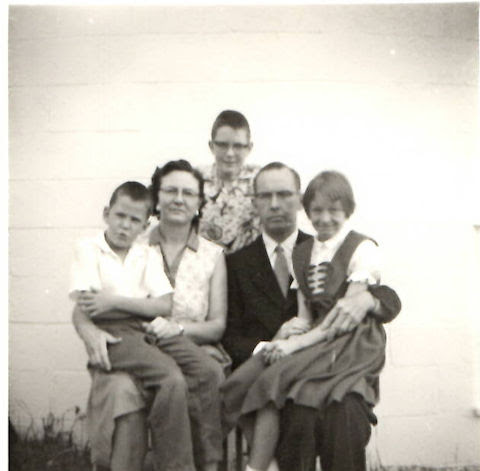
Back in those days, she couldn’t have gotten very far without him, anyway. We had a single, family passport between us, and every European country had its own border.1 Since Daddy carried the passport, we could not have gone very far without him.

My protagonist’s father is also very careful with his money. He won’t pay for movies when library books are free. On the ship, however, where they are part of the fare, he jokes that he would be losing money if the children didn’t go to the movies. Again, that was very like Daddy.

Sometimes using personal experiences and a real person’s character quirks can add color to a story. As next week’s post reminds us, however, be careful how you use them.

__________

1 The picture at the top of this post is our family passport photo from our trip to Scotland in 1961. I would not normally have sat on Daddy’s lap at that age, but it was probably done to get all five of us in one picture.


Listening to Your Characters

Monday, August 23, 2021


Sunday’s sermon talked about God as the potter and we, His creations, as the clay. We can’t tell Him what to do, although we try anyway.

Fiction works like that, too. I create the characters, and I get to tell them what to do. But sometimes they have a mind of their own. When that happens, it’s my job to decide whether to let them follow it.

And sometimes I do.

God also lets us follow our own way sometimes. But no matter why He does so, one thing is clear: God knows us better than we know ourselves.

And that’s where the analogy breaks down.

Two weeks ago I mentioned that the fatal flaw I had tried to give my protagonist wasn’t working. In a sense, she was telling me that I didn’t understand her, that even though she liked being with her friends, she loved her family more. So I will try to listen more carefully when I write the second draft.

Because sometimes the characters know themselves better than I do.


Keep the Reader Reading: The Art of Story

Monday, May 7, 2018


One of the regular readers of this blog told me that she found last week’s entry a bit confusing. Many writers are not educators and don’t use rubrics, so maybe that’s where the problem lies. Or maybe I just wasn’t clear. In any event, I’ll try to keep these subsequent posts focused on the fundamentals with fewer references to the rubric.

There are some writers who write purely for their own enjoyment, and a rare few may not care if anybody else finds their work worth reading. But most of us want an audience. When that’s the goal, fiction is worthless if it doesn’t keep the reader reading.

So what does keep a reader reading? The secret is in those building blocks that I call the Art of Story: plot, characters, and the opening chapter. Here is a brief discussion of each.

Plot

Objective: To give the reader a ride that creates and maintains tension until it reaches a satisfying conclusion.

It can be a rollercoaster ride with mounting tension, as in the Harry Potter books, or a slow train ride thorough the country that simply maintains the tension, as in Alice in Wonderland. The type of ride often depends on the genre.

Alice in Wonderland creates tension when Alice falls down the rabbit hole and maintains it as she tries to find her way back home. As the story progresses, things get “curiouser and curiouser,” but the tension doesn’t necessarily grow stronger. And it doesn’t need to. Between the tension that continues to exist and the adventures that happen along the way, the reader is motivated to keep reading.

A “satisfying conclusion” doesn’t always mean a happy one, although most readers would prefer that. A satisfying ending is simply one that makes sense to the reader. It doesn’t have to be a complete resolution, either. Voldemort remains a menace at the end of the first six Harry Potter books, but the immediate problem in each has been resolved.

For purposes of the rubric, plot is worth 20% of the score.

Characters

Objective: To create realistic main characters, including a protagonist the reader can identify with.

Readers engage best with a story when the main characters are multifaceted (round) rather than one-dimensional (flat). Real people are always multifaceted once you get to know them. If a reader sees only one dimension, the author has turned the character into a caricature. That’s fine for minor characters but not for the ones the reader spends significant time with.

Realism also requires major characters to be predictable—after the fact. The character may do something that surprises the reader, but the reader should be able to look back at the behavior and say, “that makes sense for this character in these circumstances.”

Roundness also helps the reader distinguish between characters. When they are multifaceted, there is room for differences even when the story calls for them to share many qualities. Or it can work the other way around. In my novel Inferno (which is currently circulating to agents), two cousins think they have nothing in common but discover that they are more alike than different. That mirrors real life, where I had the same experience with my first college roommate.

The protagonist is a major character and needs to be realistic, and the reader must also be able to identify with that character. This doesn’t mean the reader has to like the protagonist, but there must be some aspect of his or her problem or personality that the reader can relate to.

For purposes of the rubric, characterization is worth 15% of the score.

Opening Chapter

Objective: To begin the story by hooking the reader, identifying the style of the book, and providing information on characters and setting.

Opening lines are important, but they don’t usually sell books. Good writing sells books. It may take an entire chapter to hook the reader and set up the story, and that’s okay. Most readers will give you that much time before putting the book down. And even when leafing through the selections at a bookstore or using the “Look Inside” feature on Amazon, most purchasers will give you a page or so to convince them that you are a good writer.

Still, the pages that the potential purchaser or reader does give you need to grab the reader’s interest. Or it is probably more accurate to say they should grab the interest of the intended audience. Readers’ tastes vary, and no first line, first page, or first chapter will appeal to everyone.

The first pages also need to clue the reader in about the style of the book. This is mostly, but not entirely, a matter of genre. A sweet romance shouldn’t start with a chase scene or the reader will be disappointed when he or she discovers it isn’t a thriller. Or vice versa.

Readers also want to be introduced to the protagonist and given a sense of the setting. Not all first chapters do this, but the ones that eliminate those matters successfully are the exception rather than the rule.

For purposes of the rubric, the opening chapter is worth 5% of the score, giving the Art of Story a total of 40%.

__________

TO LEARN MORE:

If you want more of my advice on these issues, here is a list of earlier blog posts.

Plot:


Characters:


First lines:


And finally, here is a post on matching the opening scene with the genre:


__________

The picture is an illustration by John Tenniel for the original edition of Alice in Wonderland. It is in the public domain because of its age.