


Read the Instructions

Monday, July 31, 2023

I can be pretty dense sometimes.

The story begins on Father’s Day. Actually, it begins before that when I purchased Roland’s Father’s Day present, which was peace of mind for him in the form of an MP3 player for me.

Whenever Roland and I take a road trip of more than a few hours, we share the driving and the driver gets to choose the music. While some of our tastes are similar, our listening style is very different. Roland likes to scramble his music so that he gets a mixture of artists and genres rather than having two songs by the same person back-to-back. I prefer to listen to a whole CD in order before moving on to something else. That’s especially true of musicals but covers other genres as well. So when we go on a longer road trip, Roland uses his MP3 player and I take CDs.

That’s where the problem comes in. The car’s CD player holds only one disk at a time, so when one ends, Roland replaces it with the next one because that’s safer than having me take my eyes off the road to do it. We are planning a long road trip for the fall, and Roland suggested I get an MP3 player so that he can sleep without having to wake up to change CDs.

So I did. Unfortunately, I had trouble setting it up.

First, I tried to rip dozens of CDs to my laptop so I could transfer them from there. After checking the internet, I figured out how to do it on the music player that came with the laptop. Unfortunately, it didn’t download them consistently. Sometimes it started with track 2 and at other times it split the tracks into two albums that jumped all over. Worse, I didn’t realize that was an issue until I had already spent a day and a half ripping dozens of CDs.

After several frustrating, wasted days, I finally decided to read the online user’s guide from the beginning and in order. I had downloaded it before I started setting everything up, but for some reason I didn’t think I had to read it all the way through. I went straight to the sections I thought I needed, and I struck out. Then I read the user’s guide the right way and hit a home run. It still took me a day and a half to copy the same dozens of CDs (including 29 musicals) to the player using the software that the player had told me to download, but they came out complete and in order. And this time I checked as I went along.

Before reading the online users’ guide, I had also experimented with transferring files from the laptop to the player, with the same degree of success. I had tried dragging and dropping them, which works in File Explorer but didn’t work here. When I read the manual, it told me to do it a different way, and the problem was solved.

But I would have saved a lot of time and frustration if I had started by reading the instructions. 

 

The Dangers of Using Filler

Monday, July 24, 2023


The picture demonstrates how clutter can hurt a photo. What is the subject of the picture? The shells? The seaweed? The texture of the rock? Or the spot of orange that draws your eye to the left side of the photo? I don’t even know, and I took it.

Writing works the same way, although this post is going to focus on a specific type of clutter, which I can filler.

I usually have several projects going at once, all in different stages. After the first draft, I set a manuscript aside for a month or more so that I can come back to it with a fresh eye. I do, however, make notes on possible changes and may even set myself a particular goal for that second draft (besides improving the story, which is always the primary goal).

I’m getting ready to do the second draft of Almost Home, which is a story about the sinking of the Andrea Doria. It’s too short for my audience, so my goal is to make it longer. Unfortunately, that isn’t as easy as some people might think. The challenge is to avoid additions that are mere filler.

Every scene in every novel should have a purpose, and adding length doesn’t qualify. A scene that doesn’t move the story along should develop a character or the setting. That’s also true of every word, phrase, and paragraph. Everything else is merely filler that will distract people from the story and maybe even obscure it the way the clutter does in the photograph at the top of this post.

In revising Almost Home, I could be tempted to expand the conversation during the first meal at sea. For example, the strangers who share the table with Becky and her family might give intimate details of their lives. Only a few of those details have anything to do with the story or are necessary to develop the characters, however, and those are already in the first draft. The other details are just filler. I can’t even let my shy protagonist tell about the events in her early life that will become important as the story progresses. That would be a boring info dump, Nobody likes an info dump and, even worse, it would actually be inconsistent with Becky’s character.

Or, since my protagonist gets separated from her family shortly after the accident, maybe I could tell about their different experiences. That would be fine if I used several points of view, but my gut tells me to concentrate on my main character.

Instead, I’ll try to further develop Becky’s experiences after the collision .

But it will still be a challenge to avoid filler.

Who Said That?

Monday, July 17, 2023


In last week’s post, I mentioned the problems with overusing “said” as a dialogue tag, especially in an audio book. This seems like a good time to review how to identify speakers without an over-reliance on dialogue tags. I originally wrote the following article for the Indiana Writers’ Consortium blog and published it there on June 8, 2016. I also published it as a reprint on this blog on March 15, 2021. As you read, temper the section on dialogue tags with my comments about “said” in last week’s post.

Who Said That?

Dialogue can be tricky. First, there is the problem of how much or how little to use, which may depend on genre. An action novel usually has less dialogue than a love story. But in neither case should the conversation be true-to-life. The reader doesn’t want to hear the small talk that occurs around the breakfast table—unless it reveals the protagonist’s anxiety or has some other link to the story. The same is true for the uhs and ahs of normal conversation—leave them out unless they show the speaker’s hesitancy to answer a key question.

But this blog post isn’t about those issues. Instead, it will concentrate on the question that troubles most writers much of the time: How do I make sure my readers know who is talking without interrupting the story’s flow?

Most writers default to using dialogue tags. Some writers are horrified at the very idea. Oh no, never! In their view, dialogue tags were created by the devil. But if you read their own works, you’ll be surprised at the number of dialogue tags that creep in. Still, since dialogue tags should be the last resort, I’ll address them at the end.

Action

Action can be a good way to show who is speaking, although that should never be its sole purpose. When used correctly, action has the added benefit of providing information about the speaker or the setting. Consider these two examples:

Bob slammed his fist on the table. “He’s a liar.” (Showing that Bob is angry as well as attributing the statement to him.)

“I can’t lend you any money.” Mavis flung her mink stole across a Chippendale chair, barely missing the Ming vase on the stand next to it. “I’ll be going to the poor house soon, myself.” (Showing that Mavis lives a life contrary to her words.)—Okay, that one is probably over the top, but you get the picture.

The action must fit, however. Characters can only drink so many cups of coffee during a five-minute conversation, and even one may be too many. I’m guilty of this, but at least I know it. Some writers seem to think that any action is fine as long as the speaker is doing it. For example:

Tom buttered his toast. “I got fired from my job yesterday.”

If the only reason for inserting an action is to identify the speaker, it will sound contrived. Find another way to show who is speaking.

Using Names

The use of names in dialogue can identify the speaker by process of elimination. If John and Mary meet on the street, which character is talking here?

“How did the meeting go, John?”

Obviously, Mary must be speaking. But this technique can be misused, too. In real life, we seldom say another person’s name when talking directly to them. Once she had John’s attention, Mary would simply ask, “How did the meeting go?” So don’t use the name of the person being addressed unless it sounds natural.

Two-People Conversations

If you have only two people in a conversation, you may not need attributions once you have identified the first speaker. Consider this:

Mary took Dan’s coat and hung it in the closet. “How was your day?”

“Boring, as usual. I wish I could quit, but we need the money.”

“Well, dinner should cheer you up. I made your favorite meal.”

“Spaghetti?”

“Yes.”

This conversation is as boring as Dan’s job, but at least the reader can follow it. If it went on for any longer, however, we would need an occasional attribution to remind readers who is speaking. Action works well for attribution here because it also adds more life to the scene. (In this particular example, you might also want to ask whether you need the conversation at all, but it gets my point across.)

Unique Voices

Sometimes you can tell who is speaking just by how they speak or what they say. Teenagers talk differently than their parents, so in a three-way conversation you may only need to include attributions for the parents. Or if Karl has recently emigrated from Germany, we know that he is the one talking when we hear this:

“I can the question not answer.”

No attribution is necessary.

Dialogue Tags

Although writers should avoid dialogue tags when we can, sometimes we do need them. Even so, they shouldn’t be too obvious. “Karen articulated,” “David exclaimed,” and “she cautioned” all make the reader stumble over the story. With rare exceptions, stick to “said” and “asked,” which tend to disappear on the page.

The rare exception I recognize is where a particular dialogue tag is the most effective way of conveying a message, such as using “she whispered” to show that the character doesn’t want to be heard. Even so, it is better to have your character simply gasp than to have her gasp out her words. And if your character is lying, let the reader figure it out from the context rather than using “she lied” as a dialogue tag.

Experiment with different ways to attribute dialogue to your characters. But if nothing else feels natural, there is nothing wrong with “said” and “asked.” Even the best writers use those words at times.

Just count them up.


To Listen or Not to Listen?

Monday, July 10, 2023


Over the years, I’ve heard successful authors say that it’s important to read your manuscripts out loud. My usual (unspoken) response is, “that sounds good, but I’m not sure the result would be worth the effort.” So I have mostly ignored their advice. (And my own, which I gave in a March 8, 2021 post.)

But listening to audio books has shown me that what looks okay on paper doesn’t necessarily work when read.

·       I’m a big proponent of avoiding dialogue tags when possible, but there are times when doing so results in an awkward scene. For example, people who are sitting around a table eating dinner are often drinking coffee or buttering their bread for no other purpose than to identify the speaker—and it is clear that the action exists for that sole reason. Or on a telephone conversation where the POV character can’t see the person on the other side of the phone but the conversation is long enough that readers get confused if you don’t signal who is talking every now and then, pauses and throat-clearing get monotonous.


I’ve always felt that the word “said” disappears on the page if it isn’t overused, so that’s my default. But recently I was listening to a book by an Irish mystery author, and every “said” jumped into my ear. It wasn’t well-written to begin with and I’m sure she overdid the “said”s even for someone reading it on the page, but it especially irritated me to listen to.


·       Then I recently listened to the children’s classic Five Little Peppers and How They Grew by Margaret Sydney, and I kept noticing passages where someone says “oh dear” every other sentence. Usually it’s Polly, and if it had been only her I could have put it down as a character trait, although it would still have been overdone. Unfortunately, she wasn’t the only one who said it. To be fair to Margaret Sydney, there were no audio books in her time. Still, parents read those books out loud to their children.

If these authors had read their books out loud before they were published, maybe they would have caught the words and phrases that were used repeatedly and would have replaced some of them. So yes, authors should read their manuscripts out loud.

Now the question is: Will I take my own advice?

Begin as You Mean to Continue

Monday, July 3, 2023


Years ago, I attended a conference workshop where the presenter said it was important to signal the genre in the first few pages of a novel. More frequently, I have heard speakers say that the setting (time and location) and the main character should also be introduced there. There are  exceptions, of course, but they should be carefully thought through and done for a reason that enhances the story.

Those first few pages are usually the book’s best advertisement, and they shouldn’t misrepresent it. That includes the writer’s voice. Voice has many different definitions, but for my purposes here, I’m referring to the way the writer uses words, and I’m going beyond mere style.

Lately I find myself abandoning books partway through because they aren’t what I expected. They start out innocently enough. There may be an occasional swear word, but none are hard core, and any references to sex are oblique. The story is clearly PG. Then, about a fourth of the way through, the story becomes R in the intensity of the curse words and/or the graphicness of the sexual interaction. I can handle a few swear words and gentle references to sex, but too much spoils the story for me.

Some readers are okay with R-rated content, and some are even looking for it. That’s fine, but all of us deserve to know what we are getting into when we first pick up the book.

I don’t generally buy books sight unseen. Either I look at the first few pages when I am in a bookstore, or I use the Look Inside feature on Amazon (recently rebranded as “Read sample”). So if the book starts as it means to begin, sprinkled with swear words or explicit sex, I know enough to avoid it. If it doesn’t, I find myself extremely frustrated when the book proves to be something other than advertised.

As an aside, I do look at Amazon reviews—especially especially the one- and two-star reviews since they are the ones most likely to warn about language or explicit sex. But that doesn’t always work, either, especially if I am looking for an Amazon First Reads selection which doesn’t have many reviews yet.

A good writer will respect the audience and begin as he or she means to continue.


War and Peace

Monday, June 26, 2023


From the Republic of Ireland we crossed the invisible border to Northern Ireland, which is part of the United Kingdom. We wouldn’t have known we were crossing the border if our tour director hadn’t told us. We didn’t even need our passports, although the currency changed from the Euro to the British pound.

Northern Ireland may have been slightly greener, but the main differences weren’t in the scenery. For most of Ireland’s existence, there wasn’t much difference in the history, either.

And then there was.

England conquered Ireland over a century ago and has had an uneasy relationship with it ever since. In 1920, Great Britain partitioned Ireland into two separate jurisdictions, although both were still part of the United Kingdom. Then in 1948 most of Ireland gained its complete independence, while the six northernmost counties continued to be part of the UK. That’s still the situation today.

Many people have heard of the violence in Northern Ireland (referred to as “the Troubles) from the late 1960s until 1998. Although on the surface it appeared to be a religious struggle between the Roman Catholics and the Protestants, it was really a political struggle between those who wanted independence (who happened to be primarily Roman Catholics) and those who wanted to remain part of the United Kingdom (who were mostly Protestants). As the violence escalated, most people stayed in their own, segregated neighborhoods because they were safer there, although those boundaries weren’t always respected. Finally, a political peace was brokered in 1998 by a group headed by John Hume, who received the Nobel Peace Prize and two other peace prizes for his work. The second photo is one of many murals in Derry and, according to our tour director, it shows one of the first innocent child victims, a schoolgirl who was leaving a store at the time. The third shows the peace prizes awarded to John Hume, which are displayed in the Guild Hall in Derry.


Also while in Derry, we walked partway across the Peace Bridge, which winds back and forth to show that the road to peace is never straight.

In Belfast, we saw and signed a “peace wall.” These walls were built to separate the neighborhoods during the Troubles. Most have since been torn down, but this one remains. Although it does separate the still segregated neighborhoods, it appears to be mostly a tourist attraction now. Tour buses stop there, as ours did, so that anyone who wants to can sign their name on the wall, presumably in support of peace. The photo at the head of this post shows me signing the peace wall at one of the few available spots I could reach, although Roland had to help me up afterwards. Because of his height, he had an easier time finding a space. The next two photos show the Peace Bridge in Derry and Roland signing the peace wall in Belfast.


The other “war and peace” story we heard was just that—a legend that obviously has no truth to it but is a fun tale. While staying in Belfast, we took a day trip to the Giant’s Causeway, which is a natural formation created by volcanic activity. It resembles the foundations for a causeway, and there is apparently a similar formation thirteen miles away in Scotland. So the story goes like this.

An Irish giant and a Scottish giant heard about each other and wanted to have a fight, so the Irish giant built a a causeway between Ireland and Scotland. When the Irish giant saw the Scottish giant, however, he realized that he was a dwarf in comparison. He hurried back home and his wife dressed him up like a baby. When the Scottish giant came looking for the Irish giant, he saw the “baby.” The Scottish giant thought, “if the baby is that big, the father must be huge,” so he fled back to Scotland destroying the causeway on his way.

The next three photos are various views of the Giant’s Causeway.


Two other stops in Northern Ireland are worth noting. The
Titanic was built in Belfast, and we visited a museum at the shipyards. there. The museum is built to look like a ship’s hull if you look at it from the right direction. We also saw two waterfalls on our trip. Neither was very impressive, but since I love waterfalls I will include the one we saw on our way to Derry. The final two photos show the Titanic Museum and Glencar Waterfall.


That’s it from Ireland.


Hunger and Ruins

Monday, June 19, 2023


Our tour of Ireland started in the Republic of Ireland, where the Great Famine and ruins were the main themes. There were a few other sites of interest, too, which I will cover at the end of the post.

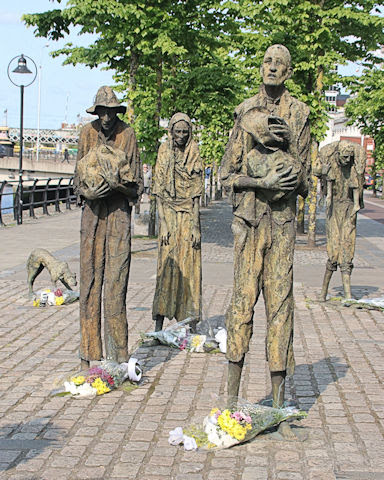
We came across our first references to the Great Famine our very first day in Ireland, when we saw a famine memorial and visited a famine ship. The memorial is composed of several sculptures showing starving people making their way to the seaports to find a better life elsewhere. The famine ship is a replica of the Jennie Johnston, which was called a famine ship because it took starving emigrants across the ocean to North America—primarily Canada. These ships were also called “coffin ships” because many of the passengers didn’t make it, although the Jennie Johnston was an exception. One of her voyages even arrived with one more passenger than it left with.

The next two photos show the famine memorial and the replica of the Jennie Johnston.


During the tour, we learned more about the famine. The potato crop was the only one affected, and wealthier people and most city-dwellers had enough to eat, but tenant farmers relied on potatoes as their principal crop and food, so when the blight arrived in Ireland in 1845 and decimated the crop over the next few years, those families starved. And since many of them couldn’t pay their landlords, evictions were common. The government did try to provide some relief, with the idea of taking it to the people, but one of the men administering the relief wasn’t willing to give up his physical comforts to travel to the back country. When he made them come to him, the famine march became a death march. We drove by part of the route, but the memorial itself was down roads the bus couldn’t travel.

The last year of the famine was 1852. When it was over, approximately one million people had died and another one million had emigrated to other countries, dropping Ireland’s population by about 20%.

We also saw a lot of ruins during our tour. The first was the Glendalough Ecclesiastical Settlement, which is the ruins of an old monetary. It was established by St. Kevin in the 6th century. Round towers were a prominent feature of monasteries a thousand years ago, functioning as a bell tower to call people to worship or inform them of important events, and the one at Glendalough is well preserved. Also well-preserved is St. Kevin’s Church, which is also known as St. Kevin’s Kitchen because the chimney looks a lot like one you find in a kitchen . Legend has it that when the Normans plundered the monastery in the 12th century, they didn’t bother with St. Kevin’s Church because they thought it was where food was prepared rather than a religious building. The next two photos show the round tower and St. Kevin’s Church (behind the graveyard).


We also visited the Rock of Cashel, which is better preserved than Glendalough. It started as a fortress but was turned over to the church body in 1101 when the King of Munster wanted to curry favor with the church (and probably with God, as well). The next photo shows the Rock of Cashel from down below.


The other well-known ruin we saw was Blarney Castle. That’s it in the photo at the head of this post. As a fiction writer I’m already filled with blarney, and Roland had heard stories about the locals using the stone as a toilet, so neither of us was interested in taking the long climb up a narrow stairway to kiss the stone. The castle grounds have a decent garden, but other than that we both considered it a waste of time. I couldn’t even get a photo of the stone from below.

Although we saw a number of other ruins from a distance, the only one worth mentioning is a ring fort that we viewed from above. The American Embassy in Dublin was designed to resemble these ancient forts. The next to photos show the old and the new.


Famine exhibits and ruins weren’t all the highlights of the Republic of Ireland, however. The following photos show St. Patrick’s Cathedral (Dublin), Kilkenny Castle (Kilkenny), Cong (where the exteriors were filmed for The Quiet Man with John Wayne and Maureen O’Hara), Kylemore Abbey (where nuns still live and work), the Cliffs of Moher, and a sheepdog demonstration (near Sligo).


One other stop is worth mentioning. At Waterford, we got a tour of the Waterford factory, which we both enjoyed. The final photos show glass blowing (cutting the stem for a wine glass), a girl cutting a design into a wine glass, and a crystal violin that sells for just under $25,000.


Next week I’ll blog about our visit to Northern Ireland.