


Showing posts with label fiction writing. Show all posts

There's Nothing New Under the Sun

Monday, July 11, 2022


I’ve reprinted this post several times, most recently on May 10, 2021. But it’s one of my favorites and is a good follow-up to last week, where I showed the many ways artists could create a vision from the same initial mold. So here it is again.

There’s Nothing New Under the Sun1

The wind was picking up. Watching the approaching gale from her seat in the cockpit, Anne was grateful that Carousel had reached shelter before the storm hit. But as the sailboat’s bare mast bobbed and weaved with the others in the harbor, Anne prayed for the sailors who were still out on Lake Michigan.

Notice the opening sentence, which I borrowed from Chi Libris. Chi Libris is a group of well-known Christian novelists that include Angela Hunt and James Scott Bell. The group decided to publish a book of short stories with five shared elements: the same opening sentence, mistaken identity, pursuit at a noted landmark, an unusual form of transportation, and the same last line (“So that’s exactly what she did.”). The plots vary widely, however. In fact, the point of their collection, What the Wind Picked Up, is to show that the same basic idea can generate many diverse stories.

That’s one reason you can’t copyright ideas. The idea itself doesn’t make the story. It’s what you do with the idea that counts.

But there’s an even more important reason why you can’t copyright ideas. The founding fathers included copyright provisions in the Constitution to encourage creative works, not to inhibit them. As Ecclesiastes 1:9 says, “there is nothing new under the sun.” If ideas could be copyrighted, there would be nothing left to write about.

Here’s one idea that is frequently found in literature. Two young people fall in love but are kept apart by their feuding families, and the consequences are tragic.

You could call Shakespeare’s Romeo and Juliet a case of mistaken identity in 16th Century Verona, Italy. The two protagonists fell in love before discovering who they had fallen in love with.

Move the setting to New York City in the 1950s, and you have West Side Story.

Then there is the apparently true story of the Hatfields and the McCoys in the Appalachian Mountains during the late 1800s. Their feud escalated after Johnse Hatfield began courting Roseanne McCoy, and Johnse’s family had to rescue him from the angry McCoy men. Did Johnse escape on a horse or use some other form of transportation that we would consider unusual today?

Or travel back to even earlier times. Legend tells of two Native American lovers from rival tribes. When their chiefs forbade their marriage, the lovers swore that if they couldn’t live together they would die together. Fleeing from their families, they embraced each other and jumped off the landmark now known as Lover’s Leap in Illinois’ Starved Rock State Park.

All of these stories use the same basic plot idea, and one (West Side Story) is still under copyright.

Now think of all the contemporary authors who have used that same plot idea. If you could copyright an idea, those stories wouldn’t exist.

Let’s look at another example.

Miss Read (pen name for Dora Saint) has written multiple books about everyday village life in England. While these books tend to have a main character, they center around an ensemble cast of ordinary, and mostly likeable, village residents. 

Does that remind you of a series by a popular American authoress?

When I read Jan Karon’s first Mitford book, I immediately thought of Miss Read and her Fairacre/Thrush Green books. It isn’t that the writing style is similar—it isn’t—or that the authors tell the same stories—they don’t. But their books have a common theme.

I don’t know if Jan Karon read Miss Read’s books before writing her own. For the sake of my point, however, let’s assume she did. And let’s also assume Jan Karon knew she could use the same idea without violating copyright law.

So that’s exactly what she did.

__________

1 This post first appeared on the June 27, 2012 Hoosier Ink blog.

Be Your Own Photographer

Monday, March 21, 2022


I’m currently working on a story that takes place in the Pullman neighborhood of Chicago during the 1894 Pullman strike. I found a number of images online, but since I live in the Chicago area, I decided to take a field trip and check it out for myself.

The Pullman factory is no longer there, although some of the buildings remain. More importantly, though, the residential parts are much as they were then. I can look at old photographs, and I did, but they didn’t give me the sense of place I received from walking the same streets my protagonists did and taking in some of the same sights they saw every day. Unfortunately, the feeling will eventually fade, so I try to keep it alive as long as possible through my own photographs.

Here are some I took while walking around the neighborhood. The one at the beginning of this post shows the wide, tree-lined streets, which were a drawing point back then as they are now. The next one shows the type of skilled workers duplex that my protagonists live in. The rest show, in order, the Greenstone Church my protagonists attend, part of the old Pullman factory, and the Pullman Hotel.


Fortunately, Pullman is a historic neighborhood and much of it has been preserved and/or restored. The same isn’t true of the Topaz War Relocation Center.

Topaz was dismantled and the buildings sold off after the war, and the last two photos show what it looked like when I visited on a research trip in 2014. Even though the camp itself was gone, being there reinforced the photos taken during the war and emphasized the sense of isolation and desolation the 8,000 inhabitants must have felt.


So if you have the opportunity to go on location to research your story, be sure to take a camera along.


Photos Tell the Story

Monday, March 14, 2022


Last week I wrote about using memoirs and other personal accounts to research a historical novel. This week I’ll cover the benefits of using old photos to supplement those resources.

Again I’m going to draw my examples mainly from the research I did for Desert Jewels because the War Relocation Authority hired professional photographers to take thousands of photographs during the removal and internment of the Japanese Americans living on the West Coast. The photos were presumably intended to show the country that the Japanese Americans were being treated humanely, but some, especially by Dorothea Lange, ended up being censored because they showed a different story. Fortunately, they have since been released and are available for historical research.

In most instances, the Japanese Americans were originally sent to assembly centers, which were intended as temporary homes until more permanent camps were built. The photo at the top of the page shows four children, presumably siblings, after arriving at the Turlock Assembly Center. Notice the tags they had to wear for identification but which also made them feel like a number rather than a name.

Then there is this photograph, showing the horse stables that were turned into makeshift “apartments” at Tanforan Assembly Center and were occupied for months before the families living in them were transferred to the Central Utah War Relocation Center, commonly known as Topaz. As you can see from the photo, living conditions at Tanforan were not humane.


The third photo is a panoramic view of Topaz. Several families were crowded into each of those barracks. Worse, the desert was a desolate setting for the Japanese Americans, most of who were used to the lush vegetation of western California.


Or to use a research example from another book, here is how downtown Chicago looked a day or two after the Great Chicago Fire had burned itself out. (The photo shows the corner of State and Madison.)


Memoirs and other personal experience accounts are the most important research sources, but photos can supplement that research by providing a more a vivid picture (literally and figuratively) of what life would have been like.

And that makes them another valuable research tool.

__________

Dorothea Lange took the first two photographs and Francis Stewart took the third. All three are in the public domain because they were taken by War Relocation Authority photographers as part of the photographers’ official duties as employees of the United States government.

The last photo is in the public domain because of its age.


Story Comes First

Monday, February 21, 2022


I have been writing a historical novel about living in the Pullman neighborhood during the Pullman strike, and I recently sent it to my middle-grade beta readers. This is the first novel I wrote with a male audience in mind, so it was the first time I used boys as beta readers. The boys who enjoy historical fiction liked it, but the ones who don’t found that it dragged too much. One boy said, “the first chapter didn’t have enough action and I lost interest quickly,” and two mentioned that the last chapters were boring.

It wasn’t hard for me to identify the problem. One reason I write middle-grade historicals is because I believe it’s important for today’s children to know about their history. But my readers want a story, not a lecture. So when I wrote the next draft incorporating my beta readers’ suggestions, I kept that in mind.

First, I added more action to Chapter 1 and eliminated some of the information I had wanted to convey about living in the Pullman neighborhood. That information slowed the story down and was there because of my desire to teach, not because it was important to the story. So it had to go.

I also added several fights. The story still doesn’t show the full violence of the strike since that took place outside the Pullman neighborhood, but the fighting does add to the story while making it more interesting.

Then there were those last two chapters that even I found boring. I had used them to sum up the lessons I wanted my readers to learn. Unfortunately, they dragged the story down rather than adding to it. Fortunately, the previous two chapters had already done a good job bringing closure to the story. So after incorporating a small amount of material from the last two chapters into earlier ones, I simply deleted them.

The story is much stronger now thanks to beta readers who followed instructions and gave me their honest opinions.

Because of their comments, I swallowed my desire to lecture and put story first.


Jigsaw Puzzles and Stories Need Substance

Monday, January 31, 2022


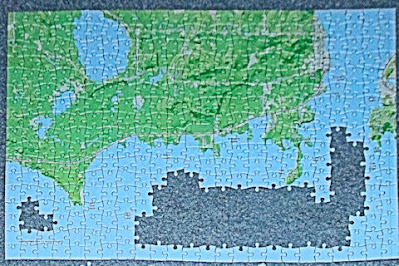
I enjoy jigsaw puzzles, so Roland gave me a “Personalized Hometown Puzzle” of DeTour Village, Michigan, for Christmas. DeTour is the light gray spot on the mainland in the upper right-hand corner of the puzzle. Unfortunately, the people who made the puzzle didn’t put any thought into it. As long as it contained DeTour, they didn’t care what was around it. And that’s why I finally gave up, as you can see from the darker gray areas that show the mat (also a present from Roland) below the puzzle.

Putting some of the land together was difficult, but I enjoyed the challenge. Then I got to Lake Huron. There are a few places with writing identifying reefs and shoals, but most of it is simply a uniform blue. Even the shapes of the pieces didn’t help because too many are similar on the two or three sides that matched the part I had completed. But if I put them in the wrong spot, nothing I tried after that would fit. I did replace several pieces with others in an effort to find the right ones, but that didn’t work, either.

So I gave up.

It didn’t have to be that way. All the puzzle maker had to do was move the image north, and possibly a little bit west, so that the puzzle area was mostly land.

Writing fiction is like putting a jigsaw puzzle together. Each piece must fit in its place to make a cohesive whole, and the story needs substance to give the reader clues about where each piece fits. Too many passages that don’t add to the story make a reader give up before finishing the book, which also loses the author an audience for the next one.

That’s where it becomes important to cut unnecessary material. Sometimes that’s all I have to do. But if it’s not enough, maybe I need to move the story north (figuratively speaking) and possibly a little bit west.

Because jigsaw puzzles and stories both need substance.


There's Nothing New Under the Sun

Monday, May 10, 2021


I’m preparing an index of the more than 600 blog posts I have written since January 1, 2010. Actually, I haven’t written quite that many since some of them have been reprints. Still, it’s a lot, and it isn’t always easy to come up with new ideas. So when I came across this one, I decided to reprint it again.1 It is one of my favorites because of the creativity.

There’s Nothing New Under the Sun

The wind was picking up. Watching the approaching gale from her seat in the cockpit, Anne was grateful that Carousel had reached shelter before the storm hit. But as the sailboat’s bare mast bobbed and weaved with the others in the harbor, Anne prayed for the sailors who were still out on Lake Michigan.

Notice the opening sentence, which I borrowed from Chi Libris. Chi Libris is a group of well-known Christian novelists that include Angela Hunt and James Scott Bell. The group decided to publish a book of short stories with five shared elements: the same opening sentence, mistaken identity, pursuit at a noted landmark, an unusual form of transportation, and the same last line (“So that’s exactly what she did.”). The plots vary widely, however. In fact, the point of their collection, What the Wind Picked Up, is to show that the same basic idea can generate many diverse stories.

That’s one reason you can’t copyright ideas. The idea itself doesn’t make the story. It’s what you do with the idea that counts.

But there’s an even more important reason why you can’t copyright ideas. The founding fathers included copyright provisions in the Constitution to encourage creative works, not to inhibit them. As Ecclesiastes 1:9 says, “there is nothing new under the sun.” If ideas could be copyrighted, there would be nothing left to write about.

Here’s one idea that is frequently found in literature. Two young people fall in love but are kept apart by their feuding families, and the consequences are tragic.

You could call Shakespeare’s Romeo and Juliet a case of mistaken identity in 16th Century Verona, Italy. The two protagonists fell in love before discovering who they had fallen in love with.

Move the setting to New York City in the 1950s, and you have West Side Story.

Then there is the apparently true story of the Hatfields and the McCoys in the Appalachian Mountains during the late 1800s. Their feud escalated after Johnse Hatfield began courting Roseanne McCoy, and Johnse’s family had to rescue him from the angry McCoy men. Did Johnse escape on a horse or use some other form of transportation that we would consider unusual today?

Or travel back to even earlier times. Legend tells of two Native American lovers from rival tribes. When their chiefs forbade their marriage, the lovers swore that if they couldn’t live together they would die together. Fleeing from their families, they embraced each other and jumped off the landmark now known as Lover’s Leap in Illinois’ Starved Rock State Park.

All of these stories use the same basic plot idea, and one (West Side Story) is still under copyright.

Now think of all the contemporary authors who have used that same plot idea. If you could copyright an idea, those stories wouldn’t exist.

Let’s look at another example.

Miss Read (pen name for Dora Saint) has written multiple books about everyday village life in England. While these books tend to have a main character, they center around an ensemble cast of ordinary, and mostly likeable, village residents. 

Does that remind you of a series by a popular American authoress?

When I read Jan Karon’s first Mitford book, I immediately thought of Miss Read and her Fairacre/Thrush Green books. It isn’t that the writing style is similar—it isn’t—or that the authors tell the same stories—they don’t. But their books have a common theme.

I don’t know if Jan Karon read Miss Read’s books before writing her own. For the sake of my point, however, let’s assume she did. And let’s also assume Jan Karon knew she could use the same idea without violating copyright law.

So that’s exactly what she did.

__________

1 This post first appeared on the June 27, 2012 Hoosier Ink blog and was reprinted on my blog on January 26, 2015.


Writing Narrative from a Character's Perspective

Monday, May 3, 2021


I usually write in a close third-person point-of-view. That means the narrative is coming from inside my POV character’s head using her thought processes, observations, and vocabulary.

Take description, for example. If my POV character is materialistic and tends to notice what people wear and how they furnish their homes, the narrative should include those details. If the character isn’t observant, the description should be minimal or non-existent—unless she has some particular reason for noticing the details in a specific situation.

Or consider this advice: use as much word variety as possible to make the narrative more interesting. I could use “couch” in one paragraph and refer to the same item of furniture as a “sofa” in another. That’s good word variety, but would my POV character really use the terms interchangeably? Some people do, but if my character wouldn’t, I shouldn’t, either. And sometimes the attempt at word variety creates confusion, such as using “cleaner” to refer to a vacuum cleaner even though many readers use to word to refer to household cleaning products such as Pine-Sol. One friend from my weekly critique group tried to avoid repeating the word “corn” by calling it “maize” the second time, but her POV character is a contemporary teenager who is unlikely to think of that word. I suggested just using “corn” twice, but she had a better solution and managed to get rid of the second reference altogether.

The same goes for grammar. If my character isn’t a stickler for it, I shouldn’t be, either. But I can’t stray too far or my readers will assume I don’t understand or respect good grammar, and that doesn’t work, either.

In the end, it becomes a balancing act. Dialogue would be deadly if we put in each “ah” and “um” from everyday life, and the same is true of narrative. Although it should create the impression of reality, it doesn’t have to mimic life.

Still, it’s nice to get as close as possible without boring the reader.

__________

The photo at the top of this page shows “The Thinker” by Auguste Rodin.


Continuity Woes

Monday, April 26, 2021


Fiction writers who want to keep their readers immersed in the story must pay attention to continuity. That means that plot and description must be consistent so that errors don’t interrupt the story. To give the most commonly used example, a heroine with green eyes in chapter one shouldn’t suddenly have brown eyes in chapter five. If readers notice that, they may not read on to chapter six.

My biggest continuity errors result from changes that occur as I write the story. In Desert Jewels, my protagonist’s name started as Martha and changed to Emi. That sounds simple enough to handle: just use Word’s search and replace function. That was fine when I first made the change. Unfortunately, as I wrote more, I was so used to the old name that it kept creeping into the new material. In the end I did another search on Martha and replaced it with Emi. But if I hadn’t, readers would have been bumped out of the story every time they came across the original name.

Then there are my protagonist’s dresses in Welcome to America. Anne starts the voyage with three dresses, and two of them get stained during the crossing. When Anne arrives at Ellis Island, she is wearing a wool dress that is too hot for the summer temperatures. After I realized that the wool dress was one of the stained ones, I had to go back and rework what she wore when.

In my murder mystery, I rearranged several large chunks of material between the second and third drafts. So it was necessary to catch and eliminate earlier references to events that now occurred later in the story.

Fortunately, I have back-up. If I don’t catch the continuity errors, my critique partner or copy editor will. That’s what happened in the manuscript I just completed, where my copy editor noticed that I had mentioned the Odyssey when I meant the Iliad.

As far as I know, I’ve managed to catch and fix continuity errors before they get embedded in a novel and pull my readers out of the story. Still, if someone does find continuity errors, I wouldn’t be alone. Here are two examples from classic novels:

  • In Robinson Crusoe by Daniel Defoe, Crusoe strips naked to swim to the wrecked ship and retrieve supplies. Yet he somehow manages to have pockets to shove some of those supplies into.
  • In Sir Arthur Conan Doyle’s Sherlock Holmes series, Dr. Watson’s war wound moves from his shoulder in A Study in Scarlet to his leg in The Sign of Four.

And another from a more recent book:

  • In Harry Potter and the Prisoner of Azkaban by J.K. Rowling, Harry and Hermione leave Buckbeak tied to a tree, but when they return he is tied to a fence.

If you do find continuity errors in my books, at least I’ll be in good company.

But I’d rather it didn’t happen at all.


Story Over Message

Monday, October 21, 2019


I’ve been reading Robinson Crusoe by Daniel Defoe. It’s an easy read for a book published in 1719, but many passages are mini-sermons. That may have been the fashion in the 18th Century but bores today’s readers—or at least this one. Fortunately for me (and unfortunately for Defoe), those sections are easy to identify and skip.

Many authors—including me—want their books to convey a message. My first two middle-grade historicals have protagonists who come from different cultures than I do. I wanted my readers to understand two seemingly contradictory but very real truths: (1) that we are all the same under the skin and (2) our cultural heritage is an important part of who we are and should be celebrated rather than suppressed. But if I had stressed that, my readers would have decided the books were dull and put them down before the message sunk in. Or they would have skipped over the lectures. Either way, the message would be lost.

So what’s a writer to do? I try to make the story primary and the message secondary. Think of Aesop’s Fables and fairy tales. The tortoise beat the rabbit because he worked steadily and didn’t slack off. That’s a message, but we remember it because of the story. “Beauty and the Beast” teaches us that it is what is inside that matters but, again, we remember the message because of the story.

I’m not saying you can’t have a message in mind when you write your book. I do. But without a compelling story the message will never get heard.

The same is true for other lessons. One reason I write middle-grade historicals is because I believe it is important for today’s children know about their history. But my readers want a story, not a lecture. When I wrote Desert Jewels, I wanted to show everything that the Japanese Americans went through during World War II when they were forced to leave their homes and move to internment camps. Unfortunately, that goal was unrealistic. There were some events and circumstances that I couldn’t weave into the story without bogging it down, so I had to leave them out. I probably still left in a few things I shouldn’t have, but hopefully the story is strong enough that my readers will forgive me for those slips.

By the time I sent Creating Esther to my middle-grade beta readers, I was doing better. However, I still wanted to show everything about how my Ojibwe protagonist lived before she went to a white-run boarding school, and that goal was unrealistic, too. This time I had the sense to ask my beta readers to point out those passages that sounded like lessons, and they did. The final version either reworked those parts or left them out.

Fiction isn’t a textbook or a sermon. If it is written that way, readers will put it down. And they should.

So if you want your readers to learn something new, put story over message.

Brushing Teeth and Cleaning House

Monday, October 14, 2019


In the last two weeks I saw several of my old colleagues from the Indiana Writers’ Consortium and had a good time visiting with them. During the six years that I ran the IWC blog, I wrote many posts that I never reprinted here. Now that IWC has disbanded, I’m trying to change that. Today’s post originally appeared on the IWC blog on September 18, 2013.

Brushing Teeth and Cleaning House

People look at a picture of a toddler cleaning a toilet and say, “Cute.” Replace the toddler with an adult, and they say, “Who cares.” Fiction works that way, too.

Every scene in every novel—or in any type of writing, for that matter—must have a purpose. In fiction, the scene should either develop a character or move the story along. Everyday details that do neither make the story boring.

I don’t want to read about a character’s morning routine. In fact, I assume it’s pretty much like mine. He gets out of bed, uses the toilet, brushes his teeth, takes a shower, gets dressed, and so on. You don’t have to tell me any of this.

As mentioned above, however, there are two exceptions. I’m willing to pay attention to details that show me something interesting about a character or advance the plot. But even then, I only want those details that make the point.

The mere fact that a protagonist brushes his teeth every morning doesn’t tell the reader a thing. But if you show him brushing them exactly 100 strokes, we might conclude that he is obsessive. And no, I don’t want to count every single one with him.

As a reader I don’t usually care to intrude on a character while she is getting dressed. But I’m interested if she gets up at two o’clock in the afternoon, rummages through the dirty clothes hamper, and pulls on a pair of rumpled jeans and a stained T-shirt without taking off her pajamas. And if she goes to the store that way, so much the better.

Similarly, I don’t usually like to watch the protagonist clean her house. Still, maybe you want to show that she’s a cleanliness freak who wrestles with every piece of heavy furniture so she can pull it out and clean behind it, a sloppy person who only dusts the furniture that is in direct sunlight, or a bored person who cleans an already clean house because she has nothing else to do. Even those characteristics may not matter to the story. If they do, show us the details. But if they don’t, leave them out.

You can also use otherwise mundane details to move the plot along. Maybe your protagonist cleans house and discovers the murder weapon just before the police knock on her door with a search warrant. Or maybe the antagonist injected the tube of toothpaste with poison and the protagonist is one step closer to death every time he brushes his teeth. One caution in the second situation, however. You probably don’t want the protagonist to know he is being slowly poisoned, but the reader needs at least a clue. Otherwise, you can’t count on the reader staying with you until you reveal all.

Do you have Facebook friends who tell you every routine detail about their day? I hide those people from my news feed, and you probably do, too. Nobody wants to read about mundane things like brushing teeth and cleaning house. Not usually, anyway.

If it doesn’t aid the story, leave it out. If it tells me something I need to know, make it interesting.

Because excessive detail creates a book readers won’t finish.

Rules for Writing Fiction

Monday, October 8, 2018


My online critique partner has been trying to follow all the “rules” for writing fiction but is having trouble when they conflict with each other or don’t further her story. That made me wonder how hard-and-fast they really are. Here is what I came up with.

In my opinion, there are only two inflexible rules for writing fiction to be read by others. (If you are writing merely to please yourself, you can ignore them, too.) These two higher-level rules are:

·       Respect your reader, and

·       Stay true to your story.

Most of the lower-level rules are really guidelines designed to help writers respect their readers. Obviously, not all readers are alike, so how the guidelines are used and the degree to which they apply depends on the intended audience. For example, thriller fans expect you to apply the “show, don’t tell” guideline more rigorously than readers of literary fiction do. Here are a few of the other many guidelines that help you respect your reader.

·       Write clearly. Readers deserve to understand what they are reading. I have started but not finished many books that used confusing sentence structures. Here are some examples:

o   “Tom and David entered the room smoking a pipe.” Since it says “a pipe” (singular), were they sharing it? If only one was smoking, then which one? Or should it say “smoking pipes?”

o   “Betty went camping with her sisters, Debbie and Carol.”  This could mean that there were at least five people on the camping trip: Betty, two or more sisters, Debbie, and Carol. Or it could mean that there were only three: Betty and her two sisters, who are named Debbie and Carol.

I thought about putting clarity among the immutable rules, but even it has exceptions. There are times when a writer is purposefully ambiguous and/or misleading, such as when he or she wants a character’s motive to be unclear until the end. But the lack of clarity should always be intentional.

·       Be consistent with point of view. There can be more than one POV character, but it is inconsiderate to head-hop within a scene. When that happens, the reader is the one who gets the headache. At least I do. It’s also important to understand how the various POVs work and use them properly, but that’s a subject for another day. In fact, it’s a subject for an entire month, and I covered it three years ago. For more detail, read my blog posts for July 6, 2015; July 13, 2015; July 20, 2015; and July 27, 2015

·       Don’t tell readers what they can figure out for themselves and don’t repeat information they already know. That tells me, as a reader, that the writer thinks I’m dense. Of course, sometimes repetition is useful for emphasis or as a rhetorical device. That’s why this is a guideline rather than a fixed rule.

·       Feed information to the reader when and where it is fresh. This includes backstory. “Fresh” doesn’t mean it has to be served right after it is made (i.e., when it occurs), but there is a difference between good cheese and moldy cheese or between crisp vegetables and rotten ones. In other words, don’t use the first chapter—or any other part of the book—to dump information on the reader the way trash is added to a garbage dump. Instead, merge backstory, details, and descriptions in where they fit naturally. If there is no place to merge them in, then they are probably unnecessary.

The other actual rule is to stay true to your story. This doesn’t mean it can’t change or develop in the writing process, but no writer should give up control. I always listen to and consider my critique partners’ suggestions, and they often improve the story. This goes for craft elements as well as plot. But I don’t make changes that don’t feel right. It is my story, and nobody else understands it the way I do.

So if you want to be a good writer, respect your readers and stay true to your story.

__________

The image at the head of this post was drawn by Frank T. Merrill for the original edition of Louisa May Alcott’s Little Women. First published in 1868, the illustration is in the public domain because of its age.

Learn Before You Write

Monday, January 15, 2018


I belong to several writers’ organizations that have email listservs for asking questions of other members. Recently, one woman sought guidance on how to get started writing fiction and asked for recommendations about classes, retreats, and other ways to learn the craft. One person recommended a specific online class, but the next person essentially vetoed that. The second person told her to just sit down and write it and then find some beta readers or a critique group to read it. Her response seemed to accept that advice, but it also highlighted her naivete. (I won’t give the details because I don’t want to embarrass her.)

Yes, if you want to be a writer, you have to write. That’s so obvious that it always surprises me when people feel they have to say it. But you start by writing short pieces and exercises, not with a book you hope to publish. Especially if it is fiction.

I just finished reading several middle-grade novels—all self-published or from small publishers—written by people who don’t understand how fiction works. The authors knew nothing about point-of-view or showing versus telling or how to make dialogue sound natural. And if I hadn’t been reading them as research, I never would have finished. I certainly won’t be buying anything else by those authors.

Experience has shown me that it is much harder to write fiction than nonfiction. Obviously, all nonfiction should create interest and flow well, and those types labeled creative nonfiction (e.g., memoirs and biographies and anything that tells a story) can be closer to fiction than to other nonfiction offerings. But creative nonfiction aside, most nonfiction is read for the information it contains, not for how it is presented.

Novels are different. Fiction readers don’t want information—they want an escape. A successful novel brings them into the story with the characters to experience what the characters experience and feel what the characters feel.

That’s what the fiction conventions are designed to do. A consistent point-of-view (single or multiple) helps readers identify with the characters and experience the story with them. A sudden POV jump breaks that connection. Showing helps readers see the world through the characters’ eyes. Too much telling distances the reader from that world. Dialogue that uses tags improperly makes the entire scene feel stilted and unrealistic.

So my advice to the woman on the listserv is to take classes and read books and attend conferences on writing fiction.

Then sit down and write.