Showing posts with label grammar. Show all posts

Quotes and Colour

Monday, July 21, 2025


Since I’m currently writing a book in the form of columns for a fictional English newspaper, I should use the grammar and spelling conventions that my protagonist would use. That could confuse my American audience, but it probably won’t since many of us are used to reading books that come “across the pond” (or ‘across the pond’) with the British grammar and spelling intact. The biggest issue is to make sure I catch it all.

As you can see from the graphic at the head of this post, the British use a single quote around dialogue where we use a double one. It does not, however, show the dissimilar placement of commas and periods that come after a quote mark because the example has no difference. The British place the comma or period inside the quote mark if it is part of the quoted material and outside if it is not, while American English always puts commas and periods on the inside. In the following example, the first sentence is American while the second is British.

The British call a period a “full stop.”

The British call a period a ‘full stop’.

The graphic also demonstrates one of many spelling differences. Spelling was the only subject I got Ds in at school. Even so, I had learned how to spell “color.” Then we moved to Scotland for what would have been my 6th grade year at home, and I had to relearn the spelling as “colour.” It wasn’t the only word I had to relearn, and I hated it, especially knowing that I would have to learn the American spellings all over again when we returned to Michigan.

American grammar conventions are second nature to me, and even American spelling comes more naturally than British spelling does. I simply cannot write the early drafts any other way. Fortunately, Microsoft WORD’s grammar and spell check program has a British version. So if I decide to use British grammar and spelling conventions in my column (and I probably will), I can run that before finalizing the manuscript. That still doesn’t guarantee that I’ll get it all correct, though.

What I’d give for a single form of English.


Two English Languages

Monday, July 14, 2025


Actually, there are many more than two English languages. American English is different than British English is different than Australian English, and so on. Even within countries such as the U.S. there are many different dialects. But for this post I’ll limit myself to the more generic American English and British English.

My current work-in-progress takes place in England during World War II. As I mentioned in my last post, I’m writing it in the form of a newspaper column. And since it is written by an English woman for an English newspaper, of course it will use British English.

That creates another challenge that I’m working through.

Some differences between American English and British English are well known, such as the British use of biscuit for what we would call a cookie. But did you know that a railroad is a railway and a thermos is a flask?

I’ve been writing with two dictionaries at hand: The American-British British-American Dictionary for English Speaking People by Jeremy Smith and the 3rd edition of The UK to USA Dictionary: British English vs. American English by Claudine Dervaes and John Hunter. Every time I’m not sure whether an American term is also used in England, I check those dictionaries. There are two problems with this, however. The first is that I may assume a word is used in England when it is not, in which case I won’t bother to look it up.

The second problem that the dictionaries are written for people who want to understand what they hear or read, not necessarily for writers or educators. So while they are fairly comprehensive, I’m not sure they include everything. If I’m wondering about a term that isn’t in them, I may need to turn elsewhere.

I have been supplementing the dictionaries with a rather unexpected resource. I enjoy the Miss Read books, which take place in England and are written by an English author. (Miss Read is her pen name.) When I wanted to know what a handyman was called in England, I couldn’t find a reference in either of the dictionaries I mentioned above. Although I thought that probably meant that the term handyman is used in British English, I wanted to be as sure as I could be. There is a handyman in a Miss Read book that I recently read on Kindle, so I went into the book and used Kindle’s search function to look for “handyman.” When I found it, I knew I could use that word comfortably. I’ve also used the same resource for several other terms and found it helpful each time.

Still, no matter how hard I try, I’ll probably miss something, and a reader will point out that the British don’t use the American term.

That isn’t the only terminology issue, though. There are times when I may use a uniquely British term when an American one will do, such as using cooker for stove. Still, if I go overboard, I will sound as if I am trying to be British myself or, worse, as if I am mocking the language. So the challenge is to make my character English without overdoing it.

An even bigger challenge comes when I try to write a column that would use British grammar and spelling.

That’s the subject of next week’s blog.


Sacrificing Grammar for Realism

Monday, June 16, 2025


One of the advantages of writing in the third person is that you can zoom in to the POV character’s thoughts or zoom out to an objective account. To use a not very good example, here is the same incident from the two ends of the spectrum.

Blasted sand. Hot and gritty. Annoying when wearing shoes, but unbearably painful in bare feet.

On the hottest day of the summer, an elderly man walked along the beach carrying his shoes and scowling.

I tend to write nearer to but not at the closest zoom-in point, reflecting the character’s thoughts without getting right into his head. To use the same incident:

Dave hated the beach, especially on such a hot day where the sand burned his feet. If his shoes didn’t pinch so badly, he'd put them back on.

Here we get insight into Dave’s emotions (he hated the beach), his physical discomfort (the sand burned his feet), and his motivation in going barefoot (his shoes pinched). Yet we aren’t quite in his head since he wouldn’t think of himself as “Dave” or “he.”

In using this point on the zoom spectrum, I try to include the POV character’s prejudices and wrong conclusions. For example, if Dave thinks his wife doesn’t love him, the narrative would say, “Millie didn’t love him,” even though she does. I don’t say, “he thought Millie didn’t love him” or put those thoughts in italics, because that would zoom me out further than I want to go.

On the other hand, I may not follow his thinking completely if the grammar would make me wince. I’m not talking about dialogue here, where the reader expects to hear it the way the character would say it. But what about in narrative that is supposed to match his thoughts?

That’s the dilemma I am facing in my current writing project. My POV character, Matthew, is self-centered. Instead of “Pa, Jackson, and me,” he would think of “me, Pa, and Jackson.” I’ve been doing it the way he would think it, but it makes me wince. Worse, it makes me wonder if the reader will put the story down because he or she thinks I don’t know my grammar. So what am I to do?

Fortunately, I still have time to figure it out.


The Oxford Comma: A Matter of Clarity

Monday, March 1, 2021


I’ve been preparing a manuscript for editing, and it has gotten me thinking about commas. Normally, I only use them where a speaker would naturally pause or when necessary to avoid confusion.

But I’m a fanatical supporter of the Oxford comma.

For those of you who don’t know what the Oxford comma is, it’s the comma that comes before the conjunction that introduces the last item or phrase in a series. For example, this sentence uses an Oxford comma: The American flag is red, white, and blue. This one doesn’t: The American flag is red, white and blue. It’s called the Oxford comma because Oxford University’s stylebook says to put it in. (It’s also called the Harvard comma, for a similar reason, or the serial comma.)

Technically, the Oxford comma is optional. But it grates on me when it is left out. So why do I believe it is so important?

The first rule of writing is clarity, and there are many times when a sentence is clear without the Oxford comma. “The American flag is red, white and blue” is an example. On the other hand, it is easy to write a sentence where the absence of the Oxford comma creates ambiguity. If that’s intentional, fine, but it usually isn’t.

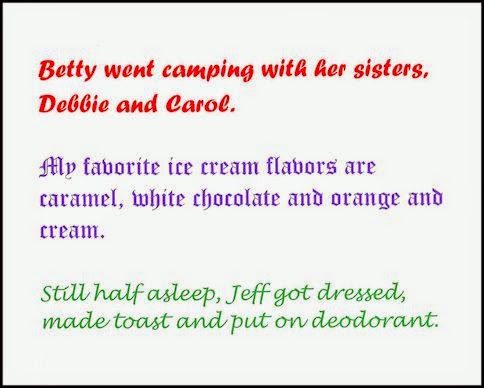
Consider the sentences in the graphic at the head of this post. “Betty went camping with her sisters, Debbie and Carol” could mean that there were at least five people on the camping trip: Betty, two or more of her sisters, Debbie, and Carol. Or it could mean that there were three people: Betty and her two sisters, whose names are Debbie and Carol. If you consistently use the Oxford comma, the reader will know which you mean.

Of course, it is possible to rearrange the sentence to clarify its meaning without using the Oxford comma. If there were five people on the camping trip, you can say,” Betty went camping with Debbie, Carol and Betty’s sisters. But why go to the trouble of rearranging the sentence if you can clarify it by simply adding that last comma?

Or consider this sentence: “My favorite ice cream flavors are caramel, white chocolate and orange and cream.” The use of the extra “and” indicates that one of the flavors has two parts to its name, but is it white chocolate and orange or orange and cream? The use of the Oxford comma clarifies the sentence, making clear that the flavors are either “caramel, white chocolate and orange, and cream” or “caramel, white chocolate, and orange and cream.”

Then there’s the third example. “Still half asleep, Jeff got dressed, made toast and put on deodorant.” Did Jeff put the deodorant on himself or the toast? Grammatically, there is only one way to read the sentence since there wouldn’t be any reason to put a comma after “dressed” unless it were a series of three phrases. So, read correctly, the sentence means that Jeff put the deodorant on himself. But someone who is reading quickly might miss that nicety and read the last two items in the series as one. After all, who knows what Jeff might do when he is half asleep? An Oxford comma before the last phrase in the series slows the reader down and makes the meaning clear.

Although clarity is the first rule of writing, consistency is also important, especially since knowing how someone writes helps the reader find clarity in the writer’s sentences. And because there are times when I need the Oxford comma for clarity, I choose to use it all the time for consistency.

Still, the Oxford comma is technically optional. If you choose not to use it, I won’t unfriend you.

But I will let you know when your sentences are unclear.

__________

This is a revision of a January 12, 2015 post.

"It is I"

Monday, June 22, 2020


This Father’s Day week, I am remembering Daddy by reprinting a blog post from September 8, 2014.
__________
“It is I”
Everything I know about grammar I learned from my father. He was the original grammar nerd.
If I knocked on Daddy’s study door and he asked, “Who is it?” I knew better than to say, “It’s me.” But if I slipped up, he was sure to raise his voice and respond, “It is I.” It wasn’t the contraction he objected to—it was the pronoun. 
I also learned not to start a request with the words, “Can I…” His response was always, “You can, but may you?”
My mother believed in using correct grammar, too, although she didn’t highlight our errors the way Daddy did. I do, however, remember her displeasure with billboards that proclaimed, “Winston tastes good like a cigarette should.” She didn’t approve of smoking, but the use of “like” instead of “as” seemed to bother her even more.
I must have picked up some knowledge in school, too, so the statement at the top of this post isn’t technically accurate. I should probably say, “Most of what I know about grammar I learned from my parents.”
But I stand by the way I said it.
When I was a child, Daddy and Mama frowned on starting sentences with “but,” too. But language is not static, and beginning a sentence with a conjunction is no longer a major sin.
At least not with most audiences. There are still some contexts—mainly academic—where formality is expected. A good writer knows his or her audience and writes for it.
Even in less formal contexts, writers should understand the rules. Many break them, as I did by starting the last paragraph with a sentence fragment. But there are two ways to break the rules. Unfortunately—or perhaps fortunately—only one of them works.
Some writers break the rules because they don’t know what they are. Since rules exist for a purpose, these writers often come across as uneducated. Even worse, the primary reason for grammar rules is to create clarity, so people who ignore them may lose their readers in the morass.
Others know the rules but break them intentionally in order to achieve a certain effect. That sentence fragment is punchier and more in-your-face than if I had said, “Most audiences no longer consider it a major sin to begin a sentence with a conjunction.” And for fiction writers, sentence fragments can speed up the action, especially in a thriller.
So what’s my point? It’s okay to break the grammar rules to achieve a certain effect. But you need to know them before you break them. Otherwise, your reader may not make it through the story or the essay or even the blog post.
Or you may find my father’s ghost standing before you and declaring, “It is I.”

Words, Words, Words

Monday, May 28, 2018


This week I’m covering the last two classifications in the rubric. The first has to do with the spoken word as depicted on the page, and the second covers the technicalities of the written word.

Dialogue

Objective 1: To identify who is talking without using irrelevant action or unnecessary dialogue tags.

Notice that the objective talks about unnecessary dialogue tags. I don’t agree with those people who say a writer should never use them. When not overused, “said” and “asked” are valid ways to handle attribution because they tend to fade into the background. But words like “interjected” and “articulated” should be avoided, as should adverbs such as in “said excitedly.” Those tags yell “look at me” instead of disappearing on the page. Instead of “said excitedly,” show her excitement in her actions.

That’s one way to avoid dialogue tags. Try something like this instead:

“It’s from Graham.” Lucy’s eyes sparkled as she grabbed the letter and tore it open.

As with any other action, however, one used for attribution must show characterization or move the story along. Dinner scenes can be especially hard to write because I am tempted to have my characters pass the potatoes or pour another cup of coffee for attribution purposes, and that gets boring after a while. It also sounds forced.

Objective 2: To write dialogue that feels realistic rather than dialogue that is realistic.

We all know how people really talk. “I, uh, saw Sue yesterday at, uh, the grocery store. In the produce section. She, uh, told me to tell you . . . Billy, stop pulling that dog’s tail! Now what was I saying? Oh yes, she, uh, told me to say hi.” Then there are the times when people talk over each other. And so on. Imagine putting real dialogue in a book without losing your reader. Impossible.

If a conversation doesn’t contribute to characterization or move the story along, leave it out. Or maybe you only need part of it. Two friends meet for lunch and talk about trivial things until they finish their dessert. Then Joan tells Cindy that Joan saw Cindy’s husband with another woman. You could provide a brief excerpt from the chit-chat or leave it out altogether and start the conversation with the bombshell. Unless you are using the chit-chat for a purpose, that is. Maybe Joan rushes from one trivial topic to another because she is too nervous to say what is really on her mind. Throwing in an “um” or two can also signal nervousness. But don’t overdo it, or you will still lose your reader.

Dialogue is one place where you should break the grammar rules. People rarely talk in complete sentences, for example, and the informality of their speech varies. If you have a very formal character, you can use his perfect grammar as a distinguishing feature. Otherwise, go ahead and break the grammar rules to make the conversation more realistic if—and this is a big if—the reader can understand the dialogue without slowing down to figure out what is being said.

That’s the problem with using dialects. They can be a lot of work for the reader. I have slave dialect in a book I am currently working on, and I tried oh so hard to get it right. (See the blog post on writing slave dialect that is linked below, which was written before I gave the manuscript to my beta readers.) I even cleared it with an African American writer friend. But when I gave the manuscript to my beta readers, they had too much trouble following it. So now I need to figure out how to provide the flavor without the actual dialect.

For purposes of the rubric, Objectives 1 and 2 are each worth 5% of the score, giving dialogue a total of 10%.

Language Use

Objective 1: To write clearly and concisely.

Any book is worthless if the reader can’t follow it. Writing is communication, and clarity is key. That includes novels and short stories as well as informative articles or blog posts like this one.

One way to NOT write clearly is to use long, convoluted sentences filled with adjectives, adverbs, and prepositional phrases. Another way is to use big words or allusions your reader won’t understand.

Obviously, there are times when you want a scene or some element of it to be ambiguous. But those instances will be infrequent.

When in doubt, keep it simple.

Objective 2: To use purposeful grammar and avoid typographical errors.

Writers who break the grammar rules because they don’t know what they are come across as uneducated. Worse, since grammar rules exist to provide clarity, those who break them out of ignorance may lose their readers along the way.

Notice that the objective talks about purposeful grammar use rather than proper grammar use. It’s okay to break the rules if you do it intentionally to achieve a certain effect. But you should know the grammar rules before you break them.

Here is a quote from Ernest Hemingway:

My attitude toward punctuation is that it ought to be as conventional as possible. The game of golf would lose a great deal if croquet mallets and billiard cues were allowed on the putting green. You ought to be able to show that you can do it a good deal better than anyone else with the regular tools before you have a license to bring in your own improvements. [1925 letter to Horace Liveright, quoted in Ernest Hemingway on Writing. Emphasis in original.]

The second half of the objective speaks to the importance of proofreading. That should be self-evident, so I won’t discuss it here.

For purposes of the rubric, Objective 1 is worth 15% of the score and Objective 2 is worth 5%, giving language use a total of 20%.

__________

TO LEARN MORE:

For more of my advice on dialogue and language use, check out these earlier blog posts.

Dialogue:


Language Use:


The Oxford Comma: A Matter of Clarity

Monday, January 12, 2015


Am I a grammar nerd? Yes and no. I believe that everyone should know the grammar rules, but I also think it is okay to break them if there is a reason. Ignorance, laziness, or just plain eccentricity aren’t good reasons. (I’m not a fan of E.E. Cummings.) Emphasis, timing, and readability are. And if a reader will think me pretentious for using “whom,” I’ll use “who” instead.
But grammar nerd or not, I’m a fan of the Oxford comma.
For those of you who don’t know what the Oxford comma is, it’s the comma that comes before the conjunction (usually “and” or “or”) that introduces the end of a series. For example, this sentence uses an Oxford comma: “The American flag is red, white, and blue.” This one doesn’t: “The American flag is red, white and blue.” It’s called the Oxford comma because Oxford University’s stylebook says to put it in. (It is also called the Harvard comma, for a similar reason, or the serial comma.) Why does it matter whether a writer uses it? I’ll explain in a minute.
First, though, I’ll tell you why I’m writing about it now.
I have an online critique partner who doesn’t use the Oxford comma. Grammatically, use of the Oxford comma is optional, so I grit my teeth and defer to her style choice. Then she sent me a chapter where she actually stuck one in, and it wasn’t needed for clarity. Although it killed me to do it, I took it out for consistency. But her use prompted me to write this blog.
The first rule of writing is clarity, and that’s why grammar rules exist. There are many times when a sentence is clear with or without the Oxford comma. “The American flag is red, white and blue” is an example. On the other hand, it is easy to write a sentence where the absence of the Oxford comma creates ambiguity. If that’s intentional, fine, but it usually isn’t.
Consider the sentences in the graphic at the head of this post. “Betty went camping with her sisters, Debbie and Carol” could mean that there were at least five people on the camping trip: Betty, two or more sisters, Debbie, and Carol. Or it could mean that there were three people: Betty and her two sisters, whose names are Debbie and Carol. If you consistently use the Oxford comma, the reader will know which you mean.
It is possible to rearrange the sentence to clarify its meaning without using the Oxford comma. If there were five people on the camping trip, you can say, “Betty went camping with Debbie, Carol, and Betty’s sisters.” But if there were three people on the camping trip, you may have to say “her two sisters, Debbie and Carol.” If you rarely or never use the Oxford comma, the phrase is still ambiguous.
Or consider this sentence: “My favorite ice cream flavors are caramel, white chocolate and orange and cream.” The use of the extra “and” indicates that one of the flavors has two parts to its name, but is it white chocolate and orange or orange and cream? The use of the Oxford comma clarifies the sentence, making clear that the flavors are either “caramel, white chocolate and orange, and cream” or “caramel, white chocolate, and orange and cream.
Then there’s the third example. “Still half asleep, Jeff got dressed, made toast and put on deodorant.” Did Jeff put the deodorant on himself or the toast? Grammatically, there is only one way to read the sentence. If it weren’t a series of three, there would be no reason to put a comma after “dressed.” So, read correctly, the sentence means that Jeff put the deodorant on himself. But someone who is reading quickly might miss that nicety and read the last two items in the series as one. After all, who knows what Jeff might do when he is half asleep? An Oxford comma slows the reader down and makes the meaning clear.
Although clarity is the first rule of writing, consistency is also important, especially since knowing how someone writes helps the reader find clarity in the sentence. And because there are times when I need the Oxford comma for clarity, I chose to use it all the time for consistency.
Still, the Oxford comma is technically optional. If you choose not to use it, I won’t unfriend you.
But I will let you know when your sentences are unclear.

"It is I"

Monday, September 8, 2014


Everything I know about grammar I learned from my father. He was the original grammar nerd.
 
If I knocked on Daddy’s study door and he asked, “Who is it?” I knew better than to say, “It’s me.” But if I slipped up, he was sure to raise his voice and respond, “It is I.” It wasn’t the contraction he objected to—it was the pronoun. 
 
I also learned not to start a request with the words, “Can I . . . .” His response was always, “You can, but may you?”
 
My mother believed in using correct grammar, too, although she didn’t highlight our errors the way Daddy did. I do, however, remember her displeasure with billboards that proclaimed, “Winston tastes good like a cigarette should.” She didn’t approve of smoking, but the use of “like” instead of “as” seemed to bother her even more.
 
I must have picked up some knowledge in school, too, so the statement at the top of this post isn’t technically accurate. I should probably say, “Most of what I know about grammar I learned from my parents.”
 
But I stand by the way I said it.
 
When I was a child, Daddy and Mama frowned on starting sentences with “but,” too. But language is not static, and beginning a sentence with a conjunction is no longer a major sin.
 
At least not with most audiences. There are still some contexts—mainly academic—where formality is expected. A good writer knows his or her audience and writes for it.
 
Even in less formal contexts, writers should understand the rules. Many break them, as I did by starting the last paragraph with a sentence fragment. But there are two ways to break the rules. Unfortunately—or perhaps fortunately—only one of them works.
 
Some writers break the rules because they don’t know what they are. Since rules exist for a purpose, these writers often come across as uneducated. Even worse, the primary reason for grammar rules is to create clarity, so people who ignore them may lose their readers in the morass.
 
Others know the rules but break them intentionally in order to achieve a certain effect. That sentence fragment is punchier and more in-your-face than if I had said, “Most audiences no longer consider it a major sin to begin a sentence with a conjunction.” And for fiction writers, sentence fragments can speed up the action, especially in a thriller.
 
So what’s my point? It’s okay to break the grammar rules to achieve a certain effect. But you need to know them before you break them. Otherwise, your reader may not make it through the story or the essay or even the blog post.
 
Or you may find my father’s ghost standing before you and declaring, “It is I.”