Showing posts with label writing. Show all posts

Writing Advice from C.S. Lewis

Monday, August 4, 2025


C.S. Lewis is one of my favorite authors and, although I don’t usually read fantasy, I love the Narnia series. As a writer, I especially enjoy the insights from C.S. Lewis Letters to Children, which was compiled by Lyle W. Dorsett and Marjorie Lamp Mead. The following advice is quoted from Lewis’ June 26, 1956 letter to a child named Joan. The numbering, the italics, and the rest of the text are taken directly from the book.

#####

1.     Always try to use the language so as to make quite clear what you mean and make sure y[ou]r. sentence couldn’t mean anything else.

2.     Always prefer the plain direct word to the long, vague one. Don’t implement promises, but keep them.

3.     Never use abstract nouns when concrete ones will do. If you mean “More people died” don’t say “Mortality rose.”

4.     In writing. Don’t use adjectives which merely tell us how you want us to feel about the thing you are describing. I mean, instead of telling us a thing was “terrible,” describe it so that we’ll be terrified. Don’t say it was “delightful”; make us say “delightful” when we’ve read the description. You see, all those words (horrifying, wonderful, hideous, exquisite) are only like saying to your readers “Please will you do my job for me.”

5.     Don’t use words too big for the subject. Don’t say “infinitely” when you mean “very”; otherwise you’ll have no word left when you want to talk about something really infinite.

#####

All writers should take this advice to heart. Unfortunately, I fail sometimes because I’ve still got a lot to learn.

But I’m trying.

Writing Lessons from Africa--Clarity is Everything

Monday, November 22, 2021


Sightseeing is no fun if you can’t see anything because of the darkness or the dust in your eyes.

A significant part of our time in South Africa was spent on safari riding in an open-air Land Rover (the first photo) while bouncing along dirt tracks (the second photo).  That was fine during the morning game drives but became a problem for me during the evening ones.

I almost always wear sunglasses while outside. They aren’t just for the sun, though. I wear contacts, and the sunglasses keep the dust out of my eyes. As anyone who wears contacts knows, getting grit under a lens is not only uncomfortable but can also result in losing the contact.

When the sun went down during the evening game drives, I couldn’t see the animals (or much of anything else) through my dark lenses. Eventually I learned my lesson and took out my contacts when it got too dark, but it took at least one evening game drive before I realized I needed to take my prescription glasses along.

So when I got home, I ordered a pair of Transitions sunglasses. Hopefully I’ll have better luck seeing the next time it’s both dark and windy out.

My sunglass issues remind me of those authors who use double meanings or try to bury literary, historical, or other lesser-known references in their work. (Yes, I know the analogy is a stretch.) But unless you are aiming for a highly-educated audience, allusions that some readers will miss can work if—and only if—the surface story is interesting without them. If my enjoyment depends on specialized knowledge or Mensa-level thinking, I won’t read that author again.

If you want to infuse your manuscripts with allusions that show how smart you are, make sure the story works on an everyday level as well.

Because reading is no fun if you can’t see the road ahead.


Writing Lessons from Africa--Explain Yourself

Monday, November 15, 2021


We were in Zimbabwe, Africa, in early September, which is around the time when the dry season ends and the rainy season begins. What we experienced was more like the dry season as there was no rain while we were there.

Apparently that was also the best time to see Victoria Falls. According to our guide, the falls are sparsest in the middle of the rainy season. And they are so full of water in the middle of the dry season that you can’t see them for the heavy mist.

That seems counterintuitive until it’s explained. The Zambezi River is fed by a natural catchment area that absorbs rainfall like a sponge during the rainy season and then releases it gradually. By the time the water reaches Victoria Falls, 1000 kilometers downriver, the dry season has begun.

The fact that Victoria Falls is fullest during the dry season is hard to believe until it’s explained. If I just made a bald statement that more water goes over the falls in the dry season than in the rainy season, would you be inclined to believe me? If you know me, probably so. But what if you don’t?

As writers, we must be careful how we deal with mysterious events or those that appear to be unlikely. That doesn’t mean we should eliminate them or give away our secrets too soon, but it does mean we need to include enough logic and foreshadowing during the course of the story for the reader to say “of course” or “that makes sense” once the solution is revealed. Otherwise, we’ll lose our audience.

So make sure you put enough information in the story to make it ring true at the end.


Writing Lessons from Africa--Tastes Differ

Monday, November 8, 2021


I think wart hogs are among the ugliest animals God made. Well, hippos on land are uglier, and I’m sure you can name a few other animals, but wart hogs are near the top of my list. One of the women I went on safari with had a different take, though. Debbie thinks wart hogs are beautiful, and she was excited every time we saw some. It just goes to show that people have different tastes.

Readers have different tastes, too. It’s easy for me to get discouraged when someone doesn’t like what I have written. If it’s a true critique where they point out things I could have done differently, I appreciate the feedback. But sometimes it’s just because they don’t like the type of things I write.

And that’s okay.

I’ve heard some writers claim that they are writing for the masses. Unfortunately, that’s an unobtainable objective. No one can please everyone, and I’d go crazy if I tried. Or I’d get so depressed that I’d give up writing altogether.

Some audiences are narrower than others, but none include everyone. Even generalized categories such as children, teens, adult women, and adult men are far too broad.

A sane writer (if there is such a thing) narrows his or her audience and writes for it. If other people enjoy the story, too, that’s simply a bonus.

So find your audience, and don’t be discouraged when you come across a reader who isn’t part of it.


Writing Lessons from Africa--The Hidden Depths

Monday, November 1, 2021


Personally, I think hippos are boring when you see them out of the water. Notice how ugly even the baby is when standing around grazing, or at least that’s my assessment.

In the water, hippos can be magic. That’s the second photo, which shows only eyes, ears, and noses peeking out.

We only saw the two hippos out of the water. I took the photo at about 9:30 a.m. from an open jeep in Pilanesberg National Park where the wildlife is used to tourists. But in the late afternoon, when hippos take to the water, we had a number of sightings. Those were at Songimvelo Game Reserve and along the Zambezi River. And the submerged hippos were by far the more interesting.

I gather lots of research when writing fiction. While that’s especially important for historical fiction, good research is necessary for all genres. Then there are those writers who create detailed character sketches for their main characters. In the process, we learn a lot of information that is helpful in developing the story but is of little interest to our readers. But because we know it, we are tempted to use it.

Bad idea.

Dumping everything we know into a story is as boring as a hippo out of water. Leaving most of that information beneath the depths, however, intrigues readers and keeps them involved.

So leave most of your research in the hidden depths.


Writing Lessons from Africa--Do You Really Need that Horn?

Monday, October 25, 2021


The word “rhinoceros” makes me think of a large animal with a horn in the center of its forehead, but that isn’t what we saw in Africa. The photo shows white rhinos at the Pilanesberg National Park and, although the bump is there, the horn is missing.

That’s the one exception to the Park’s mandate not to interfere with the natural order of things. The rangers remove the horns to protect the rhinos from their only natural predator—man.

Although it’s normal to think that a rhino’s horn is necessary to protect it from other wildlife, that apparently isn’t the case. And, if removed correctly, the absence of a horn doesn’t hurt the rhino. Unfortunately, poachers don’t care if they kill a rhino in the process of harvesting its horn. But if they know they won’t find horns on the rhinos in the Park, they won’t bother them. So it is actually the absence of a horn that protects the rhinos most.

As writers, we often have favorite phrases or passages that we believe are integral to the story. We might think a sentence or paragraph or chapter is our best art or that the story won’t work without it. But that might be akin to putting a rhino at risk by leaving it with its horn. Sometimes the section we can’t let go of is actually dragging down the story rather than helping it. Those favorite parts may need to be judged more harshly than the ones we don’t love as much because sometimes what looks like a help is actually a hinderance.

So cut off the horn if it hurts your story.


Writing Lessons from Africa--The Importance of Little Things

Monday, October 18, 2021


One of the coolest things I saw in Africa was small. Similarly, it’s often the little things that make a story work.

Less than six inches long, the Southern Masked Weaver is one of the most fascinating birds I’ve come across. First, there are the nests. Instead of building their homes on top of branches, masked weavers make them to hang down. A male weaves a grass nest and offers it to one of its many mates (or potential mates), who either accepts or rejects it. I don’t know whether rejecting a nest is the same as rejecting a suitor or whether the male keeps trying until the female is satisfied. Either way, it’s an interesting custom.

The birds themselves are also interesting. Females aren’t very colorful, but the males are. You can tell that the bird in the second photo is a male by his bright yellow body and—if you look closely enough—the black mask over his eyes. I don’t know if he is finishing up the nest or passing food to his mate inside, but the image is intriguing.

I took the first photo at approximately 8:00 a.m. in a South Africa parking lot. We were relatively close, so it’s unfortunate that there were no masked weavers in sight. I took the second photo around 5:30 p.m. along the banks of the Zambezi River while we were visiting Zimbabwe, and there were quite a few birds flying around or perched upside-down on their nests. These nests were in reeds quite a distance away, and I’m still surprised and pleased that my 300 mm lens picked up this kind of detail. Although none of my research addressed it, I’m guessing that the time of day rather than the location was the reason the birds were active during the second photo but not the first.

Small as they are, the masked weavers were one of the things that made my trip to Africa special. Similarly, it is often the little things that add spice to a story to make it unique or captivating. So when you write, play attention to the “little” incidents, scenes, and plot points and make them count.

Because the little things are important, too.


Writing Lessons from Africa--Every Writer is Different

Monday, October 11, 2021


Antelope roam everywhere in southern Africa. They even share hotel grounds with people (as do zebras). Here is a guide to identifying just a few of the many species of antelope.

The picture at the head of this post shows a waterbuck, and the one below is a kudu. If you are looking at males, the easiest way to tell them apart is by their horns, and the difference there is obvious.1 But all of them—male and female—can be identified by their markings.

Waterbucks and kudus are similar in size, but kudus have noticeable white lines running from their sides over their backs, while waterbucks have a distinctive white circle around their rear.

Then there are the impala and the springbok. Smaller and sleeker than many antelope, they are both darker on top with a lighter belly. But impala make the color change in progression from dark to light (top to bottom), while springboks have a darker mark in between. That’s how you can tell the third photo shows impalas and the fourth is a springbok. There are also significant differences in the markings on the face, but at a distance they are easier to distinguish by looking at their sides.


Then there are the blue wildebeest, which have an entirely different look. They are often described as looking like cattle in the front and horses in the back. That’s the next photo.

In Africa, you can’t just say, “I see an antelope,” because someone is sure to ask what kind. There are all different kinds of writers, too. Some (called plotters) plan every scene out in advance, while others (called pantsers) discover the story as they write it. Some are sticklers for grammar rules, and others feel free to break them if they think the story calls for it. Some use big words and long sentences, while others keep both short. There is no right or wrong way as long as it works for the writer.

Actually, that’s still too much of a generalization. Even among types of writers, every one is different. I’m sure that’s true of antelope, too, but here I’ll make the comparison to zebras, instead. We were told that a zebra’s stripes are like our fingerprints, and no two patterns are alike. Writers are like that, too. And that’s good.

So whatever type of writer you are, embrace it.

__________

1 The main difference between deer and antelope is that deer lose and regrow their antlers every year while an antelope’s antlers are permanent.


Reading Out Loud

Monday, March 8, 2021


Over the years, I’ve heard many authors claim that writers should read every manuscript out loud. Unfortunately, I didn’t see the need to follow that advice.

Not until recently.

As I mentioned in my last post, I’m a fanatical supporter of the Oxford comma. Other than that, however, my style is to use commas only where a speaker would naturally pause or when necessary to avoid confusion. That natural pause is easier to hear when the words are read out loud.

What really convinced me, however, was reading my material at the Highland Writers Group’s critique meetings (currently held via Zoom). As I read to the group, I notice passages that don’t sound quite right and nuances I didn’t pick up on when reading the manuscript in my head.

I can’t just rely on reading a manuscript to my critique group, however. Although that helps, they don’t hear the final draft. And I am only reading part of my current manuscript. So I still need to read it out loud before doing the final polish and sending it to my copy editor.

Cliché as it may be, sometimes even old dogs can learn new tricks.

__________

The image at the head of the page is one of the original illustrations from Little Women by Louisa May Alcott. According to the credits in the book, it was “designed by Frank T. Merrill, drawn, engraved, and printed under the supervision of George T. Andrew.” The drawing is in the public domain because of its age.


The Oxford Comma: A Matter of Clarity

Monday, March 1, 2021


I’ve been preparing a manuscript for editing, and it has gotten me thinking about commas. Normally, I only use them where a speaker would naturally pause or when necessary to avoid confusion.

But I’m a fanatical supporter of the Oxford comma.

For those of you who don’t know what the Oxford comma is, it’s the comma that comes before the conjunction that introduces the last item or phrase in a series. For example, this sentence uses an Oxford comma: The American flag is red, white, and blue. This one doesn’t: The American flag is red, white and blue. It’s called the Oxford comma because Oxford University’s stylebook says to put it in. (It’s also called the Harvard comma, for a similar reason, or the serial comma.)

Technically, the Oxford comma is optional. But it grates on me when it is left out. So why do I believe it is so important?

The first rule of writing is clarity, and there are many times when a sentence is clear without the Oxford comma. “The American flag is red, white and blue” is an example. On the other hand, it is easy to write a sentence where the absence of the Oxford comma creates ambiguity. If that’s intentional, fine, but it usually isn’t.

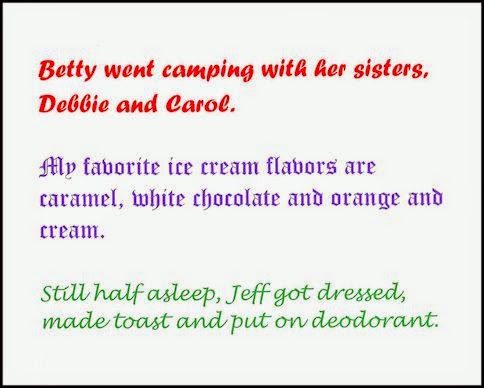
Consider the sentences in the graphic at the head of this post. “Betty went camping with her sisters, Debbie and Carol” could mean that there were at least five people on the camping trip: Betty, two or more of her sisters, Debbie, and Carol. Or it could mean that there were three people: Betty and her two sisters, whose names are Debbie and Carol. If you consistently use the Oxford comma, the reader will know which you mean.

Of course, it is possible to rearrange the sentence to clarify its meaning without using the Oxford comma. If there were five people on the camping trip, you can say,” Betty went camping with Debbie, Carol and Betty’s sisters. But why go to the trouble of rearranging the sentence if you can clarify it by simply adding that last comma?

Or consider this sentence: “My favorite ice cream flavors are caramel, white chocolate and orange and cream.” The use of the extra “and” indicates that one of the flavors has two parts to its name, but is it white chocolate and orange or orange and cream? The use of the Oxford comma clarifies the sentence, making clear that the flavors are either “caramel, white chocolate and orange, and cream” or “caramel, white chocolate, and orange and cream.”

Then there’s the third example. “Still half asleep, Jeff got dressed, made toast and put on deodorant.” Did Jeff put the deodorant on himself or the toast? Grammatically, there is only one way to read the sentence since there wouldn’t be any reason to put a comma after “dressed” unless it were a series of three phrases. So, read correctly, the sentence means that Jeff put the deodorant on himself. But someone who is reading quickly might miss that nicety and read the last two items in the series as one. After all, who knows what Jeff might do when he is half asleep? An Oxford comma before the last phrase in the series slows the reader down and makes the meaning clear.

Although clarity is the first rule of writing, consistency is also important, especially since knowing how someone writes helps the reader find clarity in the writer’s sentences. And because there are times when I need the Oxford comma for clarity, I choose to use it all the time for consistency.

Still, the Oxford comma is technically optional. If you choose not to use it, I won’t unfriend you.

But I will let you know when your sentences are unclear.
__________

This is a revision of a January 12, 2015 post.

Sit Down and Write

Monday, February 15, 2021


As I mentioned at the end of my last post, the number one rule for getting started writing is the cliché, “Just do it.” Most good writers have started out as lousy ones. But what made them good was that they kept going—practicing, welcoming criticism, tossing out the bad and keeping the good. In other words, they work and work and work at improving.

Do I write garbage? Frequently. Is that an excuse to stop writing? No. Here are a few of my favorite quotes from writers who have learned to keep going.

·       “If you don’t allow yourself the possibility of writing something very, very bad, it would be hard to write something very good.” Steven Galloway

·       “It is better to write a bad first draft than to write no first draft at all.” Will Shetterly

·       “You don’t have to be great to get started, but you have to get started to be great.” Les Brown

·       “If you’re going to be a writer, the first essential is just to write. Do not wait for an idea. Start writing something and the ideas will come. You have to turn the faucet on before the water starts to flow.” Louis L’ Amour

Once I’ve written something and tried to polish it a little, the next step is to expose it to other eyes. And I’m not talking about friends and family who will gush over it and tell me how wonderful my work is. The only helpful evaluations are the honest ones, Individual critique partners and critique groups help me hone my writing so that the garbage turns into treasure.

I’ve had an online critique partner for many years. We exchange chapters about three times a week, and she points out many errors I hadn’t noticed. Even better, she provides suggestions that had never crossed my mind.

I also belong to Highland Writers’ Group, a local critique group that used to meet in person three Saturdays a month but moved to Zoom when Covid-19 shut everything down. There are advantages and disadvantages to both venues, but the critiques are the same as always.

A serious writer welcomes all criticism even while separating the wheat from the chaff. Experience has taught me two things about responding to writing critiques. First, if I want to improve my craft, I can’t be sensitive. Second, if I want to improve my craft, I must be sensitive. The definition to avoid is “quick to take offense; touchy.” The one to embrace is “responsive to external conditions or stimulation.”1 If I quickly take offense and discount the criticisms, I don’t learn anything. But if I think about what was said and respond offensively rather than defensively, my writing is better for it. Yes, I do reject some of the suggestions I receive, but not until I have considered them carefully.

And I don’t worry about being embarrassed by the writing I submit to my critique partner or group. I didn’t say I’m never embarrassed, but I bring it even if I am. If it were already perfect, there would be no reason to ask for a critique.

So sit down and write, and then expose your work to other eyes.

__________

1These two definitions of “sensitive” come from the fourth edition of The American Heritage Dictionary of the English Language.


Getting Started Writing

Monday, February 8, 2021


A reader of this blog recently asked me if I had any tips on how to start writing. I’m far from being an expert on the issue, especially since my own success has been extremely modest, but I’m happy to share my own experience.

Conventional wisdom says to start with smaller pieces—magazine articles or short stories—and that’s what I did. I started with non-fiction articles for Christian magazines and published several before attempting my first non-fiction book. And it was years before I expanded into fiction.  

Beyond that, my first major step was to attend writers’ conferences—lots of them. Until this year, I’ve made it a practice to attend at least two writers’ conferences a year, including a multi-day one. That is how I sold my first article, my first devotion, and my first book, which are shown in the photo at the head of this post. But it isn’t all about trying to get a publishing contract. In fact, the main reason I attend writers’ conferences is to improve my craft. I also go to network with other writers, including those who can’t get me a book contract but who have gone through the same things I have. As with everything else, misery loves company. But at writers’ conferences it also provides encouragement.

This year, Covid-19 interfered with my conference plans. Yes, there are online alternatives, and I “attended” several sessions offered by the Society for Children’s Book Writers and Illustrators (SCBWI). It isn’t the same, though, and I pray things will be back to normal soon.

Talking about SCBWI, it is also important to join one or more writers’ associations. In my opinion, anyone who wants to write for children should join SCBWI and take advantage of the many resources on its website—most of which are available to members only. I also belong to the Chicago Writers Association, and it was extremely helpful recently when I looked for beta readers for my murder mystery. I put out a call for help and was flooded with responses.

Both SCBWI and CWA hold in-person conferences in better times and offer online resources now.

I also have an extensive library of craft books. There are significant differences between types of works, and I seek out craft books that focus on what I want to write. Fiction is especially complicated since readers expect to be drawn into the story, and that requires more than just good writing. Here are a few recommendations:

·       On Writing Well by William Zinsser (for nonfiction),

·       How Fiction Works by Oakley Hall (for a quick look at fiction),

·       The books in the Write Great Fiction series from Writer’s Digest Books (for a more in-depth look at the many characteristics of good fiction), and

·       A Writer’s Guide to Crafting Stories for Children by Nancy Lamb.

Learning about writing is extremely important, but you must also apply what you learn. The number one rule for getting started is, to quote a cliché, “Just do it.”

That’s the subject of next week’s post.


My "Citizen Kane" Moment

Monday, June 8, 2020


I’ve been writing a murder mystery, and I am continually reminded of the “Rosebud” incident in the movie Citizen Kane. Everything that appears in the book must have a meaning, but some things can’t be obvious until the end. So how do I insert a crucial bit of information without giving it away? Or, to put my dilemma another way, how do I make an important clue look like it isn’t?

Theoretically, the answer is simple: I can hide it in the text the way the bird in the picture is hidden in the trees. But the execution is more complicated.

In my first draft, I brought up the clue but wrote it so the detectives don’t see how it can be applicable and choose to dismiss it. Even so, I’m worried that it will be too obvious, the way the red on the bird in the first photo makes it easier to pick out.

But if I make it too obscure, my readers will miss it and wonder where it came from when the importance of the clue is revealed. The bird in the second photo blends in so well few of you will find it, and I don’t want to create that kind of frustration in my readers.
How do I find the right balance? I don’t think I’m there yet.

So I’ll keep working on the execution.

Weather as a Story Element

Monday, April 23, 2018


We’ve had some crazy weather lately, and it got me thinking about how writers use weather in their stories. Unfortunately, some writers throw it in as an afterthought or simply because they believe they should. The “rule” (although there are no real rules) is the same as the one for dialogue, where writers attempt to avoid the word “said” by using an action to identify the speaker. An action that conveys the character’s emotion or some other story element is a great substitute. But an action that is there merely to avoid a dialogue tag shouts “lazy attribution” and stands out much more than the simple word “said” does.

Weather is like that, too, even if it is only a bit player. It should be connected to the story. Don’t just put a storm in the story as background description. Make it the reason the protagonist seeks shelter in the store where she meets her true love. Or maybe you use weather to emphasize its opposite. It’s a sunny day outside but a dark day in the protagonist’s heart, so the protagonist feels as if the weather is laughing at her. But in that case its use isn’t obvious, so you need to have the protagonist note the connection for the reader.

Then there is the story where the weather is one of the characters. I’m currently working on a middle-grade novel about the Siege of Vicksburg during the Civil War. The Union forces weren’t the only enemy—the weather was, too. The sun was relentless, and one of my characters gets heat exhaustion. There was almost no rain, and the entire city was in danger of running out of water as well as food. (Yes, I know Vicksburg is on the Mississippi River, but you can’t use it if you can’t get to it.) And the one time that there was a significant rainfall, it made the caves they were living in almost uninhabitable. So I am using all of that in the story.

Don’t just throw weather into your story. Give it a reason to be there.

Or leave it out.

There's Nothing New Under the Sun

Monday, January 26, 2015


My husband had a knee replaced on January 15, and my temporary role as nursemaid is cutting into my writing time. So this week I am reprinting a post I did for the Hoosier Ink blog on  June 27, 2012.
There’s Nothing New Under the Sun
 
The wind was picking up. Watching the approaching gale from her seat in the cockpit, Anne was grateful that Carousel had reached shelter before the storm hit. But as the sailboat’s bare mast bobbed and weaved with the others in the harbor, Anne prayed for the sailors who were still out on Lake Michigan.
 
Notice the opening sentence, which I borrowed from Chi Libris. Chi Libris is a group of well-known Christian novelists that include Angela Hunt and James Scott Bell. The group decided to publish a book of short stories with five shared elements: the same opening sentence, mistaken identity, pursuit at a noted landmark, an unusual form of transportation, and the same last line (“So that’s exactly what she did.”). The plots vary widely, however. In fact, the point of their collection, What the Wind Picked Up, is to show that the same basic idea can generate many diverse stories.
 
That’s one reason you can’t copyright ideas. The idea itself doesn’t make the story. It’s what you do with the idea that counts.
 
But there’s an even more important reason why you can’t copyright ideas. The founding fathers inluded copyright provisions in the Constitution to encourage creative works, not to inhibit them. As Ecclesiastes 1:9 says, “there is nothing new under the sun.” If ideas could be copyrighted, there would be nothing left to write about.
 
Here’s one idea that is frequently found in literature. Two young people fall in love but are kept apart by their feuding families, and the consequences are tragic.
 
You could call Shakespeare’s Romeo and Juliet a case of mistaken identity in 16th Century Verona, Italy. The two protagonists fell in love before discovering who they had fallen in love with.
 
Move the setting to New York City in the 1950s, and you have West Side Story.
 
Then there is the apparently true story of the Hatfields and the McCoys in the Appalachian Mountains during the late 1800s. Their feud escalated after Johnse Hatfield began courting Roseanne McCoy, and Johnse’s family had to rescue him from the angry McCoy men. Did Johnse escape on a horse or use some other form of transportation that we would consider unusual today?
 
Or travel back to even earlier times. Legend tells of two Native American lovers from rival tribes. When their chiefs forbade their marriage, the lovers swore that if they couldn’t live together they would die together. Fleeing from their families, they embraced each other and jumped off the landmark now known as Lover’s Leap in Illinois’ Starved Rock State Park.
 
All of these stories use the same basic plot idea, and one (West Side Story) is still under copyright.
 
Now think of all the contemporary authors who have used that same plot idea. If you could copyright an idea, those stories wouldn’t exist.
 
Let’s look at another example.
 
Miss Read (pen name for Dora Saint) has written multiple books about everyday village life in England. While these books tend to have a main character, they center around an ensemble cast of ordinary, and mostly likeable, village residents.
 
Does that remind you of a series by a popular American authoress?
 
When I read Jan Karon’s first Mitford book, I immediately thought of Miss Read and her Fairacre/Thrush Green books. It isn’t that the writing style is similar—it isn’t—or that the authors tell the same stories—they don’t. But their books have a common theme.
 
I don’t know if Jan Karon read Miss Read’s books before writing her own. For the sake of my point, however, let’s assume she did. And let’s also assume Jan Karon knew she could use the same idea without violating copyright law.
 
So that’s exactly what she did.

And the Winner Is . . .

Monday, January 19, 2015


Just over a month ago I wrote a blog post pondering several ideas for my next novel. I finally picked one and have already started the research.
So what did I choose? I was leaning toward writing another middle grade historical novel, and that's what I decided to do. This one will tell the story of a Native American girl who leaves the reservation at the turn of the last century to be “civilized” at an Indian Boarding School.

I chose this topic for several reasons.

  • There is enough good research information out there to create a realistic story.
  • The topic has not been overdone. In fact, it has rarely been covered at all, with few middle grade books on the subject.
  • This is another instance of American injustice that middle graders don’t know about but should.

One more reason: I love learning about new cultures. This way I get to do it while “at work” writing.
And what could be better than that?

__________
The picture at the head of this post shows the students at the Carlisle Indian Industrial School in Carlisle, Pennsylvania around 1890. It is in the public domain because of its age.


The Oxford Comma: A Matter of Clarity

Monday, January 12, 2015


Am I a grammar nerd? Yes and no. I believe that everyone should know the grammar rules, but I also think it is okay to break them if there is a reason. Ignorance, laziness, or just plain eccentricity aren’t good reasons. (I’m not a fan of E.E. Cummings.) Emphasis, timing, and readability are. And if a reader will think me pretentious for using “whom,” I’ll use “who” instead.
But grammar nerd or not, I’m a fan of the Oxford comma.
For those of you who don’t know what the Oxford comma is, it’s the comma that comes before the conjunction (usually “and” or “or”) that introduces the end of a series. For example, this sentence uses an Oxford comma: “The American flag is red, white, and blue.” This one doesn’t: “The American flag is red, white and blue.” It’s called the Oxford comma because Oxford University’s stylebook says to put it in. (It is also called the Harvard comma, for a similar reason, or the serial comma.) Why does it matter whether a writer uses it? I’ll explain in a minute.
First, though, I’ll tell you why I’m writing about it now.
I have an online critique partner who doesn’t use the Oxford comma. Grammatically, use of the Oxford comma is optional, so I grit my teeth and defer to her style choice. Then she sent me a chapter where she actually stuck one in, and it wasn’t needed for clarity. Although it killed me to do it, I took it out for consistency. But her use prompted me to write this blog.
The first rule of writing is clarity, and that’s why grammar rules exist. There are many times when a sentence is clear with or without the Oxford comma. “The American flag is red, white and blue” is an example. On the other hand, it is easy to write a sentence where the absence of the Oxford comma creates ambiguity. If that’s intentional, fine, but it usually isn’t.
Consider the sentences in the graphic at the head of this post. “Betty went camping with her sisters, Debbie and Carol” could mean that there were at least five people on the camping trip: Betty, two or more sisters, Debbie, and Carol. Or it could mean that there were three people: Betty and her two sisters, whose names are Debbie and Carol. If you consistently use the Oxford comma, the reader will know which you mean.
It is possible to rearrange the sentence to clarify its meaning without using the Oxford comma. If there were five people on the camping trip, you can say, “Betty went camping with Debbie, Carol, and Betty’s sisters.” But if there were three people on the camping trip, you may have to say “her two sisters, Debbie and Carol.” If you rarely or never use the Oxford comma, the phrase is still ambiguous.
Or consider this sentence: “My favorite ice cream flavors are caramel, white chocolate and orange and cream.” The use of the extra “and” indicates that one of the flavors has two parts to its name, but is it white chocolate and orange or orange and cream? The use of the Oxford comma clarifies the sentence, making clear that the flavors are either “caramel, white chocolate and orange, and cream” or “caramel, white chocolate, and orange and cream.
Then there’s the third example. “Still half asleep, Jeff got dressed, made toast and put on deodorant.” Did Jeff put the deodorant on himself or the toast? Grammatically, there is only one way to read the sentence. If it weren’t a series of three, there would be no reason to put a comma after “dressed.” So, read correctly, the sentence means that Jeff put the deodorant on himself. But someone who is reading quickly might miss that nicety and read the last two items in the series as one. After all, who knows what Jeff might do when he is half asleep? An Oxford comma slows the reader down and makes the meaning clear.
Although clarity is the first rule of writing, consistency is also important, especially since knowing how someone writes helps the reader find clarity in the sentence. And because there are times when I need the Oxford comma for clarity, I chose to use it all the time for consistency.
Still, the Oxford comma is technically optional. If you choose not to use it, I won’t unfriend you.
But I will let you know when your sentences are unclear.

The Importance of Interviews

Monday, January 5, 2015


In November I had the privilege of interviewing a Japanese American couple who were incarcerated (separately) by the U.S. government during World War II. I wanted to write about it then but was waiting for permission to use a photograph of Chiyo’s family taken by a Time Life photographer at the Heart Mountain War Relocation Center. Unfortunately, I never received a response to my e-mail. So the photograph at the head of this post shows a family I don’t know and is included merely for ambiance.
As I researched my middle-grade historical novel about the Japanese American incarceration, I read a number of memoirs and spoke very briefly with one or two people who had been in the camps, but I did not have the opportunity to interview anyone in depth. Then, while we were on a research trip actually visiting the sites in my book, our local newspaper published an article about a Korean War veteran who was willing to serve his country even though he had been incarcerated as a teenager. Friends helped me connect with him, and I discovered that Ken’s wife had also been incarcerated, but in a different camp. (They met after their release.)
I talked to Ken for a short time but spent most of the day with Chiyo.
In the book, my protagonist is incarcerated at Topaz in Utah. Ken was at Gila River in Arizona, and Chiyo was at Heart Mountain in Wyoming. But even though the settings were different, the experiences were similar. Well, not completely. As with anything, personality colors experience.

Ken’s passion was cars, and the only vehicles at Gila River were the trucks owned by the administration. He was in high school but didn’t get involved in sports or other activities. So except for the summer he spent riding around with the garbage men, he felt that his stay at Gila River was wasted time.
Chiyo had a different experience. She has an outgoing personality and enjoyed the dances and other activities at Heart Mountain. She also loved ice-skating, and Heart Mountain had long winters. So Chiyo enjoyed her time there.
In many ways, the interview simply confirmed what I had already learned from other sources. But it was invaluable because it gave me a stronger sense of the people involved. Not that I didn’t get some of that from the memoirs I read, but there is nothing like sitting across from a living person and listening to his or her stories.
It isn’t always possible for a writer to interview people who have been through the events depicted in a historical novel, especially if everyone is long dead. But if you have the opportunity, take it.
Because your story will be better if you do.
__________

The photograph at the head of this post shows the Shikano family and was taken at the Central Utah War Relocation Center (Topaz) on January 3, 1945. Charles E. Mace took the picture as part of his official duties as an employee of the United States government. Because it is a government document, the photo is in the public domain.

Too Many Ideas

Monday, December 15, 2014

Writers can be classified in a number of ways. One is to separate those with not enough ideas from those with too many. I fall in the later camp, and it isn’t always a good thing.

Now that my current work is in the final stages, I’m looking for my next book. I have six ideas for novels: three for contemporary women’s fiction and three for middle grade historicals. I’ve also got other ideas percolating farther back in the cue. So how do I choose?
First, there is the genre: should I go for contemporary women’s fiction or a middle grade historical novel? Writing for the middle grades is harder than writing for adults, but I also enjoy it more. So that’s the way I’m leaning right now.
But selecting the genre is only the beginning. As I said, I have three ideas for middle grade historicals, and they are represented in the pictures above. The top picture shows the students at Carlisle Indian Industrial School around 1990. Although I probably would set the book at a fictitious boarding school, it would tell the story of the Native American students who were taken from their homes to be “Americanized,” or, as Captain Richard Henry Pratt put it, to “kill the Indian and save the man.”
The picture at the bottom left shows the first class dining saloon aboard the RMS Lusitania before the ship was sunk by the Germans in World War I. The story would be about a girl on a sinking ocean liner. It might be the Lusitania, or it might be the Andrea Doria. Not the Titanic, though. That’s been done more than enough times.
The final picture shows the corner of Dearborn and Monroe streets after the Great Chicago Fire of 1871. The story would show the protagonist’s life before, during, and after the fire, with the bulk of it centering on her escape from the flames.
All three of these historical events have potential because there is sufficient information on them to create a realistic story. And that’s important to me. Research is my middle name and accuracy is my claim to fame.
Too many ideas can cause complications. But I’d rather have that problem than the opposite one.
__________

The pictures at the head of this post are in the public domain because of their age.

Writing is Hard Work

Monday, December 8, 2014


Good writing is hard work. Sometimes the words flow easily, and sometimes they don’t. But even when they do, they usually require a lot of editing. Here are a few quotes from established writers.
“Writing is the hardest work in the world. I have been a bricklayer and a truck driver, and I tell you – as if you haven’t been told a million times already – that writing is harder. Lonelier. And nobler and more enriching.” Harlan Ellison 

“I would never encourage anyone to be a writer. It’s too hard.” Eudora Welty 

“A writer is a person for whom writing is more difficult than it is for other people.”Thomas Mann, Essays of Three Decades, 1947 

My church holds a women’s Advent Tea every two years, and each table has a hostess who decorates it and provides the dishes. One of the fun things about the event is the table viewing before lunch is served. Some of the tables are elegant and others are whimsical, but all have either an Advent, a Christmas, or a winter theme.
The first time I acted as a hostess, I used children’s books about Christmas for my theme. Last time I used lighthouses, inspired by a poem I had already written. The tie-in there was easy, because Jesus is the light who came at Christmas.
I’m a serious amateur photographer, and I looked through my pictures to see what I could use this year. Although I have photos of Christmas displays and family dinners, none of them struck a chord. I’m not sure why, but it was my seasonal photography that caught my attention. So I decided to use the four seasons as my theme.
But how could I tie that to Advent? I knew how it fit, but would the people viewing the table figure it out? I wasn’t sure, so I decided to spell it out in a poem.

That’s where the hard work began.

At first it flowed well enough. And after I got a couple of verses to a point where I was happy with them, I realized that each one had a 5-7-4 pattern: five syllables in the first line, seven in the second, and four in the third.*

But then I started writing the verse about winter, and nothing seemed to work. Either the wording was clunky or dull or the syllable count was off. After a lot of reflection, thesaurus work, and wording changes, I finally came up with a winter stanza that I thought I could live with. It went like this:

He comes in winter
Among barren gray branches
Appearing dead.

Then I sent the poem off to my online critique partner. She though that stanza was too negative to fit the general tone of the poem. She made a similar comment about one of the words in the autumn verse, but the reference to blood was intended to remind us of Christ’s sacrifice, so I left it.

I had never been happy with my winter verse, however, so I went back to work trying to come up with something better.

Here is the finished poem. It isn’t a masterpiece, but it served its purpose. You can decide for yourself whether my hard work paid off.

He Comes 

He comes in summer
In thunderstorms and showers
Cleansing the earth. 

He comes in autumn
When trees proclaim his glory
With blood-red leaves. 

He comes in winter
As white blankets cover seeds
Soon to awake. 

He comes in spring
When a tiny robin’s egg
Brings forth new life. 

Jesus comes all year
Into the hearts of Christians
Saved by His grace. 

__________

* There is one exception to the 5-7-4 pattern. Each stanza starts with “Jesus comes in [season].” Since “spring” has only one syllable, that line has four instead of five. I chose to sacrifice the syllable count to retain the wording repetition.