There's Nothing New Under the Sun

Monday, January 26, 2015


My husband had a knee replaced on January 15, and my temporary role as nursemaid is cutting into my writing time. So this week I am reprinting a post I did for the Hoosier Ink blog on  June 27, 2012.
There’s Nothing New Under the Sun
 
The wind was picking up. Watching the approaching gale from her seat in the cockpit, Anne was grateful that Carousel had reached shelter before the storm hit. But as the sailboat’s bare mast bobbed and weaved with the others in the harbor, Anne prayed for the sailors who were still out on Lake Michigan.
 
Notice the opening sentence, which I borrowed from Chi Libris. Chi Libris is a group of well-known Christian novelists that include Angela Hunt and James Scott Bell. The group decided to publish a book of short stories with five shared elements: the same opening sentence, mistaken identity, pursuit at a noted landmark, an unusual form of transportation, and the same last line (“So that’s exactly what she did.”). The plots vary widely, however. In fact, the point of their collection, What the Wind Picked Up, is to show that the same basic idea can generate many diverse stories.
 
That’s one reason you can’t copyright ideas. The idea itself doesn’t make the story. It’s what you do with the idea that counts.
 
But there’s an even more important reason why you can’t copyright ideas. The founding fathers inluded copyright provisions in the Constitution to encourage creative works, not to inhibit them. As Ecclesiastes 1:9 says, “there is nothing new under the sun.” If ideas could be copyrighted, there would be nothing left to write about.
 
Here’s one idea that is frequently found in literature. Two young people fall in love but are kept apart by their feuding families, and the consequences are tragic.
 
You could call Shakespeare’s Romeo and Juliet a case of mistaken identity in 16th Century Verona, Italy. The two protagonists fell in love before discovering who they had fallen in love with.
 
Move the setting to New York City in the 1950s, and you have West Side Story.
 
Then there is the apparently true story of the Hatfields and the McCoys in the Appalachian Mountains during the late 1800s. Their feud escalated after Johnse Hatfield began courting Roseanne McCoy, and Johnse’s family had to rescue him from the angry McCoy men. Did Johnse escape on a horse or use some other form of transportation that we would consider unusual today?
 
Or travel back to even earlier times. Legend tells of two Native American lovers from rival tribes. When their chiefs forbade their marriage, the lovers swore that if they couldn’t live together they would die together. Fleeing from their families, they embraced each other and jumped off the landmark now known as Lover’s Leap in Illinois’ Starved Rock State Park.
 
All of these stories use the same basic plot idea, and one (West Side Story) is still under copyright.
 
Now think of all the contemporary authors who have used that same plot idea. If you could copyright an idea, those stories wouldn’t exist.
 
Let’s look at another example.
 
Miss Read (pen name for Dora Saint) has written multiple books about everyday village life in England. While these books tend to have a main character, they center around an ensemble cast of ordinary, and mostly likeable, village residents.
 
Does that remind you of a series by a popular American authoress?
 
When I read Jan Karon’s first Mitford book, I immediately thought of Miss Read and her Fairacre/Thrush Green books. It isn’t that the writing style is similar—it isn’t—or that the authors tell the same stories—they don’t. But their books have a common theme.
 
I don’t know if Jan Karon read Miss Read’s books before writing her own. For the sake of my point, however, let’s assume she did. And let’s also assume Jan Karon knew she could use the same idea without violating copyright law.
 
So that’s exactly what she did.

And the Winner Is . . .

Monday, January 19, 2015


Just over a month ago I wrote a blog post pondering several ideas for my next novel. I finally picked one and have already started the research.
So what did I choose? I was leaning toward writing another middle grade historical novel, and that's what I decided to do. This one will tell the story of a Native American girl who leaves the reservation at the turn of the last century to be “civilized” at an Indian Boarding School.

I chose this topic for several reasons.

  • There is enough good research information out there to create a realistic story.
  • The topic has not been overdone. In fact, it has rarely been covered at all, with few middle grade books on the subject.
  • This is another instance of American injustice that middle graders don’t know about but should.

One more reason: I love learning about new cultures. This way I get to do it while “at work” writing.
And what could be better than that?

__________
The picture at the head of this post shows the students at the Carlisle Indian Industrial School in Carlisle, Pennsylvania around 1890. It is in the public domain because of its age.


The Oxford Comma: A Matter of Clarity

Monday, January 12, 2015


Am I a grammar nerd? Yes and no. I believe that everyone should know the grammar rules, but I also think it is okay to break them if there is a reason. Ignorance, laziness, or just plain eccentricity aren’t good reasons. (I’m not a fan of E.E. Cummings.) Emphasis, timing, and readability are. And if a reader will think me pretentious for using “whom,” I’ll use “who” instead.
But grammar nerd or not, I’m a fan of the Oxford comma.
For those of you who don’t know what the Oxford comma is, it’s the comma that comes before the conjunction (usually “and” or “or”) that introduces the end of a series. For example, this sentence uses an Oxford comma: “The American flag is red, white, and blue.” This one doesn’t: “The American flag is red, white and blue.” It’s called the Oxford comma because Oxford University’s stylebook says to put it in. (It is also called the Harvard comma, for a similar reason, or the serial comma.) Why does it matter whether a writer uses it? I’ll explain in a minute.
First, though, I’ll tell you why I’m writing about it now.
I have an online critique partner who doesn’t use the Oxford comma. Grammatically, use of the Oxford comma is optional, so I grit my teeth and defer to her style choice. Then she sent me a chapter where she actually stuck one in, and it wasn’t needed for clarity. Although it killed me to do it, I took it out for consistency. But her use prompted me to write this blog.
The first rule of writing is clarity, and that’s why grammar rules exist. There are many times when a sentence is clear with or without the Oxford comma. “The American flag is red, white and blue” is an example. On the other hand, it is easy to write a sentence where the absence of the Oxford comma creates ambiguity. If that’s intentional, fine, but it usually isn’t.
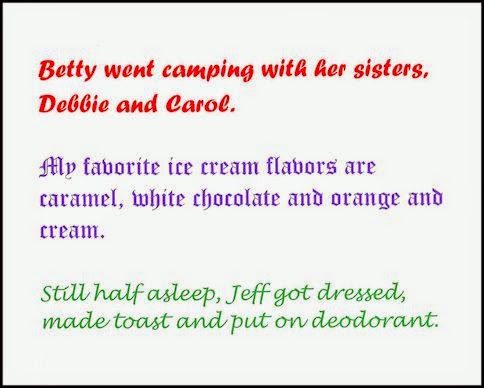
Consider the sentences in the graphic at the head of this post. “Betty went camping with her sisters, Debbie and Carol” could mean that there were at least five people on the camping trip: Betty, two or more sisters, Debbie, and Carol. Or it could mean that there were three people: Betty and her two sisters, whose names are Debbie and Carol. If you consistently use the Oxford comma, the reader will know which you mean.
It is possible to rearrange the sentence to clarify its meaning without using the Oxford comma. If there were five people on the camping trip, you can say, “Betty went camping with Debbie, Carol, and Betty’s sisters.” But if there were three people on the camping trip, you may have to say “her two sisters, Debbie and Carol.” If you rarely or never use the Oxford comma, the phrase is still ambiguous.
Or consider this sentence: “My favorite ice cream flavors are caramel, white chocolate and orange and cream.” The use of the extra “and” indicates that one of the flavors has two parts to its name, but is it white chocolate and orange or orange and cream? The use of the Oxford comma clarifies the sentence, making clear that the flavors are either “caramel, white chocolate and orange, and cream” or “caramel, white chocolate, and orange and cream.
Then there’s the third example. “Still half asleep, Jeff got dressed, made toast and put on deodorant.” Did Jeff put the deodorant on himself or the toast? Grammatically, there is only one way to read the sentence. If it weren’t a series of three, there would be no reason to put a comma after “dressed.” So, read correctly, the sentence means that Jeff put the deodorant on himself. But someone who is reading quickly might miss that nicety and read the last two items in the series as one. After all, who knows what Jeff might do when he is half asleep? An Oxford comma slows the reader down and makes the meaning clear.
Although clarity is the first rule of writing, consistency is also important, especially since knowing how someone writes helps the reader find clarity in the sentence. And because there are times when I need the Oxford comma for clarity, I chose to use it all the time for consistency.
Still, the Oxford comma is technically optional. If you choose not to use it, I won’t unfriend you.
But I will let you know when your sentences are unclear.

The Importance of Interviews

Monday, January 5, 2015


In November I had the privilege of interviewing a Japanese American couple who were incarcerated (separately) by the U.S. government during World War II. I wanted to write about it then but was waiting for permission to use a photograph of Chiyo’s family taken by a Time Life photographer at the Heart Mountain War Relocation Center. Unfortunately, I never received a response to my e-mail. So the photograph at the head of this post shows a family I don’t know and is included merely for ambiance.
As I researched my middle-grade historical novel about the Japanese American incarceration, I read a number of memoirs and spoke very briefly with one or two people who had been in the camps, but I did not have the opportunity to interview anyone in depth. Then, while we were on a research trip actually visiting the sites in my book, our local newspaper published an article about a Korean War veteran who was willing to serve his country even though he had been incarcerated as a teenager. Friends helped me connect with him, and I discovered that Ken’s wife had also been incarcerated, but in a different camp. (They met after their release.)
I talked to Ken for a short time but spent most of the day with Chiyo.
In the book, my protagonist is incarcerated at Topaz in Utah. Ken was at Gila River in Arizona, and Chiyo was at Heart Mountain in Wyoming. But even though the settings were different, the experiences were similar. Well, not completely. As with anything, personality colors experience.

Ken’s passion was cars, and the only vehicles at Gila River were the trucks owned by the administration. He was in high school but didn’t get involved in sports or other activities. So except for the summer he spent riding around with the garbage men, he felt that his stay at Gila River was wasted time.
Chiyo had a different experience. She has an outgoing personality and enjoyed the dances and other activities at Heart Mountain. She also loved ice-skating, and Heart Mountain had long winters. So Chiyo enjoyed her time there.
In many ways, the interview simply confirmed what I had already learned from other sources. But it was invaluable because it gave me a stronger sense of the people involved. Not that I didn’t get some of that from the memoirs I read, but there is nothing like sitting across from a living person and listening to his or her stories.
It isn’t always possible for a writer to interview people who have been through the events depicted in a historical novel, especially if everyone is long dead. But if you have the opportunity, take it.
Because your story will be better if you do.
__________

The photograph at the head of this post shows the Shikano family and was taken at the Central Utah War Relocation Center (Topaz) on January 3, 1945. Charles E. Mace took the picture as part of his official duties as an employee of the United States government. Because it is a government document, the photo is in the public domain.

Naughty or Nice?

Monday, December 29, 2014


For the past few weeks, I’ve been reading comics and listening to songs that imply we have to be nice if we want Santa to bring us gifts. If we’re naughty, we’ll get that lump of coal instead.
Some children may believe that, but parents know better. How many of us have actually withheld Christmas gifts just because our son or daughter was a terror all year?
The picture at the head of this post shows the Christmas I got my dollhouse. It was metal with a front door that opened, a doorbell that actually rang, and a stairway cut out at the top so that the dolls who lived there could move from one floor to the other without having to go through the open back. I also had plastic furniture sized just right. For my parents, it was an extravagance, as was the barn set given to one of my brothers. And we were not perfect children, so I’m sure we didn’t earn them.
That’s the point. The gifts we get from “Santa” are just that—gifts, not wages. Parents give their children gifts because they love them, not because the children earned them.
Our Father’s gift to us works the same way. We can’t earn our way into heaven. Salvation is a gift, given through the birth and death of God’s own Son.
That doesn’t mean the intended recipient always appreciates the gift. You may refuse those pink bunny pajamas from Aunt Clara even though they were given with love.* God allows us to reject His gift, too.
Don’t get me wrong. Just because there are no strings attached to a gift doesn’t mean it’s okay to be naughty. Children who know they are loved try to please their parents. Being children, they fail sometimes. Christians respond to God’s love by trying to serve him. Being sinners, we fail sometimes. But the act of trying is how we respond to the gift, not how we “earn” it.
This Christmas season, I pray that you will open the greatest gift of all.  
__________

* This is a reference from A Christmas Story. The analogy isn’t perfect since Ralphie’s parents made him accept the gift, but you get the point.


A Lasting Impression

Monday, December 22, 2014


As a writer, I want to make a lasting impression. I’m not in it for the fame (although I wouldn’t object to it), but I do want people to remember my stories fifty years after they first read them.
I want to be Raymond MacDonald Alden.
That name probably doesn’t mean anything to you. I had forgotten the author’s name, but I’ll never forget the book he wrote.
The writing style and long paragraphs are not popular today, but the story is timeless. I’m reprinting it as my Christmas present to you.
Why the Chimes Rang
by Raymond MacDonald Alden
            There was once, in a faraway country where few people have ever traveled, a wonderful church. It stood on a high hill in the midst of a great city; and every Sunday, as well as sacred days like Christmas, thousands of people climbed the hill to its great archways, looking like lines of ants all moving in the same direction.
            When you came to the building itself, you found stone columns and dark passages, and a grand entrance leading to the main room of the church. This room was so long that one standing in the doorway could scarecly see the other end, where the choir stood by the marble altar. In the farthest corner was the organ; and this organ was so loud, that sometimes when it played, the people for miles around closed their shutters and prepared for a great thunderstorm. Altogether, no such chuch as this was ever seen before, especially when it was lighted up for some festival, and crowded with people, young and old. But the strangest thing about the whole building was the wonderful chime of bells.
            At one corner of the church was a great gray tower, with ivy growing over it as far as one could see. I say as far as one could see, because the tower was quite great enough to fit the great church, and it rose so far into the sky that it was only in very fair weather that any one claimed to be able to see the top. Even then one could not be certain that it was in sight. Up, and up, and up climbed the ivy; and, as the men who built the church had been dead for hundreds of years, every one had forgotten how high the tower was supposed to be.
            Now all the people knew that at the top of the tower was a chime of Christmas bells. They had hung there ever since the church had been built, and were the most beautiful bells in the world. Some thought it was because a great musician had cast them in their place; others said it was because of the great height, which reached up where the air was clearest and purest: however that might be, no one who had ever heard the chimes denied that they were the sweetest in the world. Some described them as sounding like angels far up in the sky; others, as sounding like strange winds singing through the trees.
            But the fact was that no one had heard them for years and years. There was an old man living not far from the church, who said that his mother had spoken of hearing them when she was a little girl, and he was the only one who was sure of as much as that. They were Christmas chimes, you see, and were not meant to be played by men or on common days. It was the custom on Christmas Eve for all the people to bring to the church their offerings to the Christ-child; and when the greatest and best offering was laid on the altar, there used to come sounding through the music of the choir the Christmas chimes far up in the tower. Some said that the wind rang them, and others that they were so high that the angels could set them swinging. But for many long years they had never been heard. It was said that people had been growing less careful of their gifts for the Christ-child, and that no offering was brought, great enough to deserve the music of the chimes.
            Every Christmas Eve the rich people still crowded to the altar, each one trying to bring some better gift than any other, without giving anything that he wanted for himself, and the church was crowded with those who thought that perhaps the wonderful bells might be heard again. But although the service was splendid, and the offerings plenty, only the roar of the wind could be heard, far up in the stone tower.
            Now, a number of miles from the city, in a little country village, where nothing could be seen of the great church but glimpses of the tower when the weather was fine, lived a boy named Pedro, and his little brother. They knew very little about the Christmas chimes, but they had heard of the service in the church on Christmas Eve, and had a secret plan, which they had often talked over when by themselves, to go see the beautiful celebration.
            “Nobody can guess, Little Brother,” Pedro would say, “all the fine things there are to see and hear; and I have even heard it said that the Christ-child sometimes comes down to bless the service. What if we could see Him?”
            The day before Christmas was bitterly cold, with a few lonely snowflakes flying in the air, and a hard white crust on the ground. Sure enough, Pedro and Little Brother were able to slip quietly away early in the afternoon; and although the walking was hard in the frosty air, before nightfall they had trudged so far, hand in hand, that they saw the lights of the big city just ahead of them. Indeed, they were about to enter one of the great gates in the wall that surrounded it, when they saw something dark on the snow near their path, and stepped aside to look at it.
            It was a poor woman, who had fallen just outside the city, too sick and tired to get in where she might have found shelter. The soft snow made of a drift a sort of a pillow for her, and she would soon be so sound asleep, in the wintry air, that no one could ever waken her again. All this Pedro saw in a moment, and he knelt down beside her and tried to rouse her, even tugging at her arm a little, as though he would have tried to carry her away. He turned her face toward him, so he could rub some of the snow on it, and when he had looked at her silently for a moment he stood up again, and said:
            “It’s no use, Little Brother. You will have to go on alone.”
            “Alone?” cried little Brother. “And you not see the festival?”
            “No,” said Pedro, and he could not keep back a bit of a choking sound in his throat. “See this poor woman? Her face looks like the Madonna in the chapel window, and she will freeze to death if nobody cares for her. Every one has gone to the church now, but when you come back you can bring some one to help her. I will rub her to keep her from freezing, and perhaps get her to eat the bun that is left in my pocket.”
            “But I can not bear to leave you, and go on alone,” said Little Brother.
            “Both of us need not miss the service,” said Pedro, “and it had better be I than you. You can easily find your way to the church; and you must see and hear everything twice, Little Brother—once for you and once for me. I am sure the Christ-child must know how I should love to come with you and worship Him; and oh! if you get a chance, Little Brother, to slip up to the altar without getting in any one’s way, take this little piece of silver of mine, and lay it down for my offering, when no one is looking. Do not forget where you have left me, and forgive me for not going with you.”
            In this way he hurried Little Brother off to the city, and winked hard to keep back the tears, as he heard the crunching footsteps sounding farther and farther away in the twilight. It was pretty hard to lose the music and splendor of the Christmas celebration that he had been planning for so long, and spend the time instead in that lonely place in the snow.
            The great church was a wonderful place that night. Every one said that it had never looked so bright and beautiful before. When the organ played and the thousands of people sang, the walls shook with the sound, and little Pedro, away outside the city wall, felt the earth tremble around him.
            At the close of the service came the procession with the offerings to be laid on the altar. Rich men and great men marched proudly up to lay down their gifts to the Christ-child. Some brought wonderful jewels, some baskets of gold so heavy they could scarcely carry them down the aisle. A great writer laid down a book that he had been making for years and years. And last of all walked the king of the country, hoping with all the rest to win for himself the chime of the Christmas bells. There went a great murmur through the church, as the people saw the king take from his head the royal crown, all set with precious stones and lay it gleaming on the altar, as his offering to the holy Child. “Surely,” everyone said, “we shall hear the bells now, for nothing like this has ever happened before.”
            But still only the cold old wind was heard in the tower, and the people shook their heads; and some of them said, as they had before, that they never really believed the story of the chimes, and doubted if they ever rang at all.
            The procession was over, and the choir began the closing hymn. Suddenly the organist stopped playing as though he had been shot, and every one looked at the old minister, who was standing by the altar, holding up his hand for silence. Not a sound could be heard from any one in the church, but as all the people strained their ears to listen, there came distinctly, swinging through the air, the sound of the chimes in the tower. So far away, and yet so clear the music seemed—so much sweeter were the notes than anything that had ever been heard before, rising and falling away up there in the sky, that the people in the church sat there for a moment as still as though something held each of them by the shoulders. Then they all stood up together and stared at the altar, to see what great gift had awakened the long-silent bells.
            But all that the nearest of them saw was the childish figure of Little Brother, who had crept softly down the aisle when no one was looking, and had laid Pedro’s little piece of silver on the altar.
__________

Why the Chimes Rang was first published in 1909, and the picture at the top of this post is one of the original illustrations by Mayo Bunker. Both the story and the illustration are in the public domain because of their age.

Too Many Ideas

Monday, December 15, 2014

Writers can be classified in a number of ways. One is to separate those with not enough ideas from those with too many. I fall in the later camp, and it isn’t always a good thing.

Now that my current work is in the final stages, I’m looking for my next book. I have six ideas for novels: three for contemporary women’s fiction and three for middle grade historicals. I’ve also got other ideas percolating farther back in the cue. So how do I choose?
First, there is the genre: should I go for contemporary women’s fiction or a middle grade historical novel? Writing for the middle grades is harder than writing for adults, but I also enjoy it more. So that’s the way I’m leaning right now.
But selecting the genre is only the beginning. As I said, I have three ideas for middle grade historicals, and they are represented in the pictures above. The top picture shows the students at Carlisle Indian Industrial School around 1990. Although I probably would set the book at a fictitious boarding school, it would tell the story of the Native American students who were taken from their homes to be “Americanized,” or, as Captain Richard Henry Pratt put it, to “kill the Indian and save the man.”
The picture at the bottom left shows the first class dining saloon aboard the RMS Lusitania before the ship was sunk by the Germans in World War I. The story would be about a girl on a sinking ocean liner. It might be the Lusitania, or it might be the Andrea Doria. Not the Titanic, though. That’s been done more than enough times.
The final picture shows the corner of Dearborn and Monroe streets after the Great Chicago Fire of 1871. The story would show the protagonist’s life before, during, and after the fire, with the bulk of it centering on her escape from the flames.
All three of these historical events have potential because there is sufficient information on them to create a realistic story. And that’s important to me. Research is my middle name and accuracy is my claim to fame.
Too many ideas can cause complications. But I’d rather have that problem than the opposite one.
__________

The pictures at the head of this post are in the public domain because of their age.