


Ojibwe or Chippewa?

Monday, February 23, 2015


I am currently researching my next book, which will be about a Native American girl attending an Indian boarding school in 1895.* As I mentioned last week, the protagonist is from the Chippewa tribe. I grew up in Chippewa country in Michigan’s Upper Peninsula, so that seemed to be a natural choice.

That isn’t the end of the matter, however. The tribe goes by several names, so what should I call it? In earlier centuries, the members called themselves Anishinaabe, which means “original people.” Others referred to them as Ojibwa or Ojibwe or Ojibway. This may mean “people who make pictographs” (because they passed down tribal history using birch bark pictographs as well as through storytelling) or “puckered” (based on the style of moccasin they wore). Then the English came along and Anglicized it to Chippewa.**

Both Ojibwa (and its variations) and Chippewa are frequently used today, but Chippewa appears to be predominant in the names of the tribal organizations across the upper Midwest. It’s also easier for my middle grade readers to pronounce, so I have chosen to identify my protagonist as a member of the Chippewa tribe.

And because I don’t have enough information to set the first part on a specific reservation, I’m creating a generic one called the Chippewa Indian Reservation.

I also have to create a generic boarding school, and I decided to call it Dewmist Indian Boarding School. Can you guess how I came up with that name?

Find out in next week’s post.

__________

*My reference to Indian boarding schools is not meant to be insensitive or politically incorrect. That is simply what these schools have been called throughout history. In fact, the word “Indian” is in the name of most, if not all, of them.

** This information comes from several sources, but the primary one is The Chippewas of Lake Superior by Edmund Jefferson Danziger, Jr.

__________

The photo shows an Ojibwa family in front of their wigwam around 1860. It is part of the Minnesota Historical Society’s collection and is in the public domain because of its age.
The Name Game

Monday, February 16, 2015


People ask how I come up with names for my characters. I don’t always use the same method, so it’s easiest to explain by using examples.

When I started writing Desert Jewels, my protagonist’s name was Martha. I chose it because it matched the picture I had in my head. However, she refers to her mother—the other main character—as Mama. My online critique partner said that the two “M” names had her confusing the characters. Since Mama is of Swedish descent, I decided to keep that and change my protagonist’s name. I tried Ellen, then Jane, and neither felt right. I ended up with Emi, which is a Japanese name that is easy for English-speakers to pronounce. My protagonist is half Japanese, and her ethnic background is the basis for the story, so it worked perfectly.

Now I’ve started my next book, which I have tentatively titled Creating Esther. The main character is a Native American girl from the Chippewa tribe. She goes to an Indian boarding school in 1895, where they try to “civilize” her by giving her a traditionally white name. So for this protagonist I need two first names—a Chippewa name and a “white” name.

One way that superintendents and teachers chose white names was to compile a list of names from the Bible and assign the next one. Running through some Biblical names in my head, I settled on “Esther” because it just sounded right. Also, by the end of the book she will have made some decisions that put her on the path to saving her people, as the original Esther did. Of course, my Esther will do it less dramatically and as one of many forces that work together, but I like the concept.

Coming up with a Chippewa name is more challenging. I went on one of those baby naming websites and looked for Chippewa girls’ names. I like Keezheekoni because it supposedly means “burning fire,” and my protagonist has a fiery temperament. However, using the sources I found, it appears to be hard to pronounce.

There’s another problem. While most of the baby name sources list it as a Chippewa name, a couple list it as Cheyenne. And I can’t find any of its roots in A Concise Dictionary of Minnesota Ojibwe. (Ojibwe and Chippewa are two names for the same tribe. More about that in next week’s post.) Of course, there are many different dialects, and my protagonist is more likely to come from Michigan than from Minnesota. Also, Chippewa was originally a spoken language with no written equivalent, and the people who tried to write it down used various spellings. For example, in Red World and White: Memories of a Chippewa Boyhood, author John Rogers says that his new baby brother was named Ahmeek, meaning beaver. The Concise Dictionary cited above spells beaver a-m-i-k. And the pronunciation guides give those spellings different pronunciations.

So am I going to name my protagonist Keezheekoni? I’ll start there, but it might change.

Because finding the right name isn’t easy.  

The Importance of Beta Readers

Monday, February 9, 2015


Beta readers are essential when the writer isn’t part of the audience.
I read a lot of middle grade fiction, but I read it with adult eyes. And I was a middle grader once, but that was a long time ago.
So after I did an initial polish to the manuscript for my middle grade novel, I went looking for beta readers. Within the past few weeks, I gave out eight copies. Sunday I got my first two responses.
These two evaluations came from sisters—one in 4th grade and the other in 6th grade. Both told me that my main character acted too young for her age (which I had been unsure about) and that the chapters were too short (contrary to what the “experts” said chapter lengths should be). The 4th grader really took the assignment to heart, telling me that I should show more of my protagonist’s routine before Pearl Harbor, help the reader know Emi’s father better, and make the chapters flow more smoothly. (Her actual comment was that the book “kind of jumped around.”) She even pointed out that I used “choked back a sob” and “gulped back a sob” a lot. Pretty perceptive for a 4th grader.
On the other hand, I had worried about the vocabulary level. I wanted it to be challenging but not frustrating. Both comments indicated that I had succeeded in keeping the vocabulary understandable.
I already have some ideas on how to make changes, although I will wait on most until I get the other responses back.
These two evaluations also confirmed something I already knew—when writing for an audience the writer doesn’t belong to, beta readers from that group are a must.
And I can’t wait to read the rest of the comments.

Writing When Life Interferes

Monday, February 2, 2015


I’m a full-time writer, so I don’t usually have a problem finding writing time. But even when I worked in Chicago as a lawyer, I managed to find several hours a week to write. I could do that because my life had a routine, and I slotted my writing time into it.

But what happens when something explodes the routine?

My husband just got a knee replaced, and I went from full-time writer to part-time writer and part-time caregiver. I still have some writing time, but it doesn’t feel like enough.

Writing is in my genes. It’s also what keeps me sane even when I’m tearing my hair out looking for the right words and trying unsuccessfully to avoid clichés. I can’t not write. (Yes, the double negative is intentional.)

So what do I do? I look for every spare moment and use it.

Roland’s knee surgery is a good example. I spent a lot of time waiting that day. No, that’s wrong. I spent a lot of time reading as research for my next book. If I wasn’t in research mode, I could have taken my laptop and written. Or, more likely, I would have done it the old-fashioned way.

I keep a notebook labeled “WIP” (Work in Progress) that I carry with me when I expect to have a few minutes of writing time away from home. I use it when I take my elderly mother to doctors’ appointments, and I will use it when I take Roland for follow-up and physical therapy.

My WIP notebook contains four tabs.

The first tab is for typed notes such as:

·         The basic story line/plot, which is a short summary at the beginning of the project and a chapter outline later on;

·         Character sketches;

·         Notes that I made as I thought of things out of sequence, recorded so that I can add them to my draft at the appropriate spot; and

·         Anything else that I may need to refer to as I write.

The second tab contains the current manuscript. I double-side it to save space, and if it is still too long, I only take those parts of the manuscript that come right before the section I am working on now. (Or before and after for a second or third draft.) Having the entire manuscript is better for continuity, because I can look back if I can’t remember what my character did or said in the past or what the living room looks like. But if I don’t have that section, I make a note to check it when I do.

The third tab is for photocopies or printouts of any research documents that relate to the current part of the story.

And the fourth section is the most important. It has lined notebook pages to write on.

Have you ever thought about setting up a WIP notebook? You don’t have to follow my categories. You can even do it on your laptop if you prefer. But make sure you have something you can grab and take along whenever you might have some waiting time.

Because that may be the only way to write when life interferes.

There's Nothing New Under the Sun

Monday, January 26, 2015


My husband had a knee replaced on January 15, and my temporary role as nursemaid is cutting into my writing time. So this week I am reprinting a post I did for the Hoosier Ink blog on  June 27, 2012.
There’s Nothing New Under the Sun
 
The wind was picking up. Watching the approaching gale from her seat in the cockpit, Anne was grateful that Carousel had reached shelter before the storm hit. But as the sailboat’s bare mast bobbed and weaved with the others in the harbor, Anne prayed for the sailors who were still out on Lake Michigan.
 
Notice the opening sentence, which I borrowed from Chi Libris. Chi Libris is a group of well-known Christian novelists that include Angela Hunt and James Scott Bell. The group decided to publish a book of short stories with five shared elements: the same opening sentence, mistaken identity, pursuit at a noted landmark, an unusual form of transportation, and the same last line (“So that’s exactly what she did.”). The plots vary widely, however. In fact, the point of their collection, What the Wind Picked Up, is to show that the same basic idea can generate many diverse stories.
 
That’s one reason you can’t copyright ideas. The idea itself doesn’t make the story. It’s what you do with the idea that counts.
 
But there’s an even more important reason why you can’t copyright ideas. The founding fathers inluded copyright provisions in the Constitution to encourage creative works, not to inhibit them. As Ecclesiastes 1:9 says, “there is nothing new under the sun.” If ideas could be copyrighted, there would be nothing left to write about.
 
Here’s one idea that is frequently found in literature. Two young people fall in love but are kept apart by their feuding families, and the consequences are tragic.
 
You could call Shakespeare’s Romeo and Juliet a case of mistaken identity in 16th Century Verona, Italy. The two protagonists fell in love before discovering who they had fallen in love with.
 
Move the setting to New York City in the 1950s, and you have West Side Story.
 
Then there is the apparently true story of the Hatfields and the McCoys in the Appalachian Mountains during the late 1800s. Their feud escalated after Johnse Hatfield began courting Roseanne McCoy, and Johnse’s family had to rescue him from the angry McCoy men. Did Johnse escape on a horse or use some other form of transportation that we would consider unusual today?
 
Or travel back to even earlier times. Legend tells of two Native American lovers from rival tribes. When their chiefs forbade their marriage, the lovers swore that if they couldn’t live together they would die together. Fleeing from their families, they embraced each other and jumped off the landmark now known as Lover’s Leap in Illinois’ Starved Rock State Park.
 
All of these stories use the same basic plot idea, and one (West Side Story) is still under copyright.
 
Now think of all the contemporary authors who have used that same plot idea. If you could copyright an idea, those stories wouldn’t exist.
 
Let’s look at another example.
 
Miss Read (pen name for Dora Saint) has written multiple books about everyday village life in England. While these books tend to have a main character, they center around an ensemble cast of ordinary, and mostly likeable, village residents.
 
Does that remind you of a series by a popular American authoress?
 
When I read Jan Karon’s first Mitford book, I immediately thought of Miss Read and her Fairacre/Thrush Green books. It isn’t that the writing style is similar—it isn’t—or that the authors tell the same stories—they don’t. But their books have a common theme.
 
I don’t know if Jan Karon read Miss Read’s books before writing her own. For the sake of my point, however, let’s assume she did. And let’s also assume Jan Karon knew she could use the same idea without violating copyright law.
 
So that’s exactly what she did.

And the Winner Is . . .

Monday, January 19, 2015


Just over a month ago I wrote a blog post pondering several ideas for my next novel. I finally picked one and have already started the research.
So what did I choose? I was leaning toward writing another middle grade historical novel, and that's what I decided to do. This one will tell the story of a Native American girl who leaves the reservation at the turn of the last century to be “civilized” at an Indian Boarding School.

I chose this topic for several reasons.

  • There is enough good research information out there to create a realistic story.
  • The topic has not been overdone. In fact, it has rarely been covered at all, with few middle grade books on the subject.
  • This is another instance of American injustice that middle graders don’t know about but should.

One more reason: I love learning about new cultures. This way I get to do it while “at work” writing.
And what could be better than that?

__________
The picture at the head of this post shows the students at the Carlisle Indian Industrial School in Carlisle, Pennsylvania around 1890. It is in the public domain because of its age.


The Oxford Comma: A Matter of Clarity

Monday, January 12, 2015


Am I a grammar nerd? Yes and no. I believe that everyone should know the grammar rules, but I also think it is okay to break them if there is a reason. Ignorance, laziness, or just plain eccentricity aren’t good reasons. (I’m not a fan of E.E. Cummings.) Emphasis, timing, and readability are. And if a reader will think me pretentious for using “whom,” I’ll use “who” instead.
But grammar nerd or not, I’m a fan of the Oxford comma.
For those of you who don’t know what the Oxford comma is, it’s the comma that comes before the conjunction (usually “and” or “or”) that introduces the end of a series. For example, this sentence uses an Oxford comma: “The American flag is red, white, and blue.” This one doesn’t: “The American flag is red, white and blue.” It’s called the Oxford comma because Oxford University’s stylebook says to put it in. (It is also called the Harvard comma, for a similar reason, or the serial comma.) Why does it matter whether a writer uses it? I’ll explain in a minute.
First, though, I’ll tell you why I’m writing about it now.
I have an online critique partner who doesn’t use the Oxford comma. Grammatically, use of the Oxford comma is optional, so I grit my teeth and defer to her style choice. Then she sent me a chapter where she actually stuck one in, and it wasn’t needed for clarity. Although it killed me to do it, I took it out for consistency. But her use prompted me to write this blog.
The first rule of writing is clarity, and that’s why grammar rules exist. There are many times when a sentence is clear with or without the Oxford comma. “The American flag is red, white and blue” is an example. On the other hand, it is easy to write a sentence where the absence of the Oxford comma creates ambiguity. If that’s intentional, fine, but it usually isn’t.
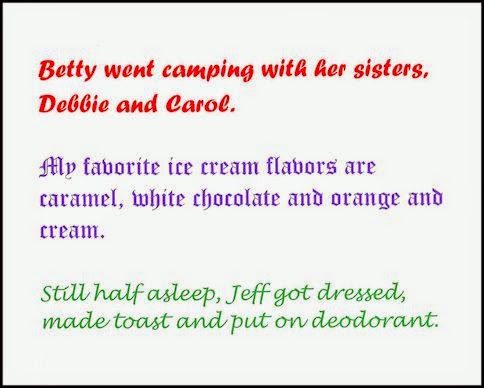
Consider the sentences in the graphic at the head of this post. “Betty went camping with her sisters, Debbie and Carol” could mean that there were at least five people on the camping trip: Betty, two or more sisters, Debbie, and Carol. Or it could mean that there were three people: Betty and her two sisters, whose names are Debbie and Carol. If you consistently use the Oxford comma, the reader will know which you mean.
It is possible to rearrange the sentence to clarify its meaning without using the Oxford comma. If there were five people on the camping trip, you can say, “Betty went camping with Debbie, Carol, and Betty’s sisters.” But if there were three people on the camping trip, you may have to say “her two sisters, Debbie and Carol.” If you rarely or never use the Oxford comma, the phrase is still ambiguous.
Or consider this sentence: “My favorite ice cream flavors are caramel, white chocolate and orange and cream.” The use of the extra “and” indicates that one of the flavors has two parts to its name, but is it white chocolate and orange or orange and cream? The use of the Oxford comma clarifies the sentence, making clear that the flavors are either “caramel, white chocolate and orange, and cream” or “caramel, white chocolate, and orange and cream.
Then there’s the third example. “Still half asleep, Jeff got dressed, made toast and put on deodorant.” Did Jeff put the deodorant on himself or the toast? Grammatically, there is only one way to read the sentence. If it weren’t a series of three, there would be no reason to put a comma after “dressed.” So, read correctly, the sentence means that Jeff put the deodorant on himself. But someone who is reading quickly might miss that nicety and read the last two items in the series as one. After all, who knows what Jeff might do when he is half asleep? An Oxford comma slows the reader down and makes the meaning clear.
Although clarity is the first rule of writing, consistency is also important, especially since knowing how someone writes helps the reader find clarity in the sentence. And because there are times when I need the Oxford comma for clarity, I chose to use it all the time for consistency.
Still, the Oxford comma is technically optional. If you choose not to use it, I won’t unfriend you.
But I will let you know when your sentences are unclear.