


Bringing History to Life

Monday, February 28, 2022


This week I am reprinting a post I published on the Indiana Writers’ Consortium blog on February 5, 2014. I am using it as a lead-in to several blog posts about historical research.

Bringing History to Life

Have you ever been told to “write what you know”? Some writers think that means they should only write what they have directly experienced. But if everyone felt that way, we would have no historical fiction and no biographies of long-dead individuals.

So what does the phrase really mean? I think it has two components.

The first component is research. Assume I want to write a story about the RMS Titanic disaster in 1912. I wasn’t there, so how can I make it realistic?

I can start by getting into the heads of those who were there.

Autobiographies, letters, newspapers, and “as told to” accounts are better than history books for learning what people actually experienced. And for more recent events, interviews can provide additional information by showing the anguish in people's voices and the pauses to compose themselves before talking about losing their fathers or brothers 

The Titanic survivors are all dead by now, so I can’t talk to them. But several wrote books or articles about the experience, and many more were interviewed by newspapers in the days following the disaster. There are even some tapes where you can hear the emotion in the survivors’ voices. These are all resources that a writer can tap into to understand what the participants experienced 

The second component of writing what you know is as simple—or as gut-wrenching—as breaking the experience down and reaching into your own background for related incidents and emotions. How can you portray the feelings of a character waiting to board a life boat or sitting on the ocean and watching the ship go down? He or she would probably have terrified. But you’ve been afraid, too. Remember the feeling and magnify it. Have you watched a loved one die? Use that. We all experience the same things in different degrees, so take your own reactions and modify them to fit the situation.

I believe in writing what I know. But that doesn’t mean I have to have been there.

__________

The photo at the top of this page was taken by Francis Godolphin Osbourne Stuart as the RMS Titanic left Southampton, England on April 10, 1912. The image is in the public domain because of its age.

Story Comes First

Monday, February 21, 2022


I have been writing a historical novel about living in the Pullman neighborhood during the Pullman strike, and I recently sent it to my middle-grade beta readers. This is the first novel I wrote with a male audience in mind, so it was the first time I used boys as beta readers. The boys who enjoy historical fiction liked it, but the ones who don’t found that it dragged too much. One boy said, “the first chapter didn’t have enough action and I lost interest quickly,” and two mentioned that the last chapters were boring.

It wasn’t hard for me to identify the problem. One reason I write middle-grade historicals is because I believe it’s important for today’s children to know about their history. But my readers want a story, not a lecture. So when I wrote the next draft incorporating my beta readers’ suggestions, I kept that in mind.

First, I added more action to Chapter 1 and eliminated some of the information I had wanted to convey about living in the Pullman neighborhood. That information slowed the story down and was there because of my desire to teach, not because it was important to the story. So it had to go.

I also added several fights. The story still doesn’t show the full violence of the strike since that took place outside the Pullman neighborhood, but the fighting does add to the story while making it more interesting.

Then there were those last two chapters that even I found boring. I had used them to sum up the lessons I wanted my readers to learn. Unfortunately, they dragged the story down rather than adding to it. Fortunately, the previous two chapters had already done a good job bringing closure to the story. So after incorporating a small amount of material from the last two chapters into earlier ones, I simply deleted them.

The story is much stronger now thanks to beta readers who followed instructions and gave me their honest opinions.

Because of their comments, I swallowed my desire to lecture and put story first.


How Many Drafts Make One?

Monday, February 14, 2022


Last week I mentioned that I like to rest my stories between drafts, but that leads to another question: How many drafts do my manuscripts go through? I usually say “three,” but, as with the time it takes to write a book, the answer isn’t that simple.

Basically, I do three master drafts and numerous lesser ones that I don’t know how to count.

Some writers claim to write the first draft from beginning to end without ever changing a word or even a period, but I’m not sure I believe them. In any event, I can’t do that. I am constantly rewriting as I write, often changing the sentence I just completed. Then I send the story off in pieces to my critique partners and incorporate their comments before starting on the next version. So if you want to be technical, that means that what I call the first draft is actually the second or third or fourth or fifth . . .

When I do what I call my second draft, I make the original changes on a paper copy and often refine them while transferring them to the computer. Then, depending on the significance of the changes, I may or may not send that draft off to my critique partners.

That is followed by a quick review to prepare the manuscript for my beta readers. I call that a “polish draft” but don’t put a number on it.

After I get the comments back from my beta readers, I do what I consider to be my third and final draft. Again, I make additional changes as I go along and I may or may not send it to my critique partners.

One more final polish, and off the manuscript goes to my copy editor. Then I make the changes I agree with before submitting it to agents or publishers.

So how many drafts do you count?

A Lengthy Process

Monday, February 7, 2022


When people ask how long it takes me to write a book. I usually say “about six months.” But it isn’t really that simple. That’s the average time from start to finish, but I usually have several projects going at once because I like to rest each story between drafts and return to it with fresh eyes. There is also a forced rest while a manuscript is with my beta readers.

It’s also not that easy to know when a particular project begins. I may have the idea months before I start researching it, or I may do a little research here and there before I start working on it in earnest. For purposes of the “six months,” I’m counting from when I start the bulk of the research and immediately follow it up with a first draft.

Knowing when a book is finished is easier. If I waited for perfection I would never finish, so I quit when I’ve reached the point of diminishing returns. That completes the writing process (although a publisher could ask for subsequent edits) and moves me on to the submission process.

The photo at the beginning of this post shows the bulletin board that hangs above my desk. You may not be able to read them, but the four sheets on the bottom are the chapter outlines from two of my works in progress. The one on the left is a book about the Pullman strike, for which I am currently working on the third draft and incorporating my beta readers’ comments. The one on the right is about a trip around Cape Horn in gold rush days. I just finished the first draft and will begin the second after sending my Pullman book off to my copy editor.

I also have a book about a lighthouse keeper’s daughter that is between the second and third drafts. I am ready to polish it and send it to my beta readers, but they just finished one. So I’m going to set the manuscript aside for a while and give them a break.

As you can see, I don’t spend a solid six months working on any one book, but the writing process does average six months from start to finish.

Then I send the manuscript out to agents or publishers, and that’s when the real wait begins.


Jigsaw Puzzles and Stories Need Substance

Monday, January 31, 2022


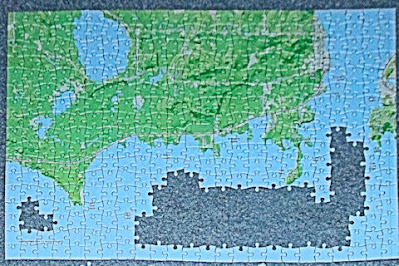
I enjoy jigsaw puzzles, so Roland gave me a “Personalized Hometown Puzzle” of DeTour Village, Michigan, for Christmas. DeTour is the light gray spot on the mainland in the upper right-hand corner of the puzzle. Unfortunately, the people who made the puzzle didn’t put any thought into it. As long as it contained DeTour, they didn’t care what was around it. And that’s why I finally gave up, as you can see from the darker gray areas that show the mat (also a present from Roland) below the puzzle.

Putting some of the land together was difficult, but I enjoyed the challenge. Then I got to Lake Huron. There are a few places with writing identifying reefs and shoals, but most of it is simply a uniform blue. Even the shapes of the pieces didn’t help because too many are similar on the two or three sides that matched the part I had completed. But if I put them in the wrong spot, nothing I tried after that would fit. I did replace several pieces with others in an effort to find the right ones, but that didn’t work, either.

So I gave up.

It didn’t have to be that way. All the puzzle maker had to do was move the image north, and possibly a little bit west, so that the puzzle area was mostly land.

Writing fiction is like putting a jigsaw puzzle together. Each piece must fit in its place to make a cohesive whole, and the story needs substance to give the reader clues about where each piece fits. Too many passages that don’t add to the story make a reader give up before finishing the book, which also loses the author an audience for the next one.

That’s where it becomes important to cut unnecessary material. Sometimes that’s all I have to do. But if it’s not enough, maybe I need to move the story north (figuratively speaking) and possibly a little bit west.

Because jigsaw puzzles and stories both need substance.


To Err is Human

Monday, January 24, 2022


I like to unwind in front of the television before going to bed, and there isn’t much on at that time of night. So sometime I watch old game shows on Buzzr, and one of them is Super Password with Bert Convy.

The other night I caught what I thought was a rather significant error. But before I go into that, let me explain a bit about how the show works.

There are a series of puzzles involving five clues each. The contestants play with celebrity guests, and the initial object is to guess those clues from one-word hints and then use them to solve the puzzle. The first puzzle is worth $100, the second $200, and so on until someone reaches $500. The winner of the $200 puzzle gets to play Ca$hword for additional money that they get to keep even if they don’t win the game. After that, they contestants change celebrity partners and the game goes on.

So here’s what I saw the other night. After the $200 puzzle, Bert Convy picked up the box with the Ca$hword clues, then set it down again and told the contestants to change partners. The tape never showed them playing Ca$hword, however. Then, after the commercial, and having changed partners, the male contestant asked if they weren’t going to play Ca$hword, and Bert said something like, “We just did that.” Nobody said anything else (at least on the tape), and the game went on with that contestant losing.

The producers of the show weren’t perfect, and when they made an error that prejudiced a player and couldn’t be fixed right away, they usually invited that player to return again as a “new” contestant. I don’t know if that happened here or if the contestant even pressed his complaint. He might not have won the Ca$hword money anyway and may have felt that the honor of being on Super Password was enough. I hope he did press it, though, because the producers would probably have appreciated learning about it that way rather than having someone else point it out later.

That’s how I feel as a writer. If you are reading my work and discover an error, please point it out. If I can do something about it, I will. Or maybe it isn’t wrong at all, in which case bringing it up will give me a chance to explain it.

But I appreciate knowing even if I can’t do anything about it. I hired a professional cover designer for my first middle-grade historical, Desert Jewels, which is about a Japanese girl living in California at the beginning of World War II. After it was published, a Chinese friend told me that the girl on the cover was Chinese rather than Japanese. I take responsibility for the error since I had rejected some cover ideas and approved this one, and it bothered me more than it did my Chinese friend. But even though it was too late to change it, I was glad I heard it from her rather than being blind-sided by someone who was not as kind about it.

If you see an error in a story or a book, don’t worry about hurting the writer’s feelings.

Better to know sooner than later.


Tell Me What I'm Doing Wrong

Monday, January 17, 2022


Every writer needs at least one critique partner. It could be an individual or a group, and I have both. Either way, we need someone to keep us on track

Sometimes it’s big things, such as beginning a book with an epidemic that doesn’t produce the desired outcome. My online critique partner, Celeste Charlene, is a retired nurse, so I asked her for advice on what illness to use. She told me there were none that worked the way I wanted, at least not at that time in that place. Although she didn’t yet know what the story was about, she suggested some other possibilities to achieve the same outcome, including a fire, and that’s what I used.

The little things are almost as important, and they add up much faster. Often, it’s just a case of confusing my reader. I know who I’m talking about or what I mean to say, and sometimes I assume my readers will read my mind as well as the words on the paper. So when Celeste or members of the Highland Writers Group misinterpret what I said, or which character I’m referring to, I know it needs clarifying.

These independent sets of eyes make my stories so much better.

It works both ways, of course. I can’t expect to take without giving. I provide the same types of feedback to Celeste as she gives me. And it works the same way in my critique group.

Not everyone is a good critique partner, however. You don’t want Aunt Nancy patting you on the back and telling you what a wonderful writer you are. Instead, you want a Celeste Charlene who understands your writing style and notices and points out the flaws in the story. Celeste and I “met” online as part of a three-person critique group, but we didn’t fit well with the other person, who soon left to find a more compatible group. But Celeste and I have been partners for ten or fifteen years.

Although we must understand each other’s writing style, that isn’t the same as critiquing it. Since every writer is—and should be—different, style is a personal matter. We do discuss it, however, asking each other questions to make sure we understand the ramifications of our choices.

If you aspire to be a writer, find a good critique partner or group to tell you what you’re doing wrong.

I’m glad I did.

__________

The photo at the top of this post shows Celeste Charlene and me in 2012.