


War and Peace

Monday, June 26, 2023


From the Republic of Ireland we crossed the invisible border to Northern Ireland, which is part of the United Kingdom. We wouldn’t have known we were crossing the border if our tour director hadn’t told us. We didn’t even need our passports, although the currency changed from the Euro to the British pound.

Northern Ireland may have been slightly greener, but the main differences weren’t in the scenery. For most of Ireland’s existence, there wasn’t much difference in the history, either.

And then there was.

England conquered Ireland over a century ago and has had an uneasy relationship with it ever since. In 1920, Great Britain partitioned Ireland into two separate jurisdictions, although both were still part of the United Kingdom. Then in 1948 most of Ireland gained its complete independence, while the six northernmost counties continued to be part of the UK. That’s still the situation today.

Many people have heard of the violence in Northern Ireland (referred to as “the Troubles) from the late 1960s until 1998. Although on the surface it appeared to be a religious struggle between the Roman Catholics and the Protestants, it was really a political struggle between those who wanted independence (who happened to be primarily Roman Catholics) and those who wanted to remain part of the United Kingdom (who were mostly Protestants). As the violence escalated, most people stayed in their own, segregated neighborhoods because they were safer there, although those boundaries weren’t always respected. Finally, a political peace was brokered in 1998 by a group headed by John Hume, who received the Nobel Peace Prize and two other peace prizes for his work. The second photo is one of many murals in Derry and, according to our tour director, it shows one of the first innocent child victims, a schoolgirl who was leaving a store at the time. The third shows the peace prizes awarded to John Hume, which are displayed in the Guild Hall in Derry.


Also while in Derry, we walked partway across the Peace Bridge, which winds back and forth to show that the road to peace is never straight.

In Belfast, we saw and signed a “peace wall.” These walls were built to separate the neighborhoods during the Troubles. Most have since been torn down, but this one remains. Although it does separate the still segregated neighborhoods, it appears to be mostly a tourist attraction now. Tour buses stop there, as ours did, so that anyone who wants to can sign their name on the wall, presumably in support of peace. The photo at the head of this post shows me signing the peace wall at one of the few available spots I could reach, although Roland had to help me up afterwards. Because of his height, he had an easier time finding a space. The next two photos show the Peace Bridge in Derry and Roland signing the peace wall in Belfast.


The other “war and peace” story we heard was just that—a legend that obviously has no truth to it but is a fun tale. While staying in Belfast, we took a day trip to the Giant’s Causeway, which is a natural formation created by volcanic activity. It resembles the foundations for a causeway, and there is apparently a similar formation thirteen miles away in Scotland. So the story goes like this.

An Irish giant and a Scottish giant heard about each other and wanted to have a fight, so the Irish giant built a a causeway between Ireland and Scotland. When the Irish giant saw the Scottish giant, however, he realized that he was a dwarf in comparison. He hurried back home and his wife dressed him up like a baby. When the Scottish giant came looking for the Irish giant, he saw the “baby.” The Scottish giant thought, “if the baby is that big, the father must be huge,” so he fled back to Scotland destroying the causeway on his way.

The next three photos are various views of the Giant’s Causeway.


Two other stops in Northern Ireland are worth noting. The
Titanic was built in Belfast, and we visited a museum at the shipyards. there. The museum is built to look like a ship’s hull if you look at it from the right direction. We also saw two waterfalls on our trip. Neither was very impressive, but since I love waterfalls I will include the one we saw on our way to Derry. The final two photos show the Titanic Museum and Glencar Waterfall.


That’s it from Ireland.

 

Hunger and Ruins

Monday, June 19, 2023


Our tour of Ireland started in the Republic of Ireland, where the Great Famine and ruins were the main themes. There were a few other sites of interest, too, which I will cover at the end of the post.

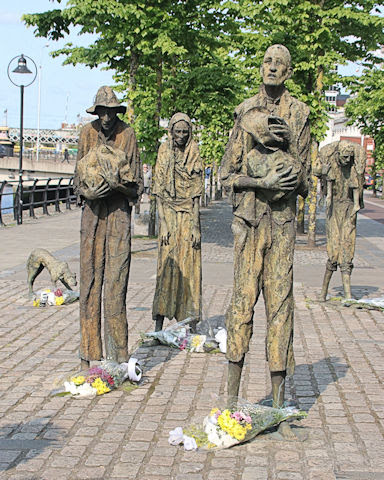
We came across our first references to the Great Famine our very first day in Ireland, when we saw a famine memorial and visited a famine ship. The memorial is composed of several sculptures showing starving people making their way to the seaports to find a better life elsewhere. The famine ship is a replica of the Jennie Johnston, which was called a famine ship because it took starving emigrants across the ocean to North America—primarily Canada. These ships were also called “coffin ships” because many of the passengers didn’t make it, although the Jennie Johnston was an exception. One of her voyages even arrived with one more passenger than it left with.

The next two photos show the famine memorial and the replica of the Jennie Johnston.


During the tour, we learned more about the famine. The potato crop was the only one affected, and wealthier people and most city-dwellers had enough to eat, but tenant farmers relied on potatoes as their principal crop and food, so when the blight arrived in Ireland in 1845 and decimated the crop over the next few years, those families starved. And since many of them couldn’t pay their landlords, evictions were common. The government did try to provide some relief, with the idea of taking it to the people, but one of the men administering the relief wasn’t willing to give up his physical comforts to travel to the back country. When he made them come to him, the famine march became a death march. We drove by part of the route, but the memorial itself was down roads the bus couldn’t travel.

The last year of the famine was 1852. When it was over, approximately one million people had died and another one million had emigrated to other countries, dropping Ireland’s population by about 20%.

We also saw a lot of ruins during our tour. The first was the Glendalough Ecclesiastical Settlement, which is the ruins of an old monetary. It was established by St. Kevin in the 6th century. Round towers were a prominent feature of monasteries a thousand years ago, functioning as a bell tower to call people to worship or inform them of important events, and the one at Glendalough is well preserved. Also well-preserved is St. Kevin’s Church, which is also known as St. Kevin’s Kitchen because the chimney looks a lot like one you find in a kitchen . Legend has it that when the Normans plundered the monastery in the 12th century, they didn’t bother with St. Kevin’s Church because they thought it was where food was prepared rather than a religious building. The next two photos show the round tower and St. Kevin’s Church (behind the graveyard).


We also visited the Rock of Cashel, which is better preserved than Glendalough. It started as a fortress but was turned over to the church body in 1101 when the King of Munster wanted to curry favor with the church (and probably with God, as well). The next photo shows the Rock of Cashel from down below.


The other well-known ruin we saw was Blarney Castle. That’s it in the photo at the head of this post. As a fiction writer I’m already filled with blarney, and Roland had heard stories about the locals using the stone as a toilet, so neither of us was interested in taking the long climb up a narrow stairway to kiss the stone. The castle grounds have a decent garden, but other than that we both considered it a waste of time. I couldn’t even get a photo of the stone from below.

Although we saw a number of other ruins from a distance, the only one worth mentioning is a ring fort that we viewed from above. The American Embassy in Dublin was designed to resemble these ancient forts. The next to photos show the old and the new.


Famine exhibits and ruins weren’t all the highlights of the Republic of Ireland, however. The following photos show St. Patrick’s Cathedral (Dublin), Kilkenny Castle (Kilkenny), Cong (where the exteriors were filmed for The Quiet Man with John Wayne and Maureen O’Hara), Kylemore Abbey (where nuns still live and work), the Cliffs of Moher, and a sheepdog demonstration (near Sligo).


One other stop is worth mentioning. At Waterford, we got a tour of the Waterford factory, which we both enjoyed. The final photos show glass blowing (cutting the stem for a wine glass), a girl cutting a design into a wine glass, and a crystal violin that sells for just under $25,000.


Next week I’ll blog about our visit to Northern Ireland.

An Accidental Literary Tour

Monday, June 12, 2023


Roland and I just got back from a tour of Ireland. It was supposed to be more of an overview rather than following a particular theme, but it turned out to have a number of literary connections.

Dublin was full of them. Our first day there, we walked almost to the Samuel Becket Bridge on our way to EPIC, the emigration museum. While there, we noticed a display with a query about C.S. Lewis. Most people think of him an Englishman because he spent most of his life in England, but he was born in Ireland and spent his early childhood there.

These two photos show the Samuel Becket Bridge and the C.S. Lewis display.


Arizona and LighhousesArizona and LighhousesOn our second day in Dublin, we visited St. Patrick’s Cathedral. Jonathan Swift, the author of Gulliver’s Travels, was the dean there for many years. In those days, it was popular (among those who could afford it) to make a death mask to remember the deceased by, and Jonathan Swift’s death mask is kept in the cathedral. That’s it at the head of this post. We also learned that people tended to fall asleep during his sermons, so he had someone build him a mobile pulpit that he could use while walking around among his congregation.

James Joyce is Dublin’s favorite son. His novel Ulysses follows his hero through an ordinary day in Dublin, and his short story collection Dubliners also shows his love for the city. While I don’t have a photo about him specifically, the next one shows a typical street in the city he loved.


The entire country claims William Butler Yeats, but he considered County Sligo to be his childhood home. The next photo is from that area and shows the scenery that he might have grown up with.


When we got to Belfast, we learned that Anthony Trollope had written his early novels while working for the Irish postal service, and part of that time he was headquartered in Belfast’s customs building. That building is the final photo.


So as you can see, our tour of Ireland turned out to be a literary journey after all.


No Survivors

Monday, June 5, 2023


Few people have heard about the sinking of the Princess Sophia, but it was a major tragedy that deserves a place in this series. Today’s post is a reprint from June 18, 2012. I have made a few minor changes for formatting and similar purposes.

No Survivors

At 2:10 a.m. on October 24, 1918, the Princess Sophia ran aground on Vanderbilt Reef in Lynn Canal, which is part of Alaska’s Inner Passage. The ship stayed there, firmly wedged in the rocks, for almost 40 hours before the wind and the waves changed course and sent the severely damaged ship to its death. During that time, the 278 passengers and 65 crew members watched other boats circling the wreck and waited to be rescued. And yet, there were no survivors.1

The picture shows the Princess Sophia around 1912, shortly after she was built.2 She was 245 feet long and could carry up to 500 passengers with special permission, although her normal capacity was 250.

The Princess Sophia made regular runs between Vancouver, Canada and Skagway, Alaska from late spring through early fall. In October, many residents of Alaska and the Yukon went “outside” for the winter, much as the Florida snowbirds head south today. In 1918, many felt lucky to have tickets on the Princess Sophia for one of the last trips out by water.

The passengers on that fateful trip ranged from gold miners and laborers to politicians and businessmen and their families. The passenger manifest included 37 women and 18 children.

Not long after the Princess Sophia left Skagway, it ran into a blinding snowstorm. Captain Locke had experienced white-out conditions before, and he did not slow down. So when he got off course and ran into Vanderbilt Reef, the ship went right up onto the rocks and stuck fast.

The Princess Sophia put out a distress call and was soon surrounded by would-be rescuers. But the reef and the gale conditions made it impossible for those boats to get close. Captain Locke considered putting his passengers into lifeboats but was concerned that they would capsize in the raging waves and the occupants would drown—something that had recently happened in another shipwreck. Since the Princess Sophia was firmly wedged in the rocks of the shallow reef, he decided to stay put until the weather calmed down. Several high tides passed without budging the ship, which seemed to confirm his judgment.

But late in the afternoon of October 25, the wind shifted and pushed the ship off the rocks. With the huge gashes cut into the hull by the original grounding, the Princess Sophia never had a chance. And because of the stormy conditions and the darkness, the would-be rescuers could only pray for the passengers’ safety. A prayer that God answered in his own way, but not as the rescuers hoped.

The official inquiry concluded that the accident was nobody’s fault and the decision to wait before evacuating the passengers was a judgment call that could have gone either way. But the politicians in Washington may share part of the blame. For years, Alaskan shipping interests had been asking for a light on Vanderbilt Reef, and their pleas had gone unanswered. After the Princess Sophia sank, they finally got their light.

Why do so few people remember the Princess Sophia today? I think it is because there are no survivor stories to add to the romance.

But I would love to know what the passengers thought and did as they were trapped on the stranded ship.


In Harm's Way

Monday, May 29, 2023


Today’s blog post about the sinking of the Lusitania is a reprint from July 2, 2012. I have made a few minor changes for formatting and similar purposes.1

In Harm’s Way

In 1915, Great Britain and her European allies were at war with Germany. The United States was a declared neutral, although its sympathies were with the British. When a German submarine sank the Lusitania on May 7, this country’s official position didn’t change. But the intensity of its feelings did.

The Lusitania left New York on May 1, 1915 and was due to arrive in Liverpool on May 8.2 Its passengers were traveling to England for various reasons, some connected with the war and some not. Oliver Bernard was hoping to enlist. Dorothy Connor was a Red Cross volunteer heading for France. Alfred Vanderbilt (son of Cornelius) was on his way to attend a London board meeting of the International Horse Show Association. Stewart and Lesley Mason were on their honeymoon. Third-class passenger Elizabeth Duckworth was simply homesick.

A number of passengers were aware of a notice that had appeared in the New York City newspapers that morning, but others were not. The notice, which had been placed by the German embassy, warned potential passengers that “vessels flying the flag of Great Britain, or any of her allies, are liable to destruction in [waters adjacent to the British Isles] and that travellers sailing in the war zone on ships of Great Britain or her allies do so at their own risk.” With or without knowledge of the notice, many passengers were worried about German submarines, but others were sure the Lusitania could outrun them.

That may have been true, but first it had to know the submarine was there. The initial sightings of the U-20’s periscope coincided with the launching of the torpedo. By then it was too late.

The torpedo blew a hole in the ship’s side, taking out the electrical system and steering controls. With the Lusitania continuing at a high rate of speed (a body in motion stays in motion) and no way to stop it, lowering the life boats into the water became a dangerous endeavor even when they were lowered correctly. But many were not. When untrained sailors used the outdated launching equipment, one end of the boat frequently dropped faster than the other and spilled its inhabitants into the water—often while they were still many feet above it.

Then there were the non-existent demonstrations on how to wear life jackets. The instructions were posted prominently in each cabin, but few passengers read them. Many deaths resulted from putting on lifejackets backwards or upside down, both of which forced the wearer’s face into the water.

The Lusitania sank about 12 miles off the coast of Ireland, but it was impossible for other boats to reach it in time. About a half hour passed from the torpedo’s impact to the ship’s last sigh before slipping under the surface. When the rescuers arrived, they found some life boats, but they also saw people clinging to wooden deck chairs and storage boxes and other debris. Of the almost 2,000 people on board, less than 800 survived.

For those of you interested in the people mentioned earlier, Oliver Bernard, Dorothy Connor, and Elizabeth Duckworth were among the survivors. Alfred Vanderbilt and Stewart and Lesley Mason were not.

Subsequent inquiries blamed the disaster solely on the German torpedo. The Germans claimed that the Lusitania was armed and carrying Canadian troops, but those claims have been debunked. Then there is the conspiracy theory that Winston Churchill (First Lord of the Admiralty at the time) set the passenger ship up for destruction as a way to force the United States into the war, but that doesn’t seem to fit the facts, either.

The Lusitania was a British ship, so why did her sinking create such an outcry in America?

There were 159 Americans on board, and 124 of them perished. And regardless of the victims’ nationalities, many people were outraged at the large number of innocent civilians killed, including dozens of babies.2

Contrary to popular belief, the sinking of the Lusitania did not propel the United States into World War I. That would not happen for another two years. Still, it was clearly a contributing factor—a strong link in a chain of events that convinced the United States to join the conflict.

And Germany would discover—as the Japanese did after Pearl Harbor—that it isn’t safe to anger the United States.

_____

1 The photo of the Lusitania is part of a panoramic picture taken by N. W. Penfield in 1907. It is in the public domain because of its age.

2 I recommend The Last Voyage of the Lusitania, by A.A. Hoehling and Mary Hoehling, which is a quick and easy read. For those who want the broader historical context, I suggest Lusitania: An Epic Tragedy, by Diana Preston.


Heros

Monday, May 22, 2023


Everyone knows that the Titanic hit an iceberg and sank, taking approximately 1500 lives with it. This week I’m going to reprint a post from April 16, 2012, that looks at it from a slightly different perspective. I have made a few minor changes for formatting and similar purposes.

Heros

On April 10, 1912, the Titanic left Southampton, England on her maiden voyage.1 Two days later, the unsinkable became the unthinkable.

I’ve always been fascinated by the disaster. This isn’t history told with dry facts and figures. It is primarily a story of real people and how they reacted in a crisis.2                               

While there are some reports of cowardly actions, many more speak of courage. And even most of the actions some call cowardly are at least understandable. For example, 21-year-old Daniel Buckley jumped into a lifeboat with several other men while the crew was loading women and children. The sailors forced the other men out, but a woman threw a shawl over Daniel as he lay sniveling in the bottom of the boat, and he escaped notice. Is that cowardice? Maybe. But I can sympathize with his desire to live.

I can also understand the different reaction from Mrs. Isador Straus, the wife of one of the owners of Macy’s Department Store. When someone suggested that her husband accompany her in a lifeboat because of his advanced age (67), he refused to go before the other men. Mrs. Straus decided to stay with her husband, saying something like, “We have lived together for many years. Where you go, I go.” They were last seen sitting side by side in deck chairs.

The Straus children were grown and out on their own. Their mother’s decision would be hard on them, but they could go on. So I can understand her decision.

But I can’t understand why Mrs. Hudson Allison chose to stay. By doing so, she orphaned her 11-month-old son and condemned her 2-year-old daughter to an awful death. The boy entered a boat with his nurse, and the girl was last seen clinging to her mother’s leg—the only first class child who died. (In fairness to Mrs. Allison, there is conflicting testimony on this issue, with one eyewitness saying she was frantically searching for her husband and son until it was too late.)

Mr. Straus was a hero, as were the many other men who stood aside without protest to let the women and children go first. Then there is Edith Evans. When she and a married friend reached one of the last remaining lifeboats, there was only room for one more. So Edith told her friend to go first because she had children who needed their mother. The friend survived, but Edith did not.

Also among the heroes were Captain Smith (died), Second Officer Lightoller (survived), and the many other crew members who remained calm and worked feverishly to save as many lives as possible.

There were many heros that night who willingly gave, or at least risked, their lives for others.

And we should be grateful.

__________

1 The picture at the head of this post shows the RMS Titanic at Southampton on April 10, 1912, two days before her maiden voyage. The photo was taken by Francis Godolphin Osbourne Stuart and is in the public domain because of its age.

2 Almost 70 years after it was published, Walter Lord’s A Night to Remember is still the best book about the Titanic. Although it does cover the facts, it excels at capturing the spirit of that night and the emotions of the participants.


The Folly of Trusting Technology

Monday, May 15, 2023


Today’s blog post is a reprint from June 25, 2012. I have made a few minor changes for formatting and similar purposes.1

The Folly of Trusting Technology

On a foggy night in July 1956, two passenger liners used the same shipping channel to head in opposite directions. The Andrea Doria was right where it should be, with the captain on the bridge and its foghorn blowing every two minutes. It probably should have been traveling at a slower speed as it sailed through the fog, but radar was supposed to compensate for the loss of visibility.

The Stockholm was heading east in the westbound channel rather than using the eastbound channel twenty miles south. The westbound channel was shorter and faster, and the Stockholm’s captain claimed it crossed the northbound and southbound lanes at a safer point. The action was permissible because use of the designated channels was recommended but not required. After setting a course, the captain retired to his cabin, leaving an inexperienced third officer on watch.

The captain and crew of the Andrea Doria tracked an oncoming ship on radar and determined that the two ships would pass starboard to starboard (right side to right side) at a close but safe distance. The third officer on the Stockholm also tracked an oncoming ship on radar and determined that the two ships would pass port to port (left side to left side) at a close but safe distance. It was only when the two ships were near enough to see each other through the fog that they realized they were on a collision course.

The Stockholm was significantly smaller than the Andrea Doria, but its steel-reinforced bow was made to slice through the ice floes of the North Atlantic. It also proved effective at slicing up the Andrea Doria. It didn’t go all the way through, but it cut open a number of first class and tourist class cabins and sent their occupants to a watery grave.

Forty-four Andrea Doria passengers died from the collision, a child died from a rescue-related injury, a male passenger died from a heart attack while resting on a rescue ship, and a woman died six months later from injuries incurred during the disaster. The death toll on the Stockholm was five—all crew members who were in their quarters in the bow at the time of the accident.

But the number of survivors was the bigger story. In an amazing rescue effort coordinated by the Coast Guard and involving Navy and commercial boats as well as a French ocean liner that turned round to assist, almost 1,700 people were saved in the eleven hours before the Andrea Doria sunk to the bottom of the ocean. And in an ironic twist, the crew of the wounded but still seaworthy Stockholm rescued many of them.2

The shipping companies and the insurer settled the case before it went to trial, so there was no formal finding of fault. From the sources I read, I think it was a combination of circumstances and human error.

But the greatest contributing factor may have been over reliance on technology. Either the radar was wrong or the crew misread it. The Titanic sank because everyone thought it was unsinkable, and the Andrea Doria sank because crew members thought radar was infallible.

It isn’t safe to put too much faith in technology.

__________

1 The picture at the head of this post shows the Andrea Doria on a previous voyage and has been artistically doctored to avoid copyright infringement. The pictures of the sinking are incredible, but they are not in the public domain yet. Although I might be able to claim fair use, I’d rather play it safe and refer you to the Internet to find them for yourselves. Or you can see them in the resource books I have listed in the next footnote.

2 If you want more information, I recommend Desperate Hours: The Epic Rescue of the Andrea Doria, by Richard Goldstein; The Last Voyage of the Andrea Doria: The Sinking of the World’s most Glamorous Ship, by Greg King and Penny Wilson; or Collision Course: The Classic Story of the Collision of the Andrea Doria and the Stockholm, by Alvin Moscow. They contain a lot of duplicate information, so unless you are doing serious research (as I was), you may want to limit yourself to reading only one. For a more personal view, however, I also recommend Alive on the Andrea Doria: The Greatest Sea Rescue in History, by Pierette Domenica Simpson, who is a survivor of the shipwreck.