Catching a Calm Day

Monday, April 27, 2015


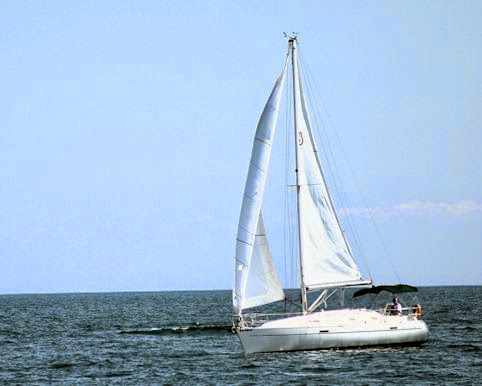
On Friday, we launched our sailboat for the season. Everything went perfectly—unlike last year, when we battled high winds and put a scratch in the fiberglass before we got Freizeit under control. This year could have gone the same way if we hadn’t been flexible.

The marina scheduled our launch for early Saturday morning, and neither Roland nor I was thrilled. But when Roland was preparing the boat, he got into a conversation with another owner who was scheduled for 11:00 a.m. on Friday. The other owner had to be out of town that day, so Roland switched with him.

That was fortunate for us. This year we launched in light winds and, as I said above, everything went perfectly. I hope the other boat had an easy launch, too, but that may not have been the case. The winds picked up on Saturday and the clouds cried with those unfortunate enough to put their boats in then. We were grateful that we had the flexibility to do it on Friday.

My writing life is like that, too. I need to be flexible enough to write in the calm periods, even when that’s not what I had originally planned. If I wait until I my scheduled times, I may discover that the light winds have turned into a gale. Maybe my brother is called into work and can’t take my mother to her dentist appointment—so I have to do it. Or my daughter pulls the television down on her head and I find myself rushing her to the doctor. (Okay, that was almost thirty years ago, but you get the point.)

So be ready to write whenever you can. It may be your best opportunity.

Lessons from Lunch

Monday, April 20, 2015


No, I’m not going to tell you that the Cobb salad I had on Saturday taught me that multiple ingredients make a story more interesting. That isn’t what I mean by lessons from lunch.

 
I drove 300 miles (round trip) on Saturday to hear a panel of respected authors speak at an ACFW Indiana luncheon. Some of the lessons I learned came from the panel (composed of Dawn Crandall, Denise Hunter, Rachael Phillips, and Cara Putman), but some came from the conversation beforehand. There were three quotes that I found particularly noteworthy. I am using the word “quotes” loosely, however. I haven’t taken shorthand since high school and may not have the words down exactly right, but they are substantially correct.

 
  • Writing something you aren’t interested in is like marrying the wrong person. While we were eating lunch, the people at my table were talking about the tension between writing as a business and writing what is on our hearts. Someone (possibly me) made the statement that if you aren’t excited about what you write, the product shows it. Then Darren Kehrer made the statement used here. He also said you end up hating the person you marry or the manuscript you have written.

         Some writers are so concerned about making money that they accept any assignments that come their way. The best writers are able to take what looks like an uninspiring assignment and find an approach that excites them. But I have also read articles and books that sound as if even the author was bored. I have taken several assignments over my writing career, and I’ve always managed to find the angle that gets me excited. But it is better to turn a project down than to put the reader to sleep.

 
  • Reading is the most important preparation for writing. Cara Putman made this statement during the panel, and she is in good company. In On Writing, Stephen King said, “If you want to be a writer, you must do two things above all others: read a lot and write a lot.”

         Cara wasn’t just talking about reading for pleasure, however. We need to read a book that way first to get the full enjoyment from it. But Cara was saying that we also need to analyze the books we read to understand what makes them captivate us. As she got ready to write her first legal thriller, she took books by three authors she thinks are good at it and wrote a chapter-by-chapter summary for each. That showed her the plot pattern that can make a good thriller.

 
  • God is faithful, but He is not predictable. Rachael Phillips said this during the panel. Her point was that we may think we know where we are going or where God wants us to go with our writing, and all of a sudden He sends us down a different path. I’ve certainly found that to be true in my life.

         I tried writing fiction in my high school days, but by the time I was ready to write as a serious pursuit, I was convinced that non-fiction magazine articles were my forte. I would never write a book. God didn’t agree, and there I was writing a book proposal and signing a contract for my first non-fiction book, In God We Trust. Okay, so maybe I could handle non-fiction books. But I would never write fiction. Then I got an idea for an adult (as in grown-up, not X-rated) novel, and I wrote it. Then I wrote another, and I have just finished a third. None of those novels have been published yet, but they show the folly of saying “never.” My most recently completed project is a middle-grade historical novel. Each new genre has been harder than the previous one. God certainly knows how to challenge me. He must also laugh at my bold statements about what I can or will “never” do.

 
         I love reading mysteries, but I could never write one. Does anybody want to take bets?

 
The Cobb salad was good, but the lessons from lunch were even better.

__________

 
The image at the head of this post shows Jo March reading. Jo March was Louisa May Alcott’s fictionalized version of herself, and she loved to read books as much as she loved to write them.

 
The picture was drawn by Frank T. Merrill and was included in the original edition of Little Women by Louisa May Alcott. First published in 1868, the illustration is in the public domain because of its age.


Should You HIre an Editor?

Monday, April 13, 2015


I just sent Desert Jewels to my copyeditor. When I tell people that, they often ask how copyediting differs from other types of editing. So this is a good time to repurpose a blog post I wrote for the Indiana Writers’ Consortium on November 13, 2013.

The IWC post was directed at self-publishing, but the information also applies when preparing a manuscript for submission to traditional publishers. I have modified the text from the original post to give it a broader application.

* * *

If you want to publish a book, you should hire a freelance editor. Yes, it can be expensive, ranging anywhere from $500 to $10,000 for a 60,000 word manuscript.* The actual price is based on a number of factors, including the type of edit and the experience of the editor. And the worse the shape of the manuscript, the more it will cost to edit. But if your goal is to produce a professional-quality book you won’t be ashamed of five years from now, it’s well worth the money.

What types of services do editors provide? For our purposes, we will concentrate on three.

Proofreading is the cheapest and most basic service that editors provide. A proofreader looks for typos, misspellings, and grammar errors. If your book has been typeset or reformatted, a proofreader can also check the final copy against your original manuscript to make sure they match. The cost to proofread a 60,000 word manuscript may average from $500 to $950.

Copyediting is probably the most common. I always pay for a copyedit before finalizing a book manuscript, even when I am submitting to a traditional publisher. After all, why wouldn’t I want to submit my best work?

Like proofreading, copyediting looks for typos, misspellings, and grammar errors. But it also looks for inconsistencies and for words and sentences and paragraphs that are confusing or awkward. One book on my shelf is easy to read and gives me interesting information, but it mentions that a woman was 12 in 1817 and 76 in 1871. So I can’t trust the facts without double-checking them with another source.

That arithmetic error is evident on the face of the manuscript, and a good copyeditor would have caught it. If you ask, a copyeditor will also check other sources to verify facts and references. Obviously, however, the more you ask a copyeditor to do, the more it will cost. For that 60,000 word manuscript, a copyedit may average anywhere from $750 to $2,500. 

Substantive editing—sometimes called line editing—is the most expensive, but it is also the most comprehensive. Although it includes some of the elements of a good copyedit, a substantive edit also looks at the contents and tells you what works and what doesn't. The editor may go so far as to recommend that you reorder your chapters to make the plot more suspenseful or eliminate your favorite passage because it’s irrelevant. For a 60,000 word manuscript, a substantive edit will average between $2,000 and $10,000.

What type of edit you need depends on your human resources. Do you belong to a writers’ critique group that includes knowledgeable members and provides honest feedback on both craft and clarity? Do you have someone (preferably not a family member or good friend) from your target audience who will give you candid comments from a reader’s perspective? And do you take full advantage of these resources? If so, you may not need a substantive edit.

I’m a grammar geek and, given time to do a careful read, am also good at catching typos and confusing words and phrases. Even so, it’s hard for me to edit my own work. I know what I wanted to say, and my mind reads it that way. And I’m not alone. Very few people can edit their own work and end up with an acceptable product. That’s why I use a copyeditor.

Of course, not everyone has the financial resources to hire an editor. Still, you may be able to figure something out. What about giving up that cappuccino you always buy on the way to work? Or do you have skills you can barter?

Start by asking yourself why you are writing and publishing. Your goals may be different if you write for your grandchildren than if you write for public consumption. But if you want to produce your best work, you will find a way to polish it before sending it out into the world.

__________

* The cost figures are from 2013.
The Hardest Book I've Ever Written

Monday, April 6, 2015


The SCBWI conference didn’t just increase my workload for Desert Jewels, as I discussed in last week’s blog. It also highlighted the additional challenges I will have when writing Creating Esther. I already knew these challenges existed, and I appreciate the insights I received at the conference.

First, unlike Desert Jewels, so far my research hasn’t revealed any memoirs that are right on point. There are plenty of memoirs about the Native American boarding school experience, but they don’t come from the right perspective. Mostly, they take place several decades later, when the students knew what to expect. Others come from the male perspective or that of a white teacher. The two most helpful memoirs are three essays by Zitkala-Sa (Gertrude Bonnin), which can be found in her American Indian Stories, and Red World and White: Memories of a Chippewa Boyhood by John Rogers (Chief Snow Cloud). The Zitkala-Sa essays tell about her experiences as a Native American student and teacher shortly before the time in my story, but they are short on details. Red World and White provides a more detailed look at Chippewa reservation life around the right time but gives little information about his boarding school experience. So piecing everything together and making it historically realistic will be much harder than it was for Desert Jewels.

The second challenge is even more significant. Except for an aunt and uncle who don’t appear very often, everyone in Desert Jewels is fluent in English, and it's the only language my protagonist knows. In my attempt to get the aunt and uncle right, I based their customs and speech on real characters described in memoirs. Desert Jewels also uses a few Japanese words, which I included in a glossary. Overall, however, language was a minor consideration.

Creating Esther is very different. At the beginning of the book, Keezheekoni understands a little English but speaks and thinks in Chippewa. Once she reaches the boarding school and is forbidden to speak her native language, her English proficiency improves significantly. In the meantime, she communicates with students from other tribes using sign language. So how do I distinguish between the different languages without confusing my English-speaking readers?

I bought a number of books to help me with this problem, including two scholarly studies on how the students acquired English language skills in the boarding schools, two basic books on Native American sign language, and an Ojibwe (Chippewa) dictionary. So maybe, with a lot of work, I could get it technically correct. But that isn’t good enough.

One speaker at the conference said that broken English and grammar errors tell the reader that the character is unintelligent, even when that is neither the reality (to the extent fiction reflects reality) nor the message the author intends to convey. The speaker said the better option is to keep the character’s English sentence structure and vocabulary simple at first and to make them more complicated as the character learns the language. Good advice, and something I may not have thought of on my own.

As to signaling whether my characters are speaking English or Chippewa, my current plan is to write the narrative and the Chippewa dialogue in regular print and to use italics when the characters are speaking or writing in English. For some people, that may sound backwards, but Keezheekoni is Chippewa and thinks in that language.

My approach may change as I go along, but my main goal won’t. Yes, I want to make it realistic.

But it must also be respectful.

When Good News is Bad News--Or is it When Bad News is Good News?

Monday, March 30, 2015


A week ago I attended a Society of Children’s Book Writers and Illustrators conference held at Canyon Inn (pictured above) in McCormick’s Creek State Park. SCBWI’s Indiana chapter did an excellent job planning and running the conference, which provided helpful sessions and good networking opportunities. Unfortunately, it messed up my self-imposed schedule for Desert Jewels.

Actually, I should probably say, “Fortunately, it messed up my self-imposed schedule.” That’s because what initially seems like bad news will be good news in the long run.

Two months ago, I sent in the first few pages of Desert Jewels for a manuscript critique. By the time I received the critique at the conference, I had already made significant changes to those pages based on beta reader comments, and I hoped that I was working on my last draft in incorporating those changes.

I was wrong. The critiquer had many positive comments, including that the writing is strong and engaging. But she also had some excellent points about places where the story sounded forced, especially when I was trying to show things that were unique to the Japanese American situation of that time. During our discussion, I also got some ideas for strengthening Emi's character arc, which I wasn't completely happy with, anyway. Unfortunately, this means that I have to make additional significant changes to the manuscript, which puts me off schedule. But the good news is that the book will be better as a result.

Perfection is not my goal. It isn’t possible to write a perfect story. If that’s what I were striving for, I would never submit my work. But that doesn’t mean I don’t want to do the best I can.

So let’s try it one more time.

Finding the (Almost) Perfect Writing Space

Monday, March 23, 2015


When I was a child, I spent a week at camp every summer. The setting was Presbytery Point in Michigan’s Upper Peninsula, surrounded by water and forest. It was a Presbyterian camp, and we were given time to go into the woods or along the shore to do our morning devotions in solitude. I climbed a tree that was quiet and away from everyone else, and I truly felt close to God during that time.

Nature can also provide an inspirational setting for our writing.

I just returned from a conference that was held at McCormick’s Creek State Park in southwest Indiana. I want more time to gather my thoughts before writing about the conference, so I’ll save that for next week’s post.

But the setting was gorgeous. When we had some free time, I hiked to McCormick’s Creek Falls, shown in the picture. The falls were very small but also very picturesque. They were also tranquil, even though there were other people around.

The park would have been the perfect writing spot if the conference had left any time for it.

That’s true of many state and county parks. When the weather warms up, take your pad and pencil and find a quiet spot outside among nature. Then write.

Unfortunately, the rooms in the inn were clean but cramped and the food was below my standards. Food is important to me not just for sustenance but also for enjoyment, so I don’t count any experience as perfect if the food is bad.

But McCormick’s Creek State Park came close.

Fiction is . . . Fiction

Monday, March 16, 2015


Academics shouldn’t criticize fiction if they don’t understand how it works.

As part of the research for Creating Esther, I have been reading Learning to Write “Indian”: The Boarding-School Experience and American Indian Literature by Amelia V. Katanski. While I agree with her overall thesis (too complicated to explain here), I find that much of her reasoning and “evidence” are faulty. I’m going to cover one example in this blog.

My Heart is on the Ground: The Diary of Nannie Little Rose, a Sioux Girl is set at Carlisle Indian School in Pennsylvania in 1880 and is one of the early books in Scholastic’s “Dear America” series. It was written by Ann Rinaldi, who is white. In my copy of the book—and apparently in Katanski’s copy, as well—the author’s name is not on the cover but is on the title page. The book—as is true of all the books in the series—is written as if it were the title character’s diary.

I’m a big fan of the “Dear America” series in general, although I have varying reactions to the individual books. Based on the research I have done so far, I think that My Heart is on the Ground paints too humane a picture of the Native American boarding school experience. I don’t attribute that treatment to any kind of cover-up, however. I assume that Rinaldi did the best she could with the information she had.

Katanski isn’t willing to make the same assumption. According to Katanski, “Whether the voice [Rinaldi] manufactures for her protagonist, Nannie, comes from her own anti-Indian politics or from research that relied too heavily on [the school administration’s] representations of life at Carlisle is uncertain.” This willingness to attribute Rinaldi’s voice to possible anti-Indian politics is based on “evidence” that shows Katanski’s ignorance of both the “Dear America” series and the art of fiction.

Katanski’s first “evidence” is that My Heart is on the Ground doesn’t have Rinaldi’s name on the cover page, so the only “author” listed is a fictional Native American girl. Katanski concludes that this is an attempt to “appropriate” a Native American identity. In reaching her conclusion, she ignores two important facts.

  • When the “Dear America” series first came on the market, none of the books had the author’s name on the cover, although they all identified the real author on the title page. At least that’s the case for the three early books, including My Heart is on the Ground, in my collection. One of these three books is about an Irish mill girl, so racism is unlikely to be the reason for leaving the author off the cover. I also have four books that were published or re-released after the series was revised, and they do carry the author’s name on the cover. However, the distinction appears to be based on publication date rather than on the character’s or author’s race.
  • Even third-grade readers know that the “Dear America” books are fiction written by someone other than the character whose name is on the diary. There is no danger that anyone would be misled.

Another piece of “evidence” Katanski uses to “prove” that Rinaldi is promoting a white agenda is Rinaldi’s use of names she found in the graveyard at Carlisle—a practice Rinaldi readily admits. But Rinaldi used them because they “were so lyrical that they leapt out at me and took on instant personalities,” not because she expected anyone to believe that her characters were the actual people in the cemetery. What fiction writer hasn’t done the same, especially when trying to be authentic to the time and place?

Finally, Katanski charges that Rinaldi “stole situations from the autobiographies of former boarding-school students . . . changing the presentation and context of those memories (most of which relate to moments of resistance) to provide fake evidence of acquiescence in the values of the boarding schools through the narration of ‘good student’ Nannie.” Excuse me? Where does Katanski think novelists get their ideas in the first place? From a vacuum? As the writer of Ecclesiastes says, “There is nothing new under the sun.” And fiction may provide evidence of the nature of fiction, but it never provides evidence—fake or otherwise—of the “facts” within it.

Can fiction be written as propaganda? Of course. But Rinaldi uses conventional fictional devices that are common across races and subject matters. To construe them as “evidence” of possible racial politics is ludicrous.

Or is Katanski saying that we shouldn’t try to understand and write about any race except our own? But then she’s violating her own rule, because she is a white academic evaluating Native American literature and boarding school experiences.

Maybe Katanski should evaluate her own bias.

__________

Katanski’s discussion of My Heart is on the Ground is found at pages 92-93 of Learning to Write Indian.

__________

The picture at the head of this post shows the students at the Carlisle Indian Industrial School in Carlisle, Pennsylvania around 1890. It is in the public domain because of its age.