Floral Photography

Monday, August 28, 2023


I mentioned last week that I had a goal to beat out a particular one of my fellow camera club members, and I did it this year in the Color/Weather category at the Lake County Fair. His specialty is flowers, so the next logical goal would be to beat him in that category. But I’m not even going to try. Yes, I’ll continue submitting flower photos at the fair, but not with a goal of besting him.

Michael’s flowers are gorgeous, and I love looking at them. There are several reasons why mine will never look that way, however.

First, Michael’s floral photographs are mostly close-ups with black backgrounds, and they look as if they were taken in a studio even when they weren’t.

Second, Michael spends thousands on equipment and hours in post-processing. Although I enjoy photography that’s not where I want to spend my time and money.

Third, Michael also spends more time than I do tracking down the perfect flower at the best time of day and finding just the right angle to shoot from.

While that kind of search might be fun, I’m a working writer and can’t always take time off when conditions are best. Many of my flowers are taken in full sun simply because that’s when I see them. While there are some adjustments I can make to compensate for that, there are other problems that I can’t fix, such as when the sun washes out the details.

That’s what happened in the photo at the top of the page. Not only was the detail washed out, but the flower itself looked a little artificial in the harsh light. Even so, I liked it well enough that I decided to enter it in the Color/Floral category at the fair. So I tried to give it a little more interest using post-processing to soften the image. Roland thinks it looks a bit like a painting. It didn’t win a ribbon, but I like it.

The next photo is the one I entered in B&W/Floral. It didn’t win a ribbon, either, although I had higher hopes for it than for the color one I entered. Unlike the color photo, this was taken on a darker day and you can see more details, such as the rain drops. Several months ago, I entered it in competition at my photo club as a color photograph, and the score there was sort of middle-of-the-road. During the critiquing afterwards, one judge told me it would have scored higher if I had cloned out the stalk behind it.

I could have done that. I have the software and the knowledge and often clone out imperfections and distractions, but her suggestion would have changed the context and the impact of the photo. Besides, the stalk is almost as interesting as the flower, although that might be part of the problem if it draws attention away from the main subject of the photo. Still, I like the way it looks in black and white, so I went ahead and entered it at the fair without changing the background.

As you can see, I like my flowers in a natural setting, such as against a brick wall or with a stalk in the background. That’s part of the reason they don’t do well at the fair.

But I’ll keep on entering them.


Another Year at the Fair

Monday, August 21, 2023


I entered 17 photos in the Advanced Division of the Lake County Fair this year and won three 3rd place ribbons and one 1st. I had to laugh because the blue ribbon was for a “just because I can” photo, meaning one that fit the category and didn’t embarrass me but that I didn’t expect to win anything. The one I thought was my best and had my hopes riding on got a 3rd place. Photography is subjective, and you can never predict what a judge will do.

The photo at the top of the page is the first-place winner from the Color/Weather category. It is from my trip to Iceland. An interesting fact is that I took it on my cell phone because I couldn’t get my more sophisticated camera to set up correctly. The best thing about this win is that I met my long-time goal to beat a particular member of my camera club.

This next photo is the one that I really, really like. It was taken at the Waterford Crystal factory in Ireland. The woman is cutting a design into a wineglass, and I love the concentration on her face. The category was B&W/Human Interest.

"Man and Mountain Goat" took third place in the Color/Portrait category. The man was obviously expecting people to photograph him and his goat because he had a cap out to accept donations. I dropped money in his cap and asked for permission anyway, which he gave.

The final photo took third place in the Color/Architecture category. Competition wise, I do better with photos showing details of buildings than I do with photos of an entire building. That’s probably true for others as well, since taking the entire building is more touristy. (I take both, though.) This photo shows some of the detail of the Melbourne (Australia) Arts Center, which was designed to look like the Eifel Tower.

I’ve been entering in the Advanced Division for several years now, with varying results. I’m up against strong competitors, and many of them take a lot more time with their photos than I do with mine (both in setting up the photo itself and in post-processing). So I’m happy with whatever I get.

With this year’s fair behind me, I can’t wait for next year.


The Dangers of Modeling Characters on Real People

Monday, August 14, 2023


Every character we include in our fiction reflects people we have known. Each characteristic—whether noble, embarrassing, or quirky—came from our experience with someone. It may be buried deep in our subconscious, but we didn’t create it. Even so, some people stand out more than others, and we may be fascinated with them and their lives. So how can we write about them without getting into trouble?

As I promised last week, this week’s post discusses some of the dangers of modeling characters on real people. It will start by discussing two of the cases covered in my book Writers in Wonderland: Keeping Your Words Legal and will end with some ideas on how to avoid the pitfalls.

Fetler v. Houghton Mifflin Co., 364 F.2d 650 (2d Cir. 1966)

Imagine yourself living in the glow that follows your first published book. Then the sheriff knocks on the door and hands you a summons. Your brother has sued you for defamation.

Oh, you say, that won’t happen to me. I only write fiction, and everybody knows fiction isn’t true. Besides, I’ll have a disclaimer at the beginning of my book saying that any resemblance to any person living or dead is purely coincidental.

That may have been what Andrew Fetler thought when he published The Travelers. If so, he soon discovered that he was wrong.

The novel revolved around a family very much like Andrew’s family and an older brother very much like Andrew’s older brother, Daniel. But the fictional parts portrayed the older brother taking actions Daniel found repugnant. So Daniel sued, and the entire family took sides.

The lower court judge dismissed the case without a trial, but the federal appeals court overturned the decision. It said the similarities between Daniel and the character in the novel were strong enough to let a jury decide whether readers would identify the real brother as the fictional one, and it sent the case back for a trial.

There is no more information on the case after that, and I don’t know how the story ended. The dispute might have gone to trial or, more likely, it may have settled. But even if Andrew ultimately won the case, he had to bear the expense and stress of a lawsuit and live with the knowledge that his novel had divided the family.

Smith v. Stewart, 660 S.E.2d 822 (Ga.Ct.App. 2008)

I do know how this story ended. A jury found that Smith (the author) had defamed Stewart. Putting Stewart in the novel also turned a friend into an enemy, and Smith may have regretted both outcomes.

Haywood Smith’s novel The Red Hat Club included a character named “SuSu.” In the book, SuSu received a large insurance settlement after her first husband was killed in a car accident. Later, she became engaged to a man who owned nursing homes in Florida and was already engaged to another woman. This man eventually stole SuSu’s insurance settlement, moved to Florida, and transferred his assets to his mistress. Although a court awarded SuSu $750,000, she was unable to collect it from him. Then, at the age of fifty, SuSu became a flight attendant.

These facts weren’t unique to the fictional character. They also fit the author’s real-life friend, Vickie Stewart.

Maybe it would have been all right if Smith had stopped there. Unlike the real-life model, however, SuSu was a sexually promiscuous alcoholic who drank on the job. Stewart took offense and sued for defamation.

The appeals court held that fiction could be defamatory if the statements were about an identifiable person, and it found enough factual similarities to let a jury decide whether readers would identify Stewart with SuSu. The jury concluded that readers who knew Stewart would realize that SuSu was based on her. Since there was no evidence that Stewart was a sexually promiscuous alcoholic, the jury also found that Smith had defamed her.

Avoiding the Pitfalls

If you want to use a real person in your fiction, change some of the facts and make the character a composite of several people. If you are fascinated by a few of your Aunt Martha’s characteristics or experiences, by all means use them, but give some of them to other characters. Change her name and physical characteristics, place her in a different job and setting (unless the job or setting are part of what makes her interesting), and mix in several noticeable personality traits that the real Aunt Martha doesn’t have. If you change enough, she is no longer recognizable. Or at least the reader who knows her will realize that your character is mostly fictional.

Daddy was a minister who wrote sermons and letters but never considered anything longer until he retired and started his autobiography, while Becky’s father is a college professor who is writing a book on Sir Walter Scott. Daddy was always taking pictures, while I gave that role to the mother in my novel. Still, the two quirks I mentioned in my last blog post were part of his personality, and using them together makes Becky’s father a more interesting character. They also make him easily recognizable to people who knew him.

As I said earlier, I’m sure Daddy would laugh while reading the passages about Becky’s father, but there is another reason I’m not worried about him getting angry and suing me. Simply put, the easiest way to avoid the pitfalls of writing about a real person is to write about somebody who is dead. You can’t libel the dead, and they can’t sue you, either.

A writer also isn’t liable for libel if the person has given his or her consent. Wait, you say, why would someone agree to be negatively portrayed? For the same reason people agree to go on reality television shows where they come across looking like jerks. Some individuals will do anything for publicity or money. Or they don’t realize how something looks until they read it on paper, watch it on TV, or hear their friends’ comments.

Make sure the consent is in writing and is broad enough to cover whatever you want to say. You also don’t want them complaining later that you didn’t tell them how the character would appear, so full disclosure is best.

Actually, there is a another way to protect yourself, but it is chancy. If you stick to the facts and make sure they can’t be misinterpreted, it isn’t libel. That doesn’t keep someone from suing you in the first place, however. Even when you win, lawsuits are expensive in time, money, and relationships.

So if you want to model characters on real people, make sure you consider the consequences.


Modeling Characters on Real People

Monday, August 7, 2023

I don’t usually model my characters on real people. The protagonist’s mother in Desert Jewels had some of my mother’s personality, but the two women are more different than similar. However, I’m currently working on the second draft of a story about the sinking of the Andrea Doria, and the father is a lot like mine.

It can be dangerous to model characters on real people, and next week’s post will discuss those dangers. With Daddy, however, I have no concerns. He would probably be flattered and find the humor in my description of his quirks. Still, I might have asked for his permission if he were still alive. But you can’t libel the dead.

My novel starts with the protagonist’s father almost missing the boat to America because he is looking for a mailbox. As far as I know, Daddy never cut any of our trans-Atlantic crossings that close, but Mama and I had near heart attacks several times when he almost missed a train in Europe. Usually he was taking one last picture, although looking for a mailbox wouldn’t have been out of character.

On one occasion, Mama, my brothers and I, and the luggage were on the train but Daddy wasn’t. Mama thought about getting off but decided to wait for him at our destination (or maybe the border). It was a good thing she did, because the train had barely gotten under way when Daddy came strolling down the aisle totally unconcerned.

Back in those days, she couldn’t have gotten very far without him, anyway. We had a single, family passport between us, and every European country had its own border.1 Since Daddy carried the passport, we could not have gone very far without him.

My protagonist’s father is also very careful with his money. He won’t pay for movies when library books are free. On the ship, however, where they are part of the fare, he jokes that he would be losing money if the children didn’t go to the movies. Again, that was very like Daddy.

Sometimes using personal experiences and a real person’s character quirks can add color to a story. As next week’s post reminds us, however, be careful how you use them.

__________

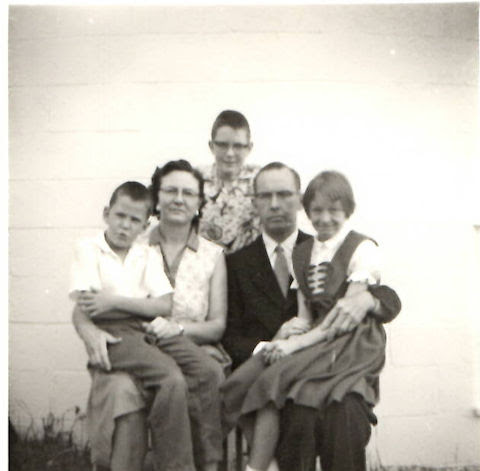
1 The picture at the top of this post is our family passport photo from our trip to Scotland in 1961. I would not normally have sat on Daddy’s lap at that age, but it was probably done to get all five of us in one picture.


Read the Instructions

Monday, July 31, 2023

I can be pretty dense sometimes.

The story begins on Father’s Day. Actually, it begins before that when I purchased Roland’s Father’s Day present, which was peace of mind for him in the form of an MP3 player for me.

Whenever Roland and I take a road trip of more than a few hours, we share the driving and the driver gets to choose the music. While some of our tastes are similar, our listening style is very different. Roland likes to scramble his music so that he gets a mixture of artists and genres rather than having two songs by the same person back-to-back. I prefer to listen to a whole CD in order before moving on to something else. That’s especially true of musicals but covers other genres as well. So when we go on a longer road trip, Roland uses his MP3 player and I take CDs.

That’s where the problem comes in. The car’s CD player holds only one disk at a time, so when one ends, Roland replaces it with the next one because that’s safer than having me take my eyes off the road to do it. We are planning a long road trip for the fall, and Roland suggested I get an MP3 player so that he can sleep without having to wake up to change CDs.

So I did. Unfortunately, I had trouble setting it up.

First, I tried to rip dozens of CDs to my laptop so I could transfer them from there. After checking the internet, I figured out how to do it on the music player that came with the laptop. Unfortunately, it didn’t download them consistently. Sometimes it started with track 2 and at other times it split the tracks into two albums that jumped all over. Worse, I didn’t realize that was an issue until I had already spent a day and a half ripping dozens of CDs.

After several frustrating, wasted days, I finally decided to read the online user’s guide from the beginning and in order. I had downloaded it before I started setting everything up, but for some reason I didn’t think I had to read it all the way through. I went straight to the sections I thought I needed, and I struck out. Then I read the user’s guide the right way and hit a home run. It still took me a day and a half to copy the same dozens of CDs (including 29 musicals) to the player using the software that the player had told me to download, but they came out complete and in order. And this time I checked as I went along.

Before reading the online users’ guide, I had also experimented with transferring files from the laptop to the player, with the same degree of success. I had tried dragging and dropping them, which works in File Explorer but didn’t work here. When I read the manual, it told me to do it a different way, and the problem was solved.

But I would have saved a lot of time and frustration if I had started by reading the instructions. 


The Dangers of Using Filler

Monday, July 24, 2023


The picture demonstrates how clutter can hurt a photo. What is the subject of the picture? The shells? The seaweed? The texture of the rock? Or the spot of orange that draws your eye to the left side of the photo? I don’t even know, and I took it.

Writing works the same way, although this post is going to focus on a specific type of clutter, which I can filler.

I usually have several projects going at once, all in different stages. After the first draft, I set a manuscript aside for a month or more so that I can come back to it with a fresh eye. I do, however, make notes on possible changes and may even set myself a particular goal for that second draft (besides improving the story, which is always the primary goal).

I’m getting ready to do the second draft of Almost Home, which is a story about the sinking of the Andrea Doria. It’s too short for my audience, so my goal is to make it longer. Unfortunately, that isn’t as easy as some people might think. The challenge is to avoid additions that are mere filler.

Every scene in every novel should have a purpose, and adding length doesn’t qualify. A scene that doesn’t move the story along should develop a character or the setting. That’s also true of every word, phrase, and paragraph. Everything else is merely filler that will distract people from the story and maybe even obscure it the way the clutter does in the photograph at the top of this post.

In revising Almost Home, I could be tempted to expand the conversation during the first meal at sea. For example, the strangers who share the table with Becky and her family might give intimate details of their lives. Only a few of those details have anything to do with the story or are necessary to develop the characters, however, and those are already in the first draft. The other details are just filler. I can’t even let my shy protagonist tell about the events in her early life that will become important as the story progresses. That would be a boring info dump, Nobody likes an info dump and, even worse, it would actually be inconsistent with Becky’s character.

Or, since my protagonist gets separated from her family shortly after the accident, maybe I could tell about their different experiences. That would be fine if I used several points of view, but my gut tells me to concentrate on my main character.

Instead, I’ll try to further develop Becky’s experiences after the collision .

But it will still be a challenge to avoid filler.

Who Said That?

Monday, July 17, 2023


In last week’s post, I mentioned the problems with overusing “said” as a dialogue tag, especially in an audio book. This seems like a good time to review how to identify speakers without an over-reliance on dialogue tags. I originally wrote the following article for the Indiana Writers’ Consortium blog and published it there on June 8, 2016. I also published it as a reprint on this blog on March 15, 2021. As you read, temper the section on dialogue tags with my comments about “said” in last week’s post.

Who Said That?

Dialogue can be tricky. First, there is the problem of how much or how little to use, which may depend on genre. An action novel usually has less dialogue than a love story. But in neither case should the conversation be true-to-life. The reader doesn’t want to hear the small talk that occurs around the breakfast table—unless it reveals the protagonist’s anxiety or has some other link to the story. The same is true for the uhs and ahs of normal conversation—leave them out unless they show the speaker’s hesitancy to answer a key question.

But this blog post isn’t about those issues. Instead, it will concentrate on the question that troubles most writers much of the time: How do I make sure my readers know who is talking without interrupting the story’s flow?

Most writers default to using dialogue tags. Some writers are horrified at the very idea. Oh no, never! In their view, dialogue tags were created by the devil. But if you read their own works, you’ll be surprised at the number of dialogue tags that creep in. Still, since dialogue tags should be the last resort, I’ll address them at the end.

Action

Action can be a good way to show who is speaking, although that should never be its sole purpose. When used correctly, action has the added benefit of providing information about the speaker or the setting. Consider these two examples:

Bob slammed his fist on the table. “He’s a liar.” (Showing that Bob is angry as well as attributing the statement to him.)

“I can’t lend you any money.” Mavis flung her mink stole across a Chippendale chair, barely missing the Ming vase on the stand next to it. “I’ll be going to the poor house soon, myself.” (Showing that Mavis lives a life contrary to her words.)—Okay, that one is probably over the top, but you get the picture.

The action must fit, however. Characters can only drink so many cups of coffee during a five-minute conversation, and even one may be too many. I’m guilty of this, but at least I know it. Some writers seem to think that any action is fine as long as the speaker is doing it. For example:

Tom buttered his toast. “I got fired from my job yesterday.”

If the only reason for inserting an action is to identify the speaker, it will sound contrived. Find another way to show who is speaking.

Using Names

The use of names in dialogue can identify the speaker by process of elimination. If John and Mary meet on the street, which character is talking here?

“How did the meeting go, John?”

Obviously, Mary must be speaking. But this technique can be misused, too. In real life, we seldom say another person’s name when talking directly to them. Once she had John’s attention, Mary would simply ask, “How did the meeting go?” So don’t use the name of the person being addressed unless it sounds natural.

Two-People Conversations

If you have only two people in a conversation, you may not need attributions once you have identified the first speaker. Consider this:

Mary took Dan’s coat and hung it in the closet. “How was your day?”

“Boring, as usual. I wish I could quit, but we need the money.”

“Well, dinner should cheer you up. I made your favorite meal.”

“Spaghetti?”

“Yes.”

This conversation is as boring as Dan’s job, but at least the reader can follow it. If it went on for any longer, however, we would need an occasional attribution to remind readers who is speaking. Action works well for attribution here because it also adds more life to the scene. (In this particular example, you might also want to ask whether you need the conversation at all, but it gets my point across.)

Unique Voices

Sometimes you can tell who is speaking just by how they speak or what they say. Teenagers talk differently than their parents, so in a three-way conversation you may only need to include attributions for the parents. Or if Karl has recently emigrated from Germany, we know that he is the one talking when we hear this:

“I can the question not answer.”

No attribution is necessary.

Dialogue Tags

Although writers should avoid dialogue tags when we can, sometimes we do need them. Even so, they shouldn’t be too obvious. “Karen articulated,” “David exclaimed,” and “she cautioned” all make the reader stumble over the story. With rare exceptions, stick to “said” and “asked,” which tend to disappear on the page.

The rare exception I recognize is where a particular dialogue tag is the most effective way of conveying a message, such as using “she whispered” to show that the character doesn’t want to be heard. Even so, it is better to have your character simply gasp than to have her gasp out her words. And if your character is lying, let the reader figure it out from the context rather than using “she lied” as a dialogue tag.

Experiment with different ways to attribute dialogue to your characters. But if nothing else feels natural, there is nothing wrong with “said” and “asked.” Even the best writers use those words at times.

Just count them up.